
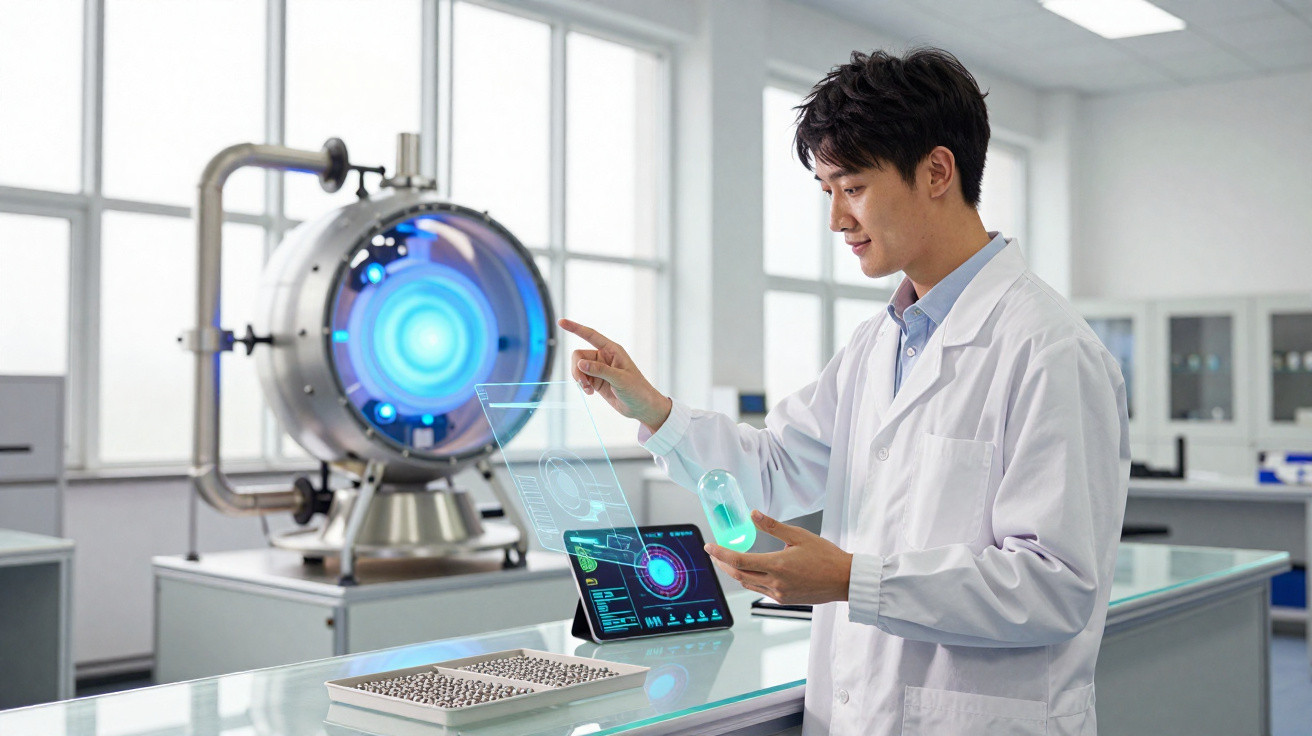
Fusion research is moving closer to commercial viability, yet one understated limitation could hold back progress across the sector.
As laboratories compete to ignite fusion plasmas, a much more mundane problem sits behind the scenes: Earth does not contain enough tritium to supply the reactors many businesses are planning. However, a new UK concept says it could turn that limitation into an advantage, enabling one plant to become a net supplier of this vital fuel.
Why tritium could bottleneck fusion’s big plans
Most fusion concepts expected to arrive first use a reaction involving two hydrogen isotopes: deuterium and tritium, commonly abbreviated to D–T. Deuterium is effectively abundant. It can be recovered from seawater, with sufficient supplies to support electricity generation for billions of years.
Tritium presents a very different challenge. There are no substantial natural reserves, it is radioactive, difficult to manage and, most importantly, in short supply.
Worldwide civilian stocks are thought to total roughly 20 kilograms. This is not an error: the fuel supporting many current fusion plans exists in an amount comparable to only a few large suitcases.
Its scarcity becomes more severe over time. Tritium has a half-life of around 12 years, so a considerable share of available stock disappears through radioactive decay every decade or so and has to be replaced.
The fusion industry cannot scale if every new plant competes for a fuel measured in tens of kilograms worldwide.
For this reason, tritium “breeding” has become both a central engineering issue and a strategic priority. A workable fusion economy requires machines that make more tritium than they consume.
First Light Fusion’s FLARE concept: a reactor that mints its own fuel
Oxford-based First Light Fusion says its FLARE power plant proposal can achieve this. Its design uses high-gain inertial fusion rather than the magnetic-confinement method employed by major tokamak programmes such as ITER in France.
Rather than keeping hot plasma contained inside a magnetic doughnut for extended periods, inertial fusion operates in pulses. Projectiles or powerful beams are fired at tiny fuel targets, compressing them with such force and speed that fusion happens before the material can fly apart.
How FLARE breeds extra tritium
FLARE’s distinctive feature is not solely fuel ignition, but its method of recycling and multiplying tritium around the reaction area.
Deuterium–tritium fusion reactions release energetic neutrons. Within FLARE, these neutrons are not simply absorbed by shielding: they are intentionally sent into a surrounding “lithium blanket” containing natural lithium.
When neutrons strike lithium atoms, nuclear reactions can create new tritium. This tritium may then be recovered, processed and returned to the fuel cycle.
The crucial measurement is the Tritium Breeding Ratio (TBR). A TBR of 1 indicates that a system generates precisely the amount of tritium it uses. A figure below 1 means supplies gradually decline, while a result above 1 produces an excess.
First Light Fusion reports a TBR of 1.8 for the FLARE design, based on two independent studies.
Put simply, every unit of tritium consumed could yield 1.8 units in return. The facility could therefore sustain its own fuel requirements and provide surplus tritium to other reactors.
This performance estimate is based on simulations conducted internally by First Light Fusion and by the radiation physics team at Nuclear Technologies in the UK. Both assessments reached the same result, helping explain the attention it has received within the fusion community.
What 1.8 TBR actually means in practice
Although a high TBR can appear theoretical, the company has set out more tangible estimates for a 333 MWe FLARE model - approximately the scale of a medium-sized power station.
- Net tritium surplus: around 25 kg per year beyond its own needs
- Current civil tritium inventory: about 20 kg worldwide
- Fuel self-sufficiency: reached in about one week of operation
Should these projections move successfully from calculations to working equipment, one plant of this capacity could equal, or potentially surpass, Earth’s entire current civilian tritium inventory each year while meeting its own fuel needs.
Why tritium could become a business model, not just a fuel cost
The commercial implications may be nearly as notable as the underlying physics. Tritium is not only scarce but costly, with market estimates commonly falling between 30,000 and 120,000 US dollars per gram, depending on its source and the circumstances.
At such prices, the theoretical value of 25 kilograms annually would be exceptionally large. In principle, income from selling FLARE’s excess tritium could cover the cost of constructing the plant, even before any electricity revenue is included.
If FLARE works as advertised, a fusion plant could double as a strategic tritium factory for an entire fleet of reactors.
Naturally, a major increase in supply would probably reduce prices. Given tritium’s radiological and strategic sensitivity, regulators would also impose strict requirements on its manufacture, transport and sale. Nevertheless, the prospect of a fusion plant offsetting its capital costs through surplus fuel sales has drawn interest from investors and policymakers.
AI steps in: speeding up fusion design and validation
First Light Fusion is placing its bets on more than physics alone. The company has entered into a memorandum of understanding with UK start-up Locai Labs to use advanced AI models in fusion research.
The collaboration is intended to speed up high-energy-density physics simulations, refine numerical codes and evaluate multi-agent AI systems that could allow scientists to iterate designs more rapidly. This work is carried out on a secure high-performance computing cluster in Oxford, with strong separation measures intended to safeguard sensitive intellectual property.
Speed has considerable value for fusion companies. Each simulation, design and experimental cycle requires both time and money. If AI tools can shorten those cycles while preserving accuracy, companies including First Light could develop commercially relevant prototypes sooner.
FLARE is not alone: global race to solve the tritium gap
Although FLARE is a particularly striking example, the tritium issue is a leading concern for almost every D–T fusion programme around the world.
International and private projects chasing tritium solutions
ITER, the major international tokamak being built in southern France, is evaluating several “breeding blanket” designs. These position various lithium forms - including solid, liquid and ceramic lithium‑6-enriched materials - around the plasma to capture neutrons effectively.
Among private companies, Commonwealth Fusion Systems, Tokamak Energy and Helion Energy are developing compact reactors with tritium-production modules positioned directly beside the machine’s hottest zones. Placing these modules nearer to the neutron flux can increase tritium output without losing particles within thick structural and shielding layers.
Other research programmes are considering circulating lithium–lead alloys, which could simultaneously extract heat and produce tritium, or heavily enriched lithium‑6 to increase production. Some groups are also investigating hybrid arrangements that pair fusion sources with fission blankets dedicated to generating tritium.
At the same time, advanced recycling techniques seek to reclaim unburned tritium from exhaust gases and reactor parts, reducing losses and extending the usefulness of every gram.
Alternatives that use less tritium at all
Work is also under way to reduce the need for tritium from the outset. Certain concepts instead concentrate on reactions such as deuterium–deuterium (D–D) or deuterium–helium‑3 (D–He3).
These reactions avoid, or reduce, direct tritium consumption. They also produce fewer high-energy neutrons, easing material-related challenges. Their disadvantage is that they require far higher temperatures and more precise plasma control, making them more difficult to deliver with present-day technology.
| Actor / approach | Technical idea | Main goal | Maturity level |
|---|---|---|---|
| ITER | Breeding blankets with solid, liquid and ceramic lithium‑6 systems | Test large-scale tritium production in a tokamak | Experimental construction and design phase |
| Commonwealth Fusion Systems | Breeding modules close to a high-field tokamak plasma | Boost neutron capture and breeding efficiency | Advanced development |
| Tokamak Energy | Compact high-field magnets plus integrated lithium systems | Raise TBR in smaller devices | Prototype design |
| Helion Energy | Pulsed architecture with careful fuel and energy recovery | Cut reliance on external tritium | Pre‑industrial development |
| Hybrid fission–fusion and Li–Pb alloys | Use neutron-rich blankets to generate tritium and remove heat | Industrial-scale tritium production | Concept studies and early demos |
What tritium actually is, and why handling it is tricky
Tritium is a radioactive form of hydrogen whose nucleus contains one proton and two neutrons. Its chemistry resembles that of ordinary hydrogen, meaning it can make water and attach itself to metals, plastics and concrete.
This introduces significant engineering difficulties. Tritium can penetrate components, diffuse through materials and create “tritiated water”, which must be captured and treated. Although its emitted radiation - beta particles - has comparatively low energy and can be blocked by thin barriers, regulators enforce stringent discharge limits to safeguard workers and the public.
Fusion facilities require sealed fuel cycles, advanced monitoring, and proven tritium capture, storage and recycling systems. Any design that claims substantial surpluses must demonstrate that these processes can be managed safely at industrial scale.
Scenarios: what a tritium-rich fusion landscape could look like
If concepts such as FLARE fulfil their claims, the fusion industry of the 2030s or 2040s could divide into two functions: fuel producers and fuel users.
A limited number of high-breeding facilities could operate as “tritium hubs”, supplying fuel and expertise to a wider group of reactors focused more heavily on grid services and local deployment. Governments would probably view these hubs as strategic assets, influencing export controls and international collaboration.
Conversely, if practical performance does not meet current simulation results, fusion companies might have to shift more decisively towards tritium-light or tritium-free reactions. They could otherwise face a slower deployment rate dictated by restricted fuel availability from existing fission reactors and dedicated breeding installations.
Either outcome points to the same emerging view: solving the tritium challenge is as important to commercial fusion as securing net energy gain from the plasma itself. The UK’s FLARE concept is a bold entrant in that contest, claiming not merely to use tritium efficiently but to produce it at volumes capable of transforming the entire sector.





Comments
No comments yet. Be the first to comment!
Leave a Comment