
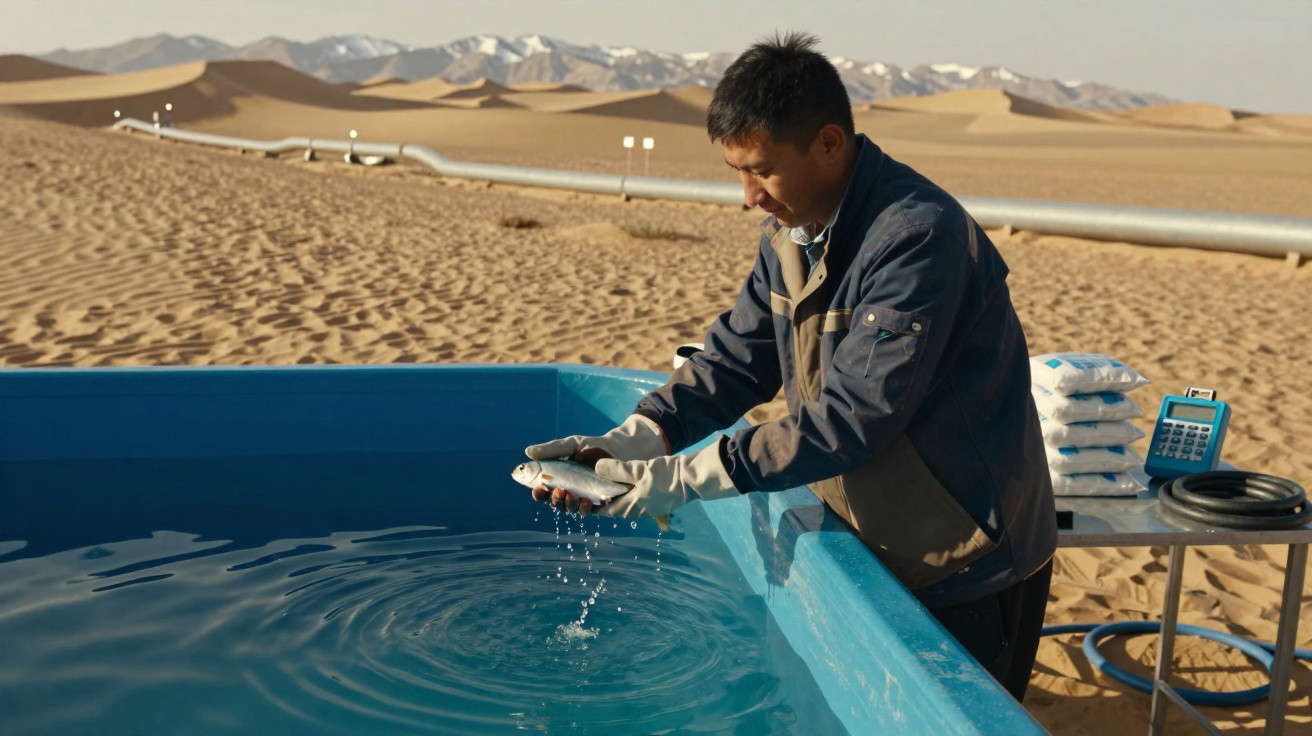
Blue pools of water are appearing in one of Central Asia’s driest and most feared places, where there were once only dunes and wind.
The Taklamakan Desert, a setting for dark legends along the ancient Silk Road, has become a high-tech testing ground for producing fish and seafood amid the sand. What once seemed like a mirage is now part of China’s official strategy to secure food, regional influence and new production models in an age of extreme climate.
From a “place of no return” to an aquaculture hub
For centuries, caravans avoided the Taklamakan in Xinjiang, travelling around its dunes to avoid vanishing in sandstorms. The desert’s name, of Uyghur origin, is commonly translated as “enter and you will not return” or “a place from which there is no return”.
The landscape is now changing dramatically. Land once associated with complete aridity contains rows of tanks, kilometres of pipework and enclosed sheds housing an unlikely industry: intensive farming of fish and marine prawns more than 1,000 kilometres from the coast.
Water recirculation technology, precision chemistry and temperature control have turned a “sand hell” into a seafood hub.
According to figures released by regional authorities, fish production in Xinjiang, driven by projects around the Taklamakan, had already reached about 196,500 tonnes in 2024. This is a volume beginning to carry weight in China’s food-security calculations.
Precision chemistry: creating a sea in the middle of the desert
Taklamakan soil is not simply dry. It is highly saline and alkaline, making it hostile even to hardy crops. Conventional irrigation schemes generally fail or become prohibitively expensive. The solution follows another route: rather than trying to “tame” the land, engineers chose to tailor the water.
From brackish water to fish tanks
The model relies on recirculating aquaculture. Water drawn from deep aquifers, which is rich in salts, is processed at treatment facilities that regulate:
- salinity, so it more closely resembles seawater;
- pH, to prevent fish stress and mortality;
- oxygen levels, through continuous aeration;
- temperature, managed by heating and cooling systems.
The aim is to recreate optimal conditions inside enclosed tanks for marine species such as grouper and whiteleg shrimp, or vannamei shrimp, which is widely used on prawn farms around the world. Water moves in a closed loop: it is filtered, treated and returned to the tanks, limiting waste in a region where every drop matters.
Recirculation makes it possible to use the desert as the “hull” of a fish farm, while the entire aquatic ecosystem is created artificially.
This approach also provides near-total control over the production chain, including feed, growth, stocking density and breeding cycles. In theory, the farm is less exposed to diseases common in coastal and polluted environments.
Food self-sufficiency and geopolitical calculation
China consumes large quantities of fish and seafood, but faces pressure on natural stocks and relies on imports to meet domestic demand. Aquaculture schemes in remote areas such as the Taklamakan help diversify supply and reduce the transport of goods from distant coastal zones to the country’s interior.
The strategy extends beyond logistics. At a time of trade tensions, reducing reliance on seafood imports gives the country greater diplomatic room for manoeuvre. By turning the desert into an artificial “inland sea”, Beijing signals both technological capacity and a willingness to use every part of its territory to generate food and income.
Glacier water on its way to Taklamakan aquaculture tanks
Much of the water reaching the area around the Taklamakan comes from melting glaciers in nearby mountains, which feed the Tarim River system. Water that was previously lost in saline soils or dispersed through inefficient irrigation channels is instead being redirected to aquaculture complexes.
The strategy seeks to balance two requirements: avoiding shortages for local communities while maintaining a steady supply for the tanks. Debate over the sustainable limit of this use is growing, particularly among Asian hydrologists and environmentalists.
| Factor | Potential risk | Measures adopted or proposed |
|---|---|---|
| Water use | Competition with farming and human consumption | Intensive recirculation and catchment monitoring |
| Salinisation | Salt accumulation in soil around the tanks | Controlled reuse and disposal in designated basins |
| Energy | High demand for heating and pumping | Integration with solar power plants in the desert itself |
Local impacts and a changing social landscape
The arrival of industrial aquaculture in the Taklamakan is reshaping Xinjiang’s economic map. Areas that were previously sparsely populated are receiving workers, technicians and refrigerated lorries carrying fresh fish to regional markets.
For nearby rural communities, it creates a range of jobs unlike their traditional agricultural work: pumping-system operators, water-quality technicians, animal-nutrition specialists and cold-chain logistics staff. The shift also requires training and cultural adjustment, as some local residents had limited familiarity with regular seafood consumption.
In place of caravans carrying silk and spices, insulated lorries now travel along the edges of the desert with live or chilled fish.
Questions are also emerging: to what extent does this new economy benefit local residents, and to what extent is it concentrated in large companies linked to the government? Researchers in the region stress the need for transparency in land concessions and profit-sharing.
Risks, challenges and the climate factor
Farming fish in the middle of a desert depends on a fragile three-part foundation: plentiful energy, uninterrupted access to water and political stability. A failure in any one of these areas could make the model too expensive or unviable.
The melting of glaciers that currently supply the Tarim basin is likely to accelerate as global warming advances, creating more water in the short term but raising the risk of scarcity in the decades ahead. Specialists warn that planning major developments around a temporary period of water abundance could create future crises.
The dependence on energy to keep the tanks climate-controlled is also considerable. The Taklamakan already hosts large solar power plants, helping to meet that demand, but any prolonged interruption would have an almost immediate effect on fish welfare.
What this experiment says about the future of food
Despite the uncertainties, the Taklamakan case points to a global trend: moving food production into fully controlled environments, away from traditionally fertile areas. Recirculating systems, enclosed aquaculture and “vertical farms” follow the same principle of removing part of agricultural and fisheries production from direct dependence on the climate.
Terms such as “recirculating aquaculture” and “artificial inland sea” are likely to become more common in the coming decades. In practical terms, they mean using technology intensively to create tailored ecosystems, often in unlikely locations.
A simple thought exercise shows the scale of this shift: if the Taklamakan model could be replicated in other deserts, such as parts of the Sahara or the Middle East, regions currently viewed mainly as sources of oil or solar energy could become significant producers of animal protein. That would bring new geopolitical and logistical scenarios, with supply chains more widely distributed and less dependent on traditional shipping routes.
For consumers, projects like this could mean a wider availability of fish in inland areas and prices less tied to seasonal fluctuations in ocean fishing. For governments and companies, meanwhile, the challenge is to balance economic efficiency, natural-resource use and social impacts in a context where even an ancient desert can become a seafood farm.






Comments
No comments yet. Be the first to comment!
Leave a Comment