
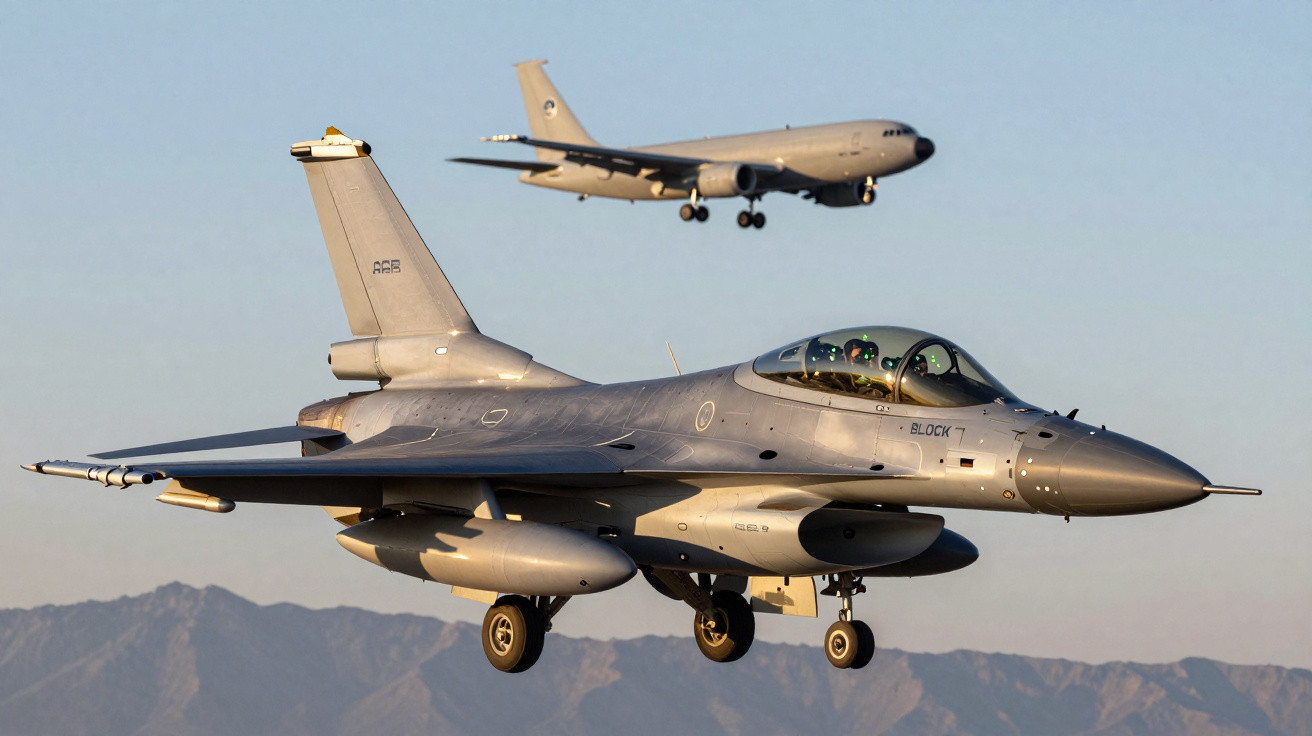
On 31 January 2006, the Chilean Air Force did not merely receive a new combat aircraft. In practical terms, the date marked the beginning of a far-reaching transformation in how national air power was understood, planned and exercised. The arrival of the first F-16 Block 50 aircraft at Los Cóndores Air Base in Iquique launched a process that, two decades later, extends well beyond the aircraft itself and is reflected in an integrated, modern air-combat system with a high degree of operational maturity.
At the time, public attention was focused on the aircraft: an advanced fourth-generation fighter, factory-new and equipped with technological capabilities unprecedented in the region. Yet the full significance of that strategic decision can only be appreciated today, with the perspective provided by 20 years of uninterrupted operations and doctrinal development.
Bringing the F-16 Block 50 into service compelled the Chilean Air Force (FACh) to move decisively away from an approach centred on individual platforms and towards a systems-based vision. The Fighting Falcon was not purchased solely for its kinematic performance or its ability to employ modern weaponry; it also provided an entry point to a new way of operating: interoperable, digital and geared towards networked warfare.
Equipped with an advanced multimode radar, self-protection systems, precision navigation and the ability to employ the latest air-to-air and air-to-surface weapons, the F-16 created requirements that went beyond technology. Its introduction demanded major changes to pilot training, maintenance, mission planning and, above all, the command-and-control concept.
Operating from Aviation Group No. 3 in the north of the country, the F-16 Block 50 fleet began to establish itself as one of the principal foundations of air defence. It soon became clear, however, that its full potential could only be realised by integrating it into a wider operational environment.
Seeing first to make better decisions
That environment began to take shape through the development of airborne early-warning capabilities. The FACh took a decisive step by introducing the EC-707 “Condor” during the final decade of the 20th century, followed by the Boeing E-3D Sentry aircraft acquired from the United Kingdom. These aircraft placed Chile within the small group of countries operating an AWACS system with strategic reach.
The E-3D is not simply an aircraft fitted with radar. It is an airborne command centre able to monitor vast areas of airspace, detect aircraft at long range - including those flying at low level - identify contacts and coordinate air operations in real time. Its arrival substantially enhanced the FACh’s situational awareness and reshaped the relationship between sensor and operator.
For F-16 Block 50 crews, operating beneath the umbrella of an E-3D Sentry means fighting with superior information. Rather than relying exclusively on its own radar, the fighter becomes part of a framework in which targets can be detected, prioritised and allocated by an external platform, shortening response times and raising the likelihood of success.
In doctrinal terms, the FACh moved from reactive air defence to an anticipatory model founded on early detection and centralised airspace control.
Staying airborne, not merely arriving
The ability to see first has limited value if an airborne presence cannot be maintained. In this respect, air-to-air refuelling has been another key force multiplier in consolidating the system.
Through its fleet of KC-135 Stratotankers, the FACh has given the F-16 Block 50 an operational endurance suited to Chile’s geography. In a country more than 4,000 kilometres long, with extensive regions far from urban centres and air bases, the ability to extend time in the air is not simply a tactical benefit but a strategic requirement.
Air-to-air refuelling makes it possible to sustain lengthy air patrols, cover broad stretches of territory and project capabilities beyond the immediate radius of air bases. When integrated with AWACS, it enables a system capable of monitoring, deciding and acting continuously, without operational interruption.
Link-16: the network connecting the system
The component that ultimately gives coherence to this structure is Link-16, the tactical data link connecting F-16 Block 50 aircraft with E-3D Sentry platforms, other aircraft, ground units and command centres.
This network allows information to move securely and promptly, including the positions of friendly aircraft, threats identified by external sensors, developments in the air situation and target allocation. The outcome is a common tactical picture shared by every relevant participant.
This networked-combat concept not only lowers the pilot’s workload but also improves the system’s overall effectiveness. Every platform performs a specific role within a coordinated structure in which the whole is clearly greater than the sum of its parts.
Twenty years after their arrival, the F-16 Block 50 aircraft remain fully relevant not because time has stood still, but because they have developed alongside the system around them. Current modernisation programmes, focused on mission software, communications, identification friend or foe and data links, are specifically intended to preserve that integration and secure future interoperability.
The FACh has chosen a rational approach to managing the lifecycle of its assets, giving priority to operational relevance and system coherence rather than hasty replacements. This approach has made it possible to sustain a credible, flexible combat capability aligned with international standards.
In retrospect, the arrival of the F-16 Block 50 in 2006 was not an end point but the beginning of a process. Today, these fighters serve as the executing arm of an integrated air-combat system, supported by early-warning platforms, air-to-air refuelling and a data network that connects sensors with decisions.
More than simply fielding a modern fleet, the Chilean Air Force has established a way of understanding air defence founded on information, coordination and persistence. That is the true legacy of 31 January. It is also why, 20 years later, the F-16 Block 50 remains a central pillar in safeguarding the sovereignty of Chilean airspace.

Comments
No comments yet. Be the first to comment!
Leave a Comment