
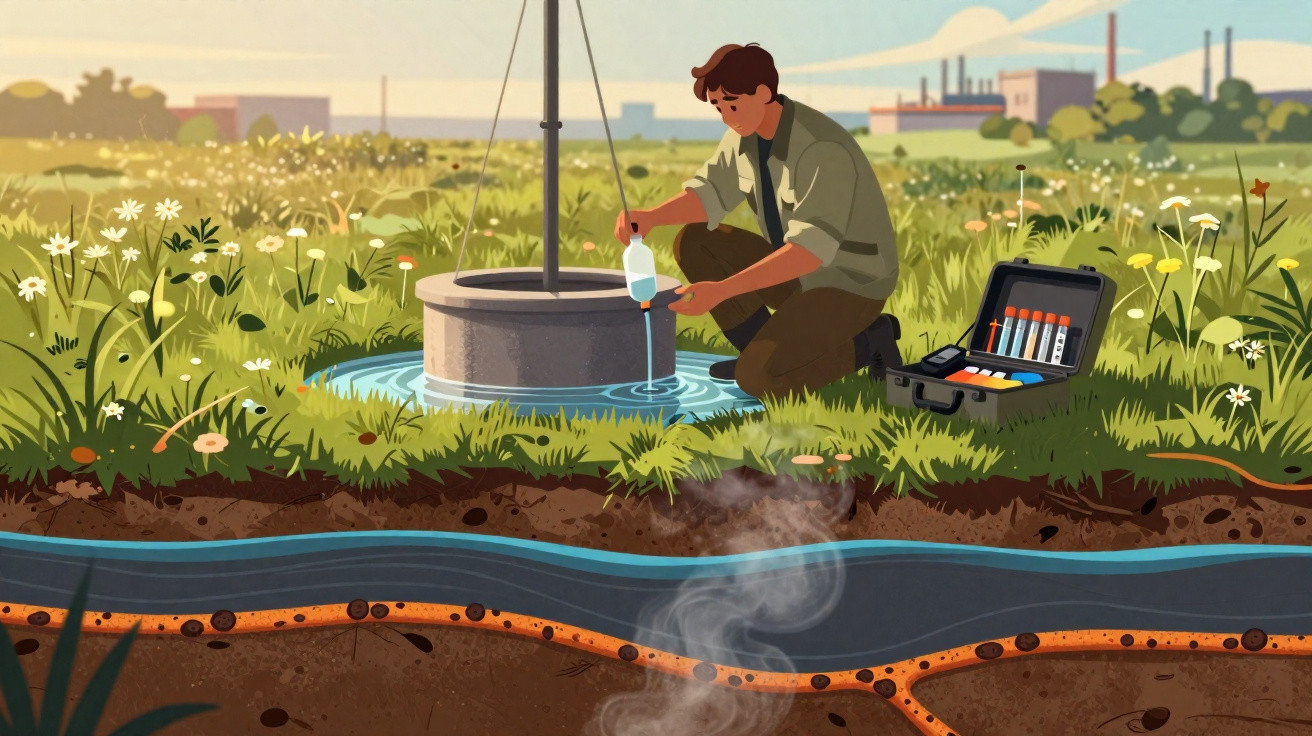
At former industrial sites, contaminated groundwater often remains trapped in the most inaccessible areas: dense clay and silt pockets packed so tightly that virtually nothing can pass through them. Pollution persists longest in these zones, frustrating most groundwater cleanup efforts and leaking back out for decades after treatment has finished.
Iron particles can render such contaminants harmless on contact, yet placing them inside compacted clay has always been the obstacle. Researchers in Italy tested an approach not previously used in a complex aquifer: rather than solving the delivery challenge, they created the iron below ground.
The delivery challenge
For over 20 years, nanoremediation has been a widely used solution for contaminated aquifers – underground formations that store groundwater. Engineers inject iron, which breaks apart pollutants in the ground, and the technique has become routine.
Transport, however, remains a major limitation. Even in nanoparticle form, solid iron moves only minimally through tightly packed soil. Pollutants absorbed by dense clay can therefore continue to leach out for years, contaminating water again long after looser sand appears clean.
Dr Andrea Gallo, an environmental engineer who led the experiments at the Polytechnic University of Turin (PoliTo), and his colleagues took another approach. Instead of manufacturing iron in a laboratory and pushing it underground, they formed it in place.
Growing iron underground
Their technique replaces a single injection with two. First, a safe solution containing dissolved iron is injected; a reducing agent follows later, converting the iron into solid metal. Particles develop where the two substances meet underground, precisely at the point where they are required.
Ordinary tap water determines that meeting point. The researchers inject a pulse of water between the two solutions, with the duration of that pulse deciding where they combine. A simple equation establishes how long the water should flow.
Choosing the reducing agent required careful consideration. Conventional methods rely on an agent whose by-products are too toxic for use underground, while producing particles in that manner entails significant environmental costs. The Turin method instead uses gentler sulphur-based components.
A buried experiment
For the trial, the team filled a box roughly 1 metre long with quartz sand and ran water through it to replicate a flowing aquifer. A central well introduced the solutions through repeated cycles.
Once the experiment was complete, they removed the sand in layers around 2.5 centimetres thick and photographed every slice. The photographs revealed a dark oval mark extending approximately 15 centimetres from the well, corresponding with the location calculated by the equation.
Two results were particularly notable. The iron occupied almost precisely the volume forecast by the model, while roughly three-quarters of it converted into solid particles. None emerged from the far end of the box, indicating that the particles adhere to and remain within the sand.
Confirming the iron
A dark mark alone establishes very little. The key issue was whether the particles were genuine metallic iron – the reactive material capable of breaking down pollutants – rather than inactive rust. That distinction is essential.
Surface scans detected a distinct metallic-iron signal beneath a fine rust coating. The coating was no thicker than could be explained by the brief exposure to air while the sand was excavated, implying that the reactive core remained undamaged.
Microscopic examination showed clusters of small flakes attached to the sand grains, still in place after rinsing. They were only tens of nanometres across, placing them within the size range of commercially available iron used for this work.
Breaking down solvents
Metallic iron is of limited value unless it can destroy the contaminants it is intended to treat. The researchers assessed it using two chlorinated solvents – trichloroethylene and perchloroethylene – which are both used in dry cleaning and degreasing and both persist stubbornly in groundwater.
Over 21 days in sealed vials, newly made particles removed more than 96% of both chemicals. Particles recovered from the sand box eliminated much less, between 30 and 40 percent. This difference probably reflected the small amount of iron contained in those samples.
When measured per gram of iron, the reaction rates were typical for particles of this type. That agrees with a wider study of how reactive iron attacks trapped solvents pore by pore, indicating that the particles produced underground perform like established materials.
Reaching the hard layers
The most demanding assessment used a slim transparent tank containing compact clay pockets, the same areas where conventional particles stop moving. Looking through the glass, the researchers observed iron forming as the two solutions came together.
Reactive iron had not previously been grown inside a realistic, uneven aquifer of this kind. The dark treatment zone spread into the compact pockets, indicating that reactive iron had developed within the layers that continue to contaminate water for years – precisely the layers usually abandoned as unreachable.
The researchers then made a direct comparison. In a matching tank, they injected a commercial suspension, while the iron formed underground covered more than four times as much area, reaching soil that the injected particles could not access.
New groundwater cleanup
The findings show that reactive iron can be produced from safe ingredients within the difficult-to-reach layers of a contaminated aquifer, offering a new method for groundwater cleanup. It creates a broader and more consistent treatment zone than the particles engineers have injected for decades.
This creates an opportunity that has largely been unavailable. Locations previously considered too challenging, where solvents sit in clay and contaminate water again for years, may become viable groundwater cleanup targets, treated at their source instead of pursued downstream.
A substantial gap remains between a laboratory tank and an operational cleanup project. The team intends to test the iron’s ability to react within soil, as well as investigate how the injected chemicals influence underground microbes and any substances that do not react.





Comments
No comments yet. Be the first to comment!
Leave a Comment