
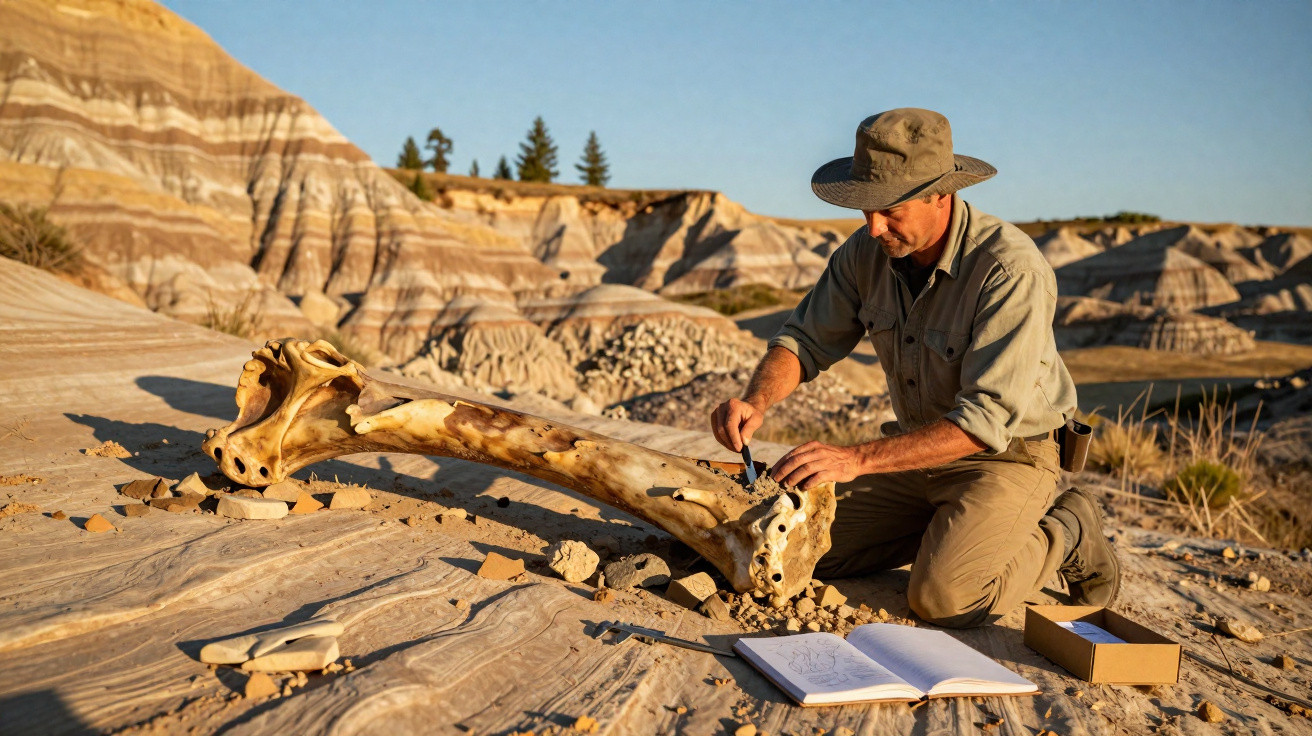
Discovered in the 1970s, this fossil has only now been re-examined by palaeontologists. Its exceptional size reveals the existence of a colossal carnivore that was already dominating North American ecosystems during the Cretaceous.
Although Tyrannosaurus rex is now hugely famous and remains one of the most iconic dinosaurs, it was in fact part of an entire lineage, the Tyrannosaurini, which is often overlooked in the public imagination. A distinction must be made between its genus, Tyrannosaurus, which includes closely related species, and this lineage, encompassing the “true” T. rex alongside its direct ancestors and other close relatives. Until now, palaeontologists had regarded Tyrannosaurus rex as the undisputed king of Maastrichtian predators, the final stage of the Cretaceous, between 66 and 68 million years ago: the last representative of the Tyrannosaurini lineage.
Yet an analysis of a 96 cm fossilised tibia from an unnamed giant tyrannosaur, published on 12 March 2026 in the journal Scientific Reports, has just challenged that timeline. The 50-year-old bone had been held by the Kirtland Foundation in New Mexico, but dates from an earlier period: the late Campanian, around 74 million years ago. The animal was not a Tyrannosaurus rex, but an older member of the Tyrannosaurini. The finding indicates that, eight million years before T. rex reached its peak, giant tyrannosaurs were already at the top of the food chain in North America.
The forgotten giant of the Campanian
A team led by Nicholas Longrich, a palaeontologist at the University of Bath, re-examined the 50-year-old tibia recovered from the Hunter Wash site. Without a complete skeleton, the researchers could not formally name a new species to which it might have belonged. However, its size alone shows that the gigantism characteristic of the Tyrannosaurini lineage may have emerged well before the end of the Cretaceous.
Comparing the Hunter Wash tyrannosaur with Sue
To place the fossil within the tyrannosaur family tree, the team compared it with specimen FMNH PR2081, better known as “Sue”. This T. rex skeleton, discovered in 1990, is the family’s anatomical benchmark because of its exceptional preservation and dimensions. This dinosaur is a true palaeontological superstar; so enormous was it-12.3 metres long and estimated to have weighed around 8 to 9 tonnes-that researchers often use it as a yardstick when comparing the size of a predator’s bone, whether newly found or, as in this case, reanalysed.
Measured against Sue’s tibia, the other bone reaches 84% of its length and 78% of its circumference. It was certainly smaller, but scientists did not previously know that tyrannosaurs could attain such dimensions in the late Campanian. The team’s calculations suggest that the animal may have been 10 to 11 metres long and weighed close to 4.7 tonnes.
That would make it a genuine heavyweight. Tyrannosaurs had been thought to have remained “medium-sized” predators, roughly 5 to 6 metres long, for almost their entire existence, only becoming 12-metre giants during the final two million years before their extinction.
Anatomical clues to the Tyrannosaurini lineage
Its dimensions were not the only evidence: the bone’s anatomy was the second factor allowing researchers to link it to the tyrannosaur lineage. Unlike Bistahieversor sealeyi-another tyrannosauroid found in the same geological layers in New Mexico, but with a more primitive morphology-this tibia has a broad base and a triangular structure around the ankle. This morphological feature is found only in T. rex and its closest relatives, the Tyrannosaurini.
“Whatever hypothesis is favoured [Editor’s note: whether this tibia belonged to a new giant species or to a very early T. rex lineage], the unusual size of the Hunter Wash tyrannosaur is significant: it reveals a previously unsuspected presence of large tyrannosaurids at the end of the Campanian, and shows that their evolution towards gigantism is far older than previously believed,” the team concludes.
Some of the anatomical traits associated with the celebrated T. rex, and by extension with giant tyrannosaurs, had therefore already appeared in their ancestors almost ten million years before their ecological dominance. Natural selection may have encouraged an earlier specialisation of their skeletal structure, enabling it to bear, several million years later, the colossal masses reached by these predators at the end of the Cretaceous. Nevertheless, these new findings are based on a single bone, and it remains extremely difficult to confirm this hypothesis fully until further discoveries provide stronger support. If that happens, this individual could represent one of the long-sought earliest giants of the Tyrannosaurini lineage, further enriching the family tree of this major group.






Comments
No comments yet. Be the first to comment!
Leave a Comment