
For years, researchers regarded North Atlantic salinity as little more than background variation within the climate system. It reveals how water circulates, whereas heat was assumed to be doing the important work.
New research disputes that assumption. As the Atlantic’s overturning circulation slows, salt levels across the region could fluctuate more sharply than at any time in recorded history. In this scenario, salt rather than temperature emerges as the greater danger.
A slowing Atlantic loop
Known as the Atlantic Meridional Overturning Circulation (AMOC), this system carries warm, salty surface water northwards. As that water cools, it becomes denser and sinks, before returning southwards through the deep ocean.
The research was led by climate scientist Tomoki Iwakiri at the University of Hawaii at Mānoa. His team extended eight major climate models to 2300 under a scenario of unchecked fossil-fuel consumption.
Parts of this process are already under way. Observations indicate that the AMOC has been weakening for decades, while one study linked a cold patch in the North Atlantic to that decline. In the models, the circulation falls to one quarter of its present strength.
North Atlantic salt shifts
The unexpected finding concerns salt rather than heat. Salinity describes the amount of salt contained in seawater. At present, the strongest variations occur in the western Atlantic near the turbulent Gulf Stream.
As warming intensifies and the current weakens, however, this arrangement reverses. The previously quieter central and eastern Atlantic experience the biggest fluctuations, while the former western hotspot becomes calm – a complete turnaround.
By 2300, the size of these swings increases by more than fivefold, exceeding anything in the ocean record. Extreme changes occur three to four times more frequently. Scientists already knew the circulation was weakening, but not that salinity could vary on this scale.
A travelling salt wave
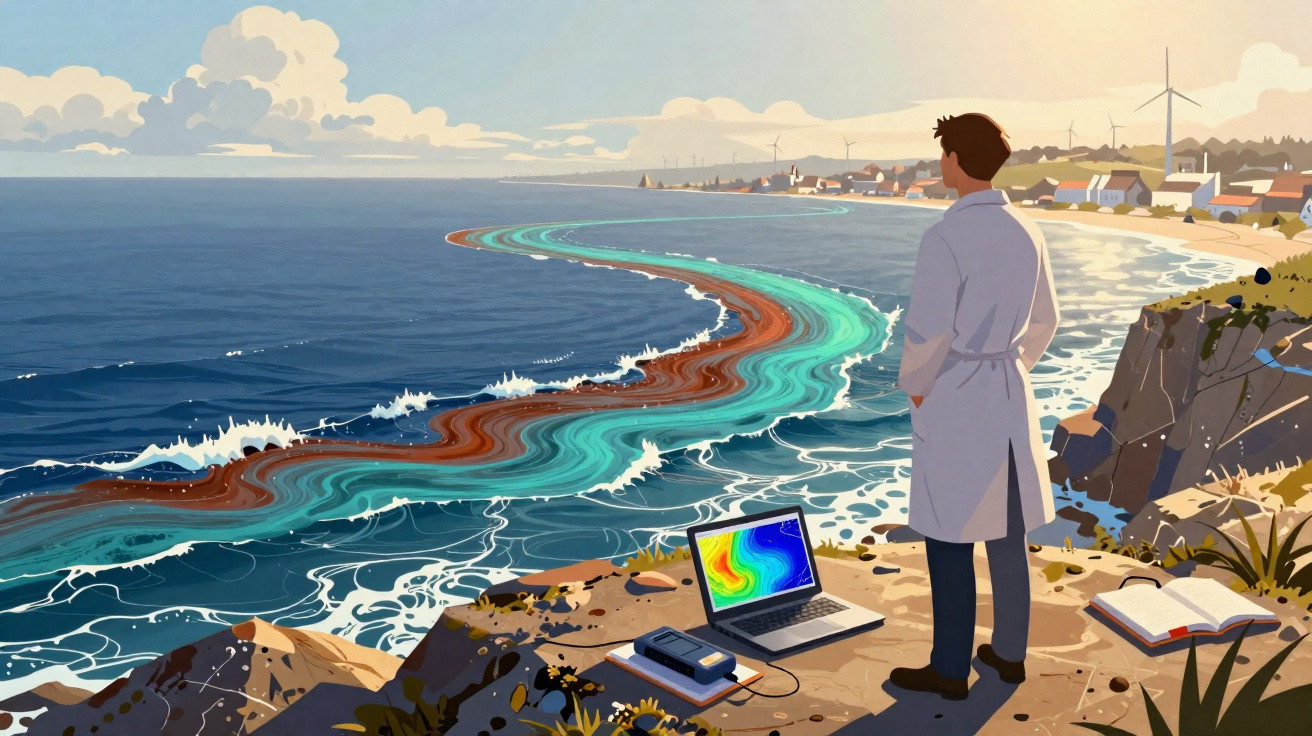
Following individual extreme episodes reveals how these fluctuations develop. A patch of unusually salty water appears at the western edge of the basin, then moves eastwards over six to eight years, becoming more intense along the way.
The North Atlantic has undergone abrupt changes before. One paper documented its greatest freshening in more than a century during the 2010s. The newly identified fluctuations differ because they alternate between salty and fresh conditions, strengthening as they travel.
Their growth is sustained by the interaction of salt and heat. In the models, a salty patch draws warm water alongside it, while that warmth brings in additional salt, creating a self-reinforcing process.
When researchers disable that interaction, the amplification disappears – revealing a mechanism not previously observed in this setting.
Connecting the changes to AMOC
Two gradual changes in the ocean’s underlying state lie beneath these fluctuations. The Gulf Stream slows and transports less warm, salty water northwards.
At the same time, the contrast between saltier southern waters and fresher northern waters becomes wider.
Both developments are directly associated with the declining AMOC. The models showing the greatest weakening of the circulation also produce the largest Gulf Stream slowdown and the sharpest salinity contrast. This consistency across all eight models strengthens the finding.
It is this steeper salinity contrast that fuels the travelling wave. A weaker current and a stronger wave appear together. Since most models begin with too much contrast in salinity, they could be understating the scale of what lies ahead.
Carbon cuts do not fully prevent it
It might seem reasonable to expect emissions cuts to avert the problem. The researchers tested this possibility by raising carbon dioxide to a peak and then reducing it towards current levels.
Although the planet cooled, the salinity swings remained. Because the ocean reacts slowly, the AMOC continued to weaken for about 50 years after carbon dioxide reached its peak. The extreme behaviour persisted throughout the cooling period.
Once the slowdown passes a certain point, the swings do not reverse simply as warming subsides. Instead, they remain for centuries, sustained by an ocean that adjusts only gradually. Emissions reductions lessen the impact, but do not undo it.
Risks for Europe’s coastline
These salinity changes are not confined beneath the sea surface. Saltier water is denser and sits lower, while fresher water remains higher. The shifts therefore raise and lower local sea levels, with Europe’s Atlantic coastline facing the greatest effects.
The threat worsens when an extreme salinity event coincides with high sea level. Such combinations are rare today, yet become common in the models. The risk of coastal flooding rises from Spain and Portugal to Norway and Iceland.
The weakening current would alter the region in further ways. Separate research suggests it would intensify European heatwaves. Salinity extremes present a less visible risk by disrupting coastal marshes that protect shorelines.
A newly named rhythm
After concluding that the rhythm was genuine, the authors called it the North Atlantic Salinity Oscillation. Its cycle lasts about ten years. It remains uncertain whether the current drives the pattern or whether the ocean generates it independently.
This pattern may not be confined to the future. Comparable salinity swings accompanied abrupt disruptions in the distant past, when meltwater entered the North Atlantic and slowed the circulation. That points to a possible intrinsic tendency within the ocean.
The study firmly demonstrates that a weakening AMOC produces salinity swings unlike any previously recorded, with salt and heat amplifying them. They are persistent enough to survive the warming that initially sets them in motion.
For Europe’s coasts, the slowdown represents a significant hazard that merits mapping – evidence that it could leave the ocean more unfamiliar than the warming people anticipated.






Comments
No comments yet. Be the first to comment!
Leave a Comment