
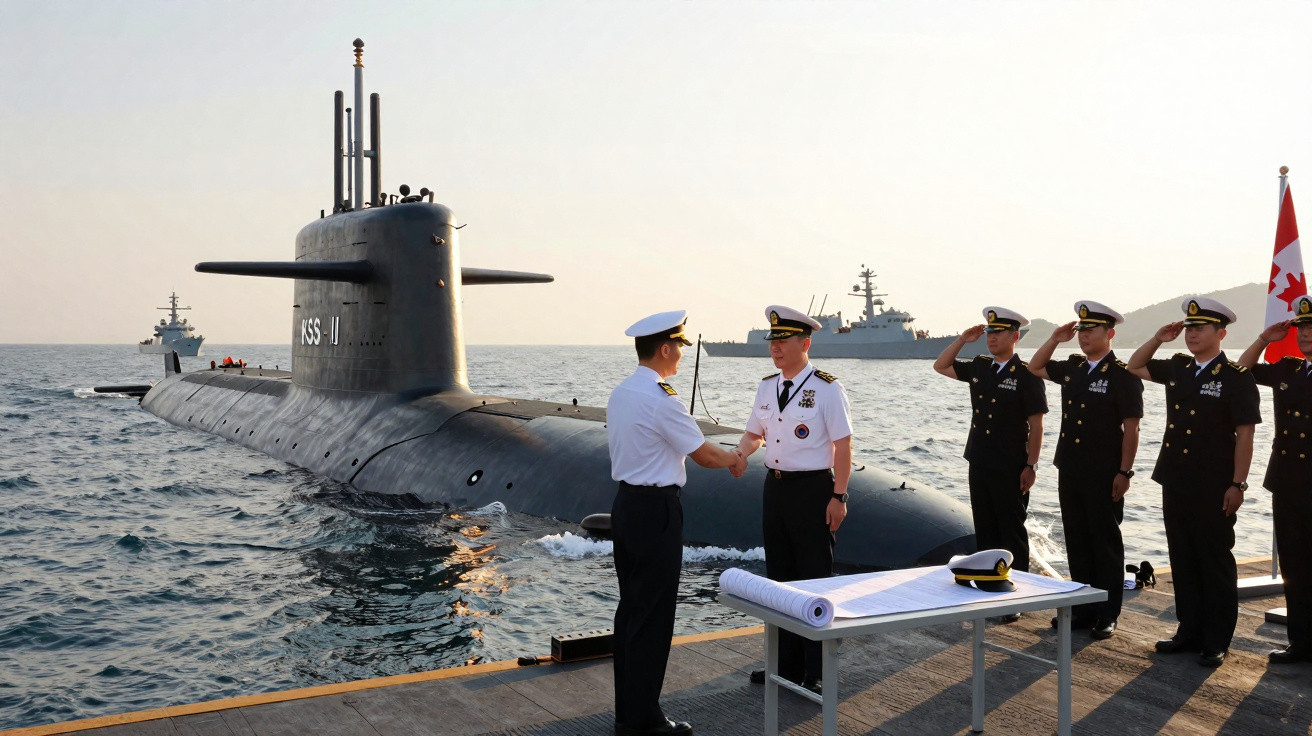
ROKS Dosan Ahn Chang-ho deployment to Canada
In a historic first for the South Korean and Canadian navies, one of South Korea’s new KSS-III submarines will conduct exercises with the Royal Canadian Navy. The deployment will also include participation in US-led multinational drills. Officially, the purpose is to deepen maritime co-operation while advancing the industrial competition for the future submarine programme currently being assessed by the Royal Canadian Navy.
The 3,000-tonne submarine ROKS Dosan Ahn Chang-ho will sail from Jinhae to Victoria, on Canada’s west coast, to take part in combined exercises scheduled for June. South Korea’s Navy stated that the voyage will cover roughly 14,000 kilometres, with refuelling stops in Guam and Hawaii. Two Canadian submariners will join the South Korean crew there for the final leg to Canadian waters. Once the mission is complete, it will represent the longest distance ever travelled by a South Korean submarine.
Following the bilateral drills, ROKS Dosan Ahn Chang-ho will join the US-led multinational Rim of the Pacific (RIMPAC) exercise, due to be held in Hawaii in late June. According to the South Korean Navy, the deployment is intended to demonstrate operational capabilities as South Korean companies compete for a major contract that Canada regards as a priority for renewing its submarine fleet.
The submarine’s departure will be marked by a ceremony at the Submarine Forces Command at Jinhae naval base. South Korean officials, including the naval vice-chief and the head of the state arms procurement agency, will attend. Foreign representatives will also be present, including Canada’s ambassador to South Korea, Philippe Lafortune, and the United Kingdom’s ambassador to South Korea, Colin Crooks, the South Korean Navy reported. Officials emphasised that the activity forms part of a wider co-operation process.
KSS-III bid for the Royal Canadian Navy submarine programme
The industrial backdrop shows that South Korea is seeking to position its KSS-III design in the competition to supply 12 new attack submarines for the Royal Canadian Navy, a programme intended to replace the existing Victoria class. In May 2025, South Korean companies confirmed that the project had government backing, aimed at expanding the presence of South Korean military equipment among new operators around the world. The process also assessed Japanese Taigei-class proposals, Spain’s S-80 Plus, France’s Scorpene, and U212/214 designs offered by Germany’s Thyssenkrupp Marine Systems (TKMS).
In early 2026, TKMS announced that it would broaden its proposal to supply Type 212CD submarines to Canada, negotiating arrangements with Norwegian and German companies to strengthen its bid. The company’s chief executive, Oliver Burkhard, said the discussions covered not only the construction of the vessels but also areas such as rare earths and artificial intelligence, which Ottawa considers relevant. The process continues after the 2025 shortlisting of the South Korean KSS-III and German Type 212CD designs, with proposals from Saab, Naval Group and Navantia excluded.
South Korean state support and the $40 billion competition
South Korea has strengthened its industrial campaign in recent months. This included the signing of an official document late last year by the ministries of Defence, Foreign Affairs and Industry, alongside the Navy and companies Hanwha Ocean Co. and HD Hyundai Heavy Industries Co., formally confirming state support for the bid. The overall submarine contract is estimated at approximately 60 trillion won ($40 billion), underlining the scale of the programme for the competing companies.
The joint exercise involving the South Korean submarine and the Royal Canadian Navy therefore takes place in a setting where operational, diplomatic and industrial interests converge. The deployment of ROKS Dosan Ahn Chang-ho will allow South Korea to showcase long-range capabilities, while Canada continues its assessment of options to modernise its submarine fleet, a decision with strategic and economic consequences for decades to come.
Images for illustrative purposes.





Comments
No comments yet. Be the first to comment!
Leave a Comment