
At 9.15 on a Saturday morning in a small local salon, the coffee machine is sputtering in the corner and magazines are slipping off the waiting-room table. A woman in her early fifties studies her reflection with the familiar blend of interest and apprehension. Her shoulder-length hair is neither short nor long: “nothing-special brown”, in her own words. The hairdresser, perhaps 25, flicks through images on her phone, holds up the screen and asks: “What about… this?”
The image could have come directly from 1966: softly rounded and neatly shaped, with the neck uncovered and a gentle fringe. It is the iconic 60s bob, brought firmly up to date.
At once, the woman sits taller. Something shifts by a few millimetres in her stance, her expression and her gaze. She has not worn her hair this short since starting her first job.
Yet this is the style quietly taking centre stage in 2026.
The 60s bob returns as the power cut for women over 50
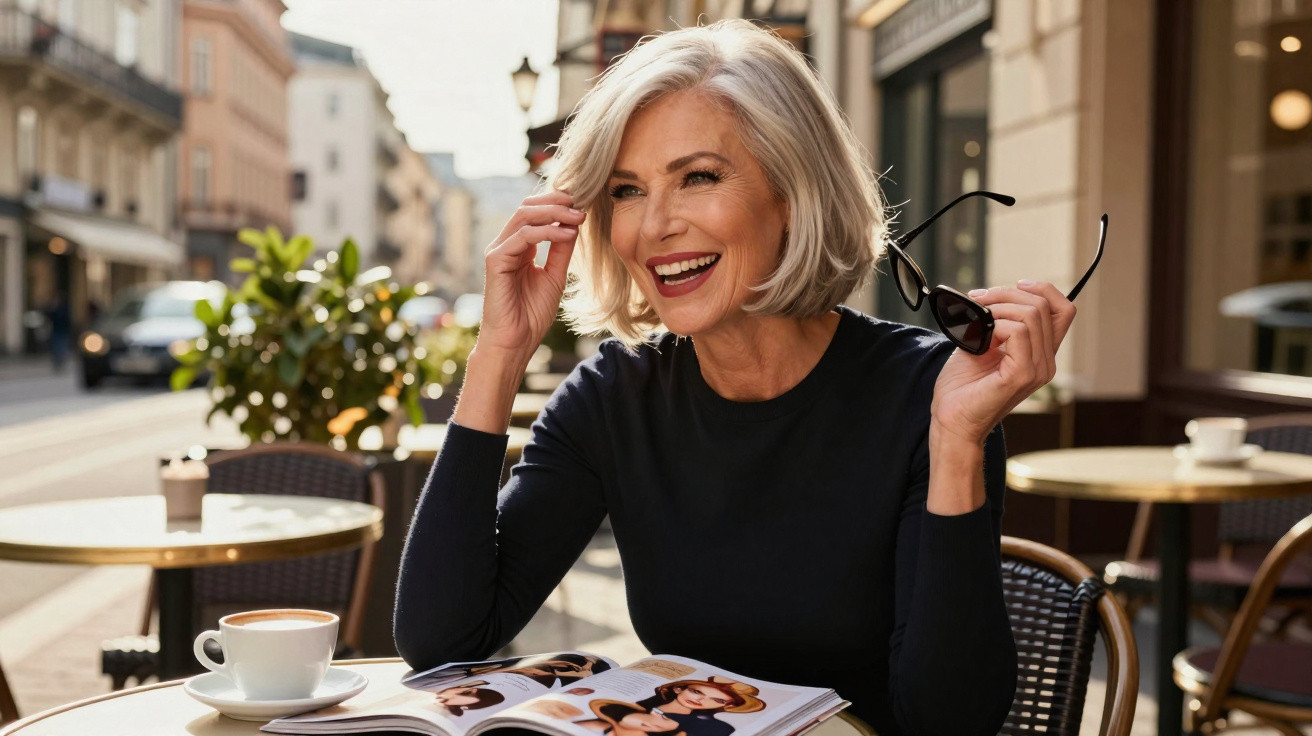
The comeback style is unmistakable: a softly rounded bob, generally falling just beneath the ears or skimming the jaw, with gentle volume and natural movement. During the 1960s, it framed faces in hazy jazz clubs and along London streets. In 2026, it is appearing everywhere, from red carpets and Zoom calls to the school gate, grandchildren alongside.
For women over 50, the style has a particular kind of appeal. It exposes the neck, makes the overall outline feel lighter and can seemingly raise the features without a syringe in sight. Many call it a “mini facelift” achieved with scissors rather than needles.
Consider Isabel, 57, who had spent years concealing herself behind long, lacklustre hair pulled into the same low ponytail. She entered the salon clutching a screenshot of a 1964 magazine cover, wearing an apologetic smile. “Do you think I could really do this?”
Forty minutes later, her hair sat halfway down her neck, softly curved, with a feathered fringe sweeping across forehead lines she no longer wished to scrutinise. On her way out, she applied lipstick she “never bothers with anymore” and even asked the receptionist to photograph her “for the girls’ group chat.”
A fortnight later, she returned with three friends. They all chose the same cut, although each wore a different interpretation of it. The hairdresser laughed and shrugged: “The 60s bob is having its revenge.”
There is a practical explanation for the style’s current surge. After 50, hair texture often shifts and density can reduce, while lengthy layers may begin to pull the face downwards. A structured bob with a slight curve has the reverse effect: it creates lift, restores shape and draws attention back to the eyes rather than the lengths.
Fashion’s recurring cycles undoubtedly contribute, but there is something more significant at work. Women who remember this style on their mothers or in vintage film posters are making it their own. There is less lacquer and more movement; less “perfect housewife” and more “I decide who I want to be at this age.”
That combination of nostalgia and autonomy is exactly why it feels so fitting in 2026.
How to wear a new 60s bob without looking “stuck in time”
The details are what make this vintage-inspired haircut modern. Its foundation is a bob that falls anywhere from the earlobe to the nape, with a subtle curve rather than a rigidly straight finish. The back is commonly cut a little shorter than the front, revealing the nape and giving the silhouette extra length.
Request soft edges from your hairdresser instead of a severe, ruler-straight perimeter. Fine internal layers, largely unseen within the haircut, maintain airiness and prevent the dreaded “helmet” look. If a fringe appeals, opt for a curtain fringe or wispy version that blends into the sides instead of a dense 1960s block fringe.
The idea is straightforward: capture the era’s mood without recreating it like a postcard.
Women over 50 often have two concerns: their neckline and their hairline. Shorter hair can feel worrying because it might “reveal everything”. In practice, a bob placed at the right point can be remarkably kind. A nape that is lightly textured rather than overly exposed creates a small shadow that can have a slimming effect.
The most ageing factor is usually not short length. It is hair that is too set to move, colour that is excessively dark and stuck to the scalp, or a style that battles against natural texture. Honestly, nobody truly maintains that every day.
Choosing a 60s bob that works with, rather than against, your natural wave is the genuinely age-defying approach.
“Women in their 50s and 60s don’t come asking to look younger,” says Lisa, a Paris-trained stylist now based in Manchester. “They come asking to look less tired. The right bob doesn’t erase years, it erases heaviness. That’s a huge difference.”
A handful of simple principles can preserve the balance between retro inspiration and a current look:
- Colour with dimension – Choose delicate highlights, lowlights or luminous grey rather than one solid, flat layer of dye.
- A slightly undone finish – Apply light mousse, blast-dry briefly with your head upside down, then run your fingers through it instead of committing to an exhausting, stiff round-brush session.
- Movement around the face – Face-framing sections, a soft fringe or a side sweep can soften expression lines.
- Modern accessories – Slim metal spectacles, a tailored blazer or bold earrings immediately refresh the 1960s reference.
- Regular micro-trims – Book them every 6–8 weeks to retain a crisp line without taking off substantial length.
More than a haircut: why this 60s classic feels different after 50
This style’s powerful resonance now has a reason. Beyond trend forecasts and TikTok videos, many women moving through their fifties are reassessing how visible they want to be. Long hair can occasionally act as a curtain, offering a way to hide slightly. The revived 60s bob does the reverse, quietly declaring, “I’m still here.”
Most of us know the experience: catching sight of yourself in a shop window and recognising that your hair no longer reflects the person you feel yourself to be. A new haircut offers a reason to bring those two images into alignment. It is not about looking 30 again, but about resembling your present-day self on an especially good day.
Menopause, career changes, children leaving home and first grandchildren arriving: at this stage, hair is seldom only hair. When a woman over 50 sits in the chair and says, “Let’s cut,” she may really mean, “Let’s drop the weight of a decade I’ve just survived.”
This is also why the 60s-inspired bob suits the moment so well. It is clean, uncomplicated and almost minimalist. It does not shout or demand 25 products. It follows the jawline, supports the cheekbones and allows silver strands to shine for anyone who wants them to.
One refreshingly honest line is repeated in salons: “I just want something easy that still looks like I tried.”
The strength of this revival is its rejection of all-or-nothing rules. You might embrace grey while choosing a graphic, razor-sharp bob. You can retain dyed brunette hair and select a soft, rounded interpretation that feels more French than a vintage television presenter. You can try it, dislike it, grow it out and revisit it five years later.
The haircut is only a tool. The more important story is what you choose to place before the mirror after the hair has fallen to the floor. Perhaps that is why so many women send their “after” photos to group chats, quietly hoping a friend will respond: “Send me the number of your hairdresser, I’m going next.”
And the discussion seldom ends with hair.
| Key point | Detail | Value for the reader |
|---|---|---|
| Modern 60s bob shape | Softly rounded, a little shorter at the back, with gentle edges and light internal layers | Creates lift and movement, plus a subtle “facial refresh” effect without surgery |
| Adapted to texture and lifestyle | Suits natural waves, easy-care styling and nuanced colour dimension | Delivers a stylish look for real life rather than only for photoshoots |
| Emotional and identity boost | Marks a fresh stage of life, trading “hiding behind hair” for clear lines | Can bring external appearance into line with inner confidence after 50 |
FAQ:
- Question 1 Is the 60s-style bob suitable if I have fine, thinning hair after 50?
- Answer 1 Yes, and it may be among the most flattering choices. A properly cut bob can make hair seem denser by removing wispy ends and focusing volume around the jaw and nape. Request discreet internal layers and avoid heavy thinning shears, as they can leave fine hair looking even more sparse.
- Question 2 Will a shorter, 60s-inspired cut make my neck and jawline more noticeable?
- Answer 2 They will be more visible, but the result need not be severe when the line is correctly placed. A length that barely touches the jaw and curves inward slightly can visually “hold” the face’s contours. A gently textured nape produces a flattering shadow that generally slims and lifts rather than exposes.
- Question 3 How often do I need to trim this cut to keep it looking fresh?
- Answer 3 Aim for an appointment every 6 to 8 weeks. This bob depends on a defined outline, and too much growth can quickly make it look weighty or shapeless. Brief micro-trim appointments are normally enough to keep it crisp without making you feel as though you are constantly cutting it.
- Question 4 Can I wear this cut if I’m letting my grey grow in naturally?
- Answer 4 Absolutely: it is one of the strongest shapes for a natural transition to grey. The crisp outline complements silver and salt-and-pepper hair beautifully, while a few subtle highlights or lowlights can merge old colour with fresh growth. The outcome often looks chic rather than “mid-transition.”
- Question 5 What styling routine works best if I don’t want to spend ages blow-drying?
- Answer 5 Distribute a small amount of lightweight mousse or cream through damp hair, rough-dry it upside down for a few minutes, then allow it to air-dry for the remainder. If desired, use a brush or straighteners to turn the ends slightly inwards. Two or three easy steps will retain the 60s feel without demanding high-maintenance effort.






Comments
No comments yet. Be the first to comment!
Leave a Comment