
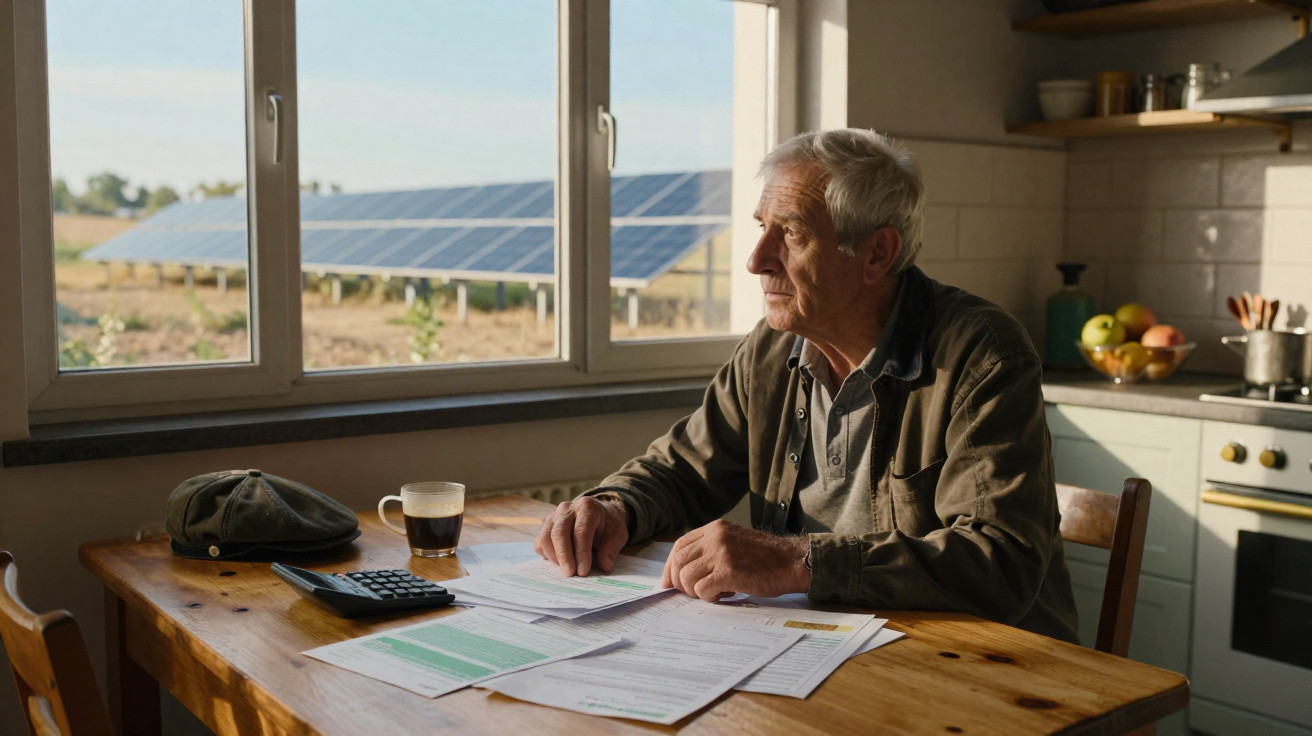
On a dull Tuesday morning in rural Devon, 73-year-old Brian Turner follows the boundary of the field he no longer cultivates. Where barley once rippled in the wind, ranks of blue-black solar panels track the weak winter sun. He brushes his hand across the chilly metal fencing and chuckles, though it is the dry laugh of a man who feels he has become the punchline.
A decade ago, Brian agreed a lease with a solar developer, pleased that his small plot could become a modest power station. He told neighbours he was helping his grandchildren's future: the rent would supplement his pension while the panels reduced local emissions. Today, however, a letter from the tax office lies on his kitchen table. It demands a “green land levy” which, he says, consumes every penny he receives.
“I wanted to help the planet, not go bankrupt,” he says, looking towards panels that no longer seem to belong to him. To anyone outside the situation, it appears to be a climate success. Living through it, Brian says, feels like being caught in a trap.
A climate ambition becomes a tax nightmare
When Brian met the solar firm's representative in the pub, the offer appeared straightforward. Let an underused field, retain ownership of the land and receive dependable rental income for twenty-five years, while renewable electricity supplies thousands of homes. Nobody spoke of a future land charge that could classify the same field as a valuable industrial location.
He recalls that the agreement was thick enough to stop a tractor wheel. Brian read through parts of it, raised several questions and decided to proceed; a local solicitor reviewed it briefly and was reassured by the project's “green” credentials. At the time, councils were approving solar farms as an inexpensive climate measure. The same council has since reclassified a number of sites, Brian's among them, increasing their assessed land value and activating a new “renewable infrastructure contribution”.
The demand is greater than his yearly state pension. When he rang the helpline, he was told the valuation was “aligned with climate policy and fiscal responsibility”. Put plainly, making his field greener made it costlier to own. That is how this climate justice story starts: one man, a field covered in panels and an unforeseen tax demand.
Neighbours divided as villages face green land tax
A short drive from Brian's village reveals a very different model. On a hill above the neighbouring town, a community-owned solar cooperative displays its results with pride: local dividends, lower energy bills for low-income households and a hardship fund. The burden does not rest on one pensioner.
Even there, though, the new “green land tax” has created unease. Some residents believe profitable infrastructure ought to make a fair contribution to public services and climate adaptation schemes. Others regard it as a hidden charge that penalises small landowners more severely than remote corporate developers.
The same divide is emerging throughout the country. A rural advocacy group's survey found that nearly 40% of farmers and smallholders hosting renewable energy projects feel “financially exposed” to future changes in policy. Politicians describe this as “sending price signals”; people in villages say it is changing the rules halfway through the game. Both descriptions are true, depending on where you're standing.
Climate justice in policy papers and everyday life
In policy documents, the approach seems neat: impose higher taxes on carbon-intensive activity, encourage low-carbon schemes and use income from new green infrastructure to pay for flood defences, bus routes and insulation programmes. Nobody wants a further regressive arrangement in which those with the least bear the greatest burden.
But land is not a spreadsheet entry. It exists beneath people's feet, within family stories, precarious pensions and debts passed down through generations. Once a field is legally designated a “strategic energy asset”, tax rules can change overnight even when the owner's earnings remain almost unchanged.
In truth, few people study every clause in a 40-page lease when they are simply relieved to have found a way to manage on a small pension. When climate-related charges arrive years afterwards, the sense of betrayal reaches beyond the financial loss. If the green transition is presented as a moral obligation, those who respond expect not to be sacrificed first.
What future solar farm hosts can do differently
For landowners currently approached by solar or wind developers, Brian's experience has become a warning exchanged at livestock markets and parish halls. The first sensible step may be unglamorous, but it matters: approach the lease as though you are giving away part of your future, rather than merely renting out an unused field. Obtain written confirmation of who is liable for each tax under existing rules and under possible future reclassifications.
Some solicitors now advise including a straightforward trigger clause. Should a fresh tax, levy or valuation arise because of the energy development, the expense is shared with, or transferred to, the operator. One Yorkshire farmer required a cap so that their overall tax liability connected to the solar site could not exceed a fixed percentage of the rent. That one contractual sentence could separate green earnings from green insolvency.
Communities have another option when they participate together: collective negotiation. Several Scottish villages negotiated as one group and demanded a legal assurance that any future climate-related land taxes would be paid from a shared fund financed by project profits. Verbal reassurances were not enough for them; they required signatures.
They also called for full transparency about anticipated earnings across the entire 25 years, rather than only the attractive first five. This allowed them to argue that developers able to project revenue should also be able to anticipate and bear policy risks. As one local councillor said bluntly: “If you're building a power station, then act like a power company, not a tenant with a shed.”
The emotional danger lies in believing that being “green” automatically shields people from severe regulations. A more realistic approach is to view renewable energy as any other tough commercial venture, without losing a deep commitment to the climate.
We have all experienced the point at which a moral case feels so compelling that asking about money seems embarrassing. That is precisely where people such as Brian were harmed. They did not want to appear greedy when raising rent, risk or taxation.
Money questions in climate projects are not selfish; they're survival. If a developer avoids clear answers about future levies or dismisses worst-case outcomes, that is usually a reason to pause rather than rush ahead.
Too many landowners also overlook that climate justice works both ways. A household deserves safeguarding just as much as the environment does. Including this protection in agreements and local campaigning is not sabotage; it is how public support survives when the first tax notice arrives.
“People think if you complain about this, you're against renewables,” Brian says quietly.
“I still believe the panels are good.
I just don't think the price of saving the planet should be my house.”
- Ask awkward questions early – Who is responsible if tax classifications change, and where is that obligation stated in the agreement?
- Think village, not just field – Could neighbours, cooperatives or councils distribute ownership and risk more fairly?
- Read the small print with someone on your side – Use a solicitor experienced in energy agreements, not only farm sales.
- Plan for the long haul – What happens if your health deteriorates, your children inherit or the company is sold?
- Push for policy clarity – Petitions, local meetings and media scrutiny can pressure councils to reconsider unfair levies.
When a “green” bill arrives on an empty kitchen table
The day Brian received the tax demand, he sat by himself in his narrow kitchen with the radio silent. Beneath the fluorescent light, he laid out the paperwork and followed the figures with a finger that had once steered a plough. Beyond the window, the solar farm quietly fed clean electricity into a grid whose power he could scarcely afford to use.
Similar accounts are emerging across Europe and further afield, from retired vineyard owners in southern France to small ranchers in Texas. Some are challenging the charges through the courts; others are cancelling prospective deals and rejecting projects once viewed as a legacy. Here, the language of a “just transition” collides with council budgets and legal wording.
The solution, however, is not to remove solar panels or discard climate objectives. It is an uncomfortable but clear proposition: climate justice concerns not only who endures floods and heatwaves, but also who absorbs the financial shocks created by the transition. When that balance fails, trust disappears.
As governments seek revenue while steering economies away from fossil fuels, fields such as Brian's may seem like convenient targets. Taxing a quiet pensioner with a solar lease carries less political risk than confronting a multinational oil company backed by lawyers. Unless that reasoning is contested, the green revolution could become something people dread rather than support.
When the next developer arrives at a farm gate carrying a glossy brochure of sunlit panels and smiling children, the discussion is likely to change. People are beginning to ask who truly benefits if the scheme goes ahead, and who will be left paying the bill ten years later. More than any policy slogan, that question may determine the speed of the transition.
| Key point | Detail | Value for the reader |
|---|---|---|
| Risk sits with small landowners | New “green land taxes” may reclassify fields as high-value energy sites, increasing costs overnight | Helps readers identify concealed financial risks in apparently positive climate projects |
| Contracts can share future taxes | Clauses can limit owners' exposure and transfer new levies to developers or shared funds | Provides a practical way to negotiate fairer solar and wind leases |
| Climate justice includes income security | Safeguarding pensions and homes is part of a just transition, not a selfish request | Recasts climate debates around fairness rather than guilt or silence |
FAQ:
Question 1 Can a landowner be required to pay a new green land tax after signing a solar lease?
In many areas, yes. Tax regulations may change and, unless the agreement transfers that liability to the developer, the land's legal owner will normally be responsible.Question 2 Is hosting a solar farm still financially worthwhile for small landowners?
It can be, provided rents are realistic, contracts clearly cover tax and maintenance, and there is an exit option for heirs or in the event that the operator fails.Question 3 How can communities prevent division over new renewable projects?
They can negotiate collectively, seek shared ownership or benefits and demand transparent impact assessments before signing any agreement.Question 4 What should I ask a developer before leasing my land?
Ask who pays each current and future tax, what occurs if policies change, how decommissioning will be financed and what safeguards apply if the company is sold or becomes insolvent.Question 5 Does challenging unfair green taxes mean I am against climate action?
No. Opposing unjust costs imposed on vulnerable people is part of meaningful climate action, not a rejection of it.






Comments
No comments yet. Be the first to comment!
Leave a Comment