
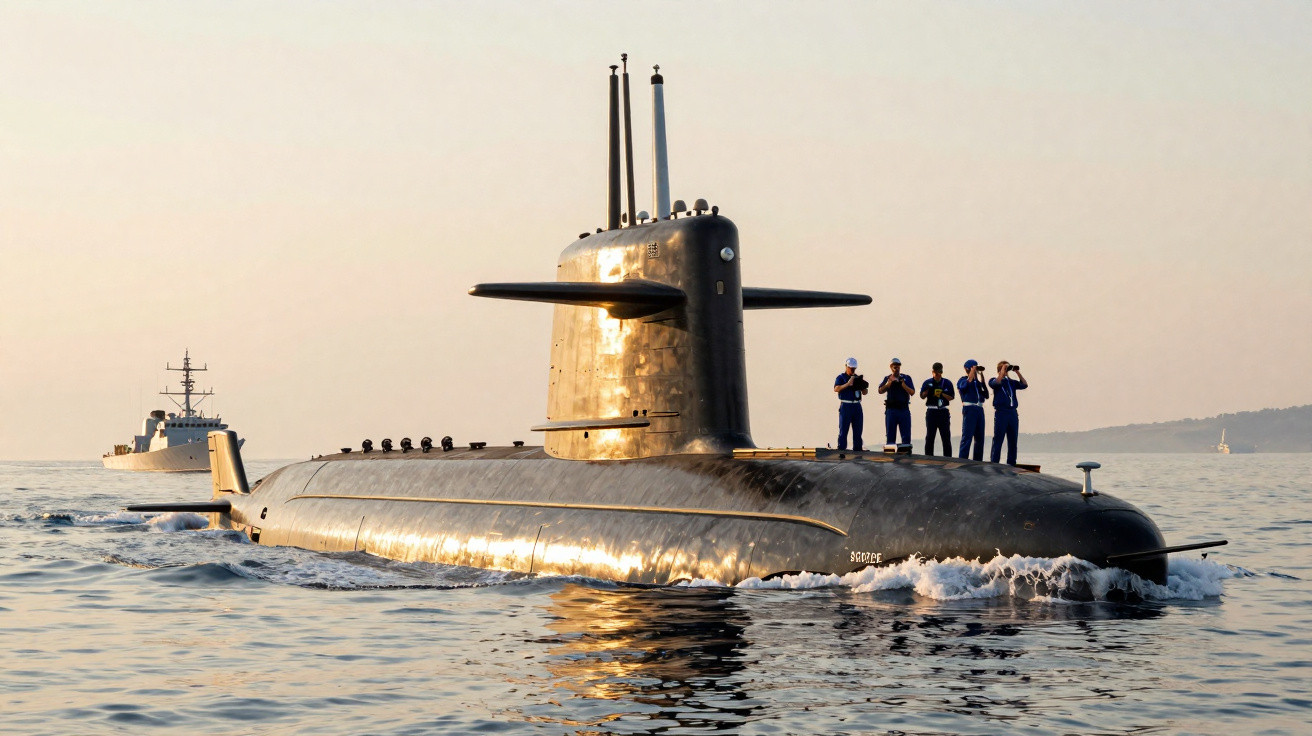
The French Navy has announced a significant new milestone in the creation of its future nuclear submarine fleet: the fourth Barracuda-class submarine has started its initial sea trials, pointing towards entry into service in the coming months. In a short statement posted on its social-media channels, the service said the event occurred on 24 February in waters off Cherbourg, involving naval personnel alongside the manufacturer Naval Group and the Directorate General of Armaments (DGA).
SSN De Grasse begins Barracuda-class submarine sea trials
While offering few further details, the French Navy stated: “Sea trials begin, the verification of technical and operational capabilities by the DGA and Naval Group with a view to its delivery to the Navy in 2026.” The activity is therefore understood to be the phase known as the “Alpha Trial,” during which the submarine must start proving the new capabilities that distinguish it from the first three Barracuda-class vessels. These include a new combat-management system, called SYCOBS, and a next-generation electronic-warfare system.
Each submarine in the class displaces approximately 4,700 tonnes on the surface and measures roughly 99 metres in length, with a diameter of 8.8 metres. They are known to be able to achieve maximum speeds of around 25 knots, enabled by a hybrid propulsion arrangement comprising a pressurised-water reactor of about 150 MW, a propulsion turbine, two electric motors and two turbo-generators. Their endurance is approximately 70 days at sea before resupply is needed.
The submarine is operated by a crew of 63 personnel, while also being able to carry commando teams of up to 15 additional personnel. Its armament will include cruise missiles, F21 heavyweight torpedoes, modernised Exocet SM39 anti-ship missiles and the ability to deploy FG-29 mines.
The name and nuclear activation of SSN De Grasse
This fourth submarine is named SSN De Grasse, in recognition of the career of François Joseph Paul de Grasse. He was a former officer who served, among other roles, as lieutenant general of the French Naval Armies. He was also Count of Grasse and Marquis of Grasse-Tilly, and is noted in military history for his role in the 1781 Battle of the Chesapeake during the American War of Independence, where he defeated a Royal Navy force.
The submarine was able to enter these first sea trials after completing the stage known as “Divergence”, during which the vessel’s reactors are brought online so that they can remain permanently active and monitored until the submarine leaves service. Personnel from TechnicAtome, responsible for designing and building its nuclear reactor, were also present during this phase. Staff from the Atomic Energy Commission (CEA) additionally supervised the process to ensure its safety.
French Navy Barracuda programme status
Following SSN De Grasse, two further submarines-SSN Rubis and SSN Casabianca-will still be required to complete the fleet planned by the French Navy, which is intended to replace the ageing Rubis-class submarine. Looking ahead, the service welcomed a report in January suggesting that it could receive the two vessels up to one year earlier than originally scheduled: in 2029 rather than 2030. SSN Suffren, Duguay-Trouin and Tourville are already in active service.
Image credits: @MarineNationale on X
You may also like: The French Navy will become the first operator of the VTOL version of Airbus’ Aliaca drone





Comments
No comments yet. Be the first to comment!
Leave a Comment