
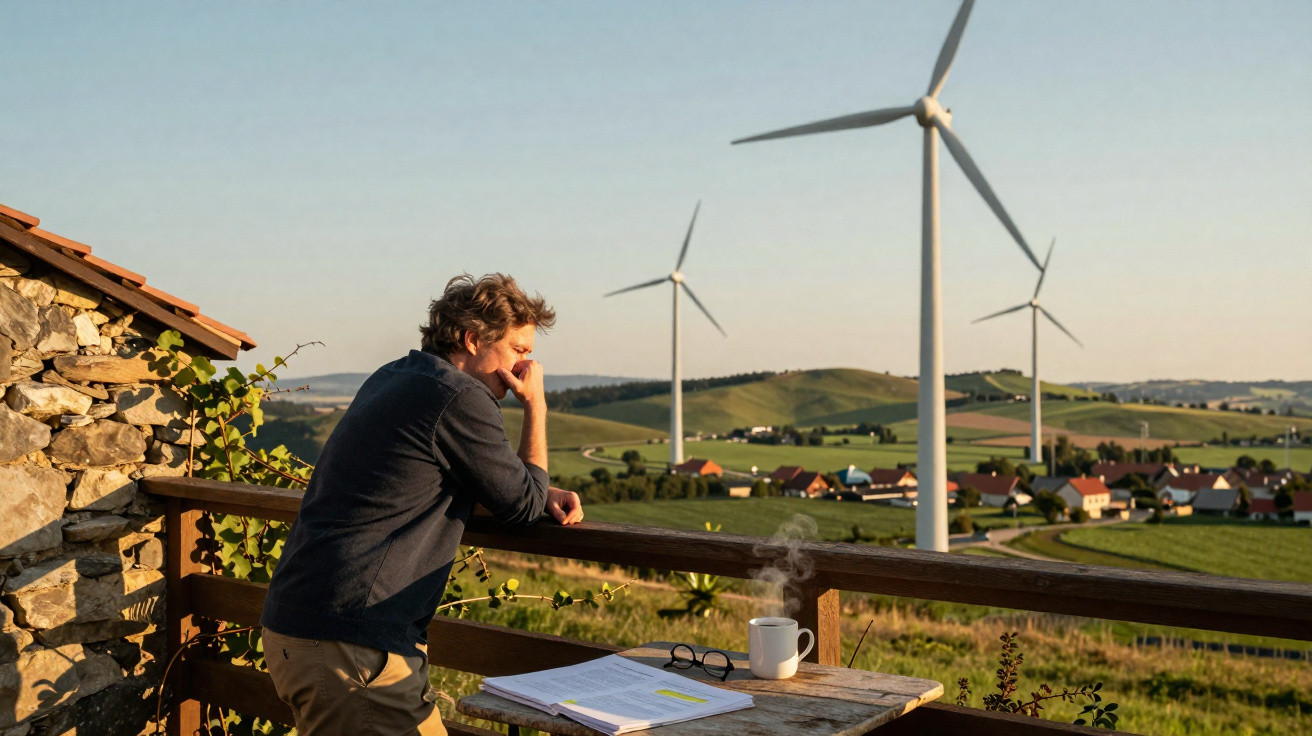
Hedges scraped against the windows, birds burst from the hawthorn and, at the road’s end, a stone cottage sat nestled among green hills. He got out, drew in the moist, rich-smelling air and thought: this was the answer. A peaceful life. No sirens, no midnight rows from the upstairs flat, no vending machines droning along the corridor.
He carried in his boxes wearing a foolish grin, stopping every few minutes to take in the horizon: sheep in one direction, a cluster of oaks in another, and distant fields traced softly across the landscape. Then he noticed them: slim white towers along the ridge, their blades turning slowly through the sky. At first, they seemed almost graceful. By day three, he could see nothing else.
Now he wants them removed. Demolished. And, all at once, the entire village has a view on the matter.
When your dream view includes spinning wind turbines
The idea of rural tranquillity is hard to shake. You imagine quiet, birdsong and a landscape that stays exactly as it is. In reality, things are usually rather less tidy. Life in the modern countryside includes tractors at 5 a.m., the smell of slurry on hot days and, increasingly, lines of wind turbines on the skyline.
For someone new to the area who has spent their savings on a picture-postcard setting, turbines can feel like an invasion. They alter more than the scenery: they disrupt the story they had imagined for themselves. The person who got away. The couple who finally escaped. When the view fails to live up to the dream, disappointment can harden into something more intense.
That is how a personal frustration turns into a community dispute. The difficult question is this: should one person’s spoiled view count for more than a community’s decision to accommodate clean energy?
Across Europe and North America, variations of this debate unfold in planning committees and local Facebook groups. Residents who once knew uninterrupted horizons now see what supporters call “wind farms” and opponents describe as “industrial landscapes”. In parts of the UK, onshore wind projects slowed considerably after years of objections centred on their visual impact.
German researchers have found that people living near turbines may initially be neutral before becoming polarised. A minority embrace them as signs of progress. An equally sized minority can come to resent them profoundly, particularly when they believe choices were imposed upon them. Between these groups is a large, mostly silent section of people who simply live alongside them and carry on.
Our new rural resident quickly joins the resentful camp. He learns that planning permission was approved years before. He discovers that objecting now is much like arguing with the weather. But knowing the paperwork was correct does not erase his feeling of being misled. Legal processes and emotions run to different timetables.
At its centre, the issue pits two things against each other that rarely fit comfortably together: individual expectations and collective requirements. Legally, the position is generally straightforward. In most jurisdictions, you do not “own” the outlook beyond your boundary. Courts may recognise nuisances such as noise, shadow flicker or safety concerns, but not distress caused by an altered skyline.
For people relocating to the countryside, however, the outlook is not incidental. It is part of what they think they bought. Estate agents promote “unspoilt vistas” while knowing that planning policy may change. When a turbine is built, buyers can feel that the product was changed after they paid for it.
Energy planners counter that expansive, open areas are precisely the right locations for turbines: there are fewer nearby residents, stronger winds and greater potential for clean electricity. Climate commitments are not theoretical in these places; they are made tangible in steel and concrete on the ridge. When one person calls for turbines to be dismantled because of their view, they are not merely disagreeing with a neighbour. They are challenging national energy policy, worldwide emissions goals and the decisions of people who lived there long before they arrived.
What can you actually do if wind turbines spoil “your” view?
Your first step should not be to call a solicitor. It should be to take notes. Before beginning a campaign, distinguish between genuine harm and straightforward disappointment. Keep a record for several weeks of the times when the turbines trouble you most. Is there a low-frequency hum after dark? Is shadow flicker reaching your windows at sunset? Or is it simply their presence in photographs taken from your garden?
Where there are specific problems - noise above authorised limits, blade shadows across windows or flashing lights absent from the planning documents - you have something measurable to pursue. Councils and regulators respond to evidence: decibel measurements, time-stamped footage and written records. A detailed pattern of disruption has much more force than a broad complaint that the countryside has been “spoiled”.
Then, quite literally, go and speak to your neighbours. Find out what they think. Some may share your worries, while others may depend on turbine income to keep their farms viable. Such a discussion will not suddenly change how you feel about the view, but it can shift the dispute from “me against them” to “how do we live with this together?”
Challenges in court against turbines that are already operating are uncommon, costly and seldom successful. Planning law normally safeguards infrastructure that has been properly approved. The point at which objections carry most weight is therefore before construction starts. This is often where the process fails: notices pinned to parish boards, technical wording that few people read, and consultations scheduled when working residents cannot attend.
Once the crane arrives, it can feel as though the opportunity has passed. Most of the time, it has. This is why the strongest way to “defend the view” begins much earlier and is rather mundane: checking planning notices, putting direct questions at local meetings, reviewing zoning maps and even searching for “scoping opinion” documents in your area. Let’s be honest: hardly anyone does that every day.
Even so, if spinning blades are already outside your window, smaller improvements may still be achievable. Operators will sometimes alter lighting, modify operating times in certain conditions or agree to plant screening vegetation with neighbouring residents. These are not dramatic triumphs. They are modest, practical arrangements that make day-to-day life more manageable while accepting that the turbines will remain.
“I thought I was buying a painting that would hang in front of my window forever,” our countryside newcomer told me. “Then someone walked into the frame and refused to leave.”
That feeling of intrusion has genuine emotional force. After a draining commute and a tiring evening, the blades may seem almost mocking. You see them and think: I worked so hard to leave the city, and the city came after me. On a windy night, their swishing can feel as though it cuts directly through your thoughts.
- Do not let resentment build up inside you. Speak early, before irritation turns into fixation.
- Go to a viewpoint where the turbines appear smaller, as a reminder that the landscape remains larger than they are.
- Consider what you really require: quiet, darkness or a feeling of control?
- Put that anger towards something concrete, such as improved planning rules, clearer property listings or local benefit programmes.
- Remember that everyone nearby has made some sacrifice too, even if it differs from the loss you feel.
A view, a village and a warming world in the background
On a clear morning, the turbines may appear unexpectedly peaceful. Birds continue to cross the valley. Tractors still labour up the lane. The cottage walls still retain warmth in winter and stay cool in summer, just as they did before any of this began. The man at the window may still flinch at the sight of the blades, but in time they may fade a little into the everyday background.
We have all experienced the moment when the life we pictured does not resemble the life we are actually living. In this case, that realisation is marked across the sky by three vast white strokes. Some will insist that nobody should have to accept such a transformation. Others will argue just as strongly that resisting it is a luxury the climate crisis can no longer support.
Somewhere between these positions lies an uncomfortable compromise: tighter planning rules, more meaningful consultation, financial benefits shared locally, truthful estate agent advertising and a more mature discussion of what “unspoilt” means in a warming world. Whether our newcomer to the countryside ever accepts his altered skyline is almost secondary. The greater question is what we, collectively, are prepared to see beyond our own windows.
| Key point | Detail | Why it matters to the reader |
|---|---|---|
| Legal rights vs. expectations | You rarely have a legal right to a fixed “view” beyond your property boundary. | Clarifies what you can realistically claim if a development changes your horizon. |
| Timing of objections | Most influence happens before turbines are built, during planning and consultation. | Shows when to get involved so your voice actually counts. |
| Living with change | Negotiation, mitigation and emotional adjustment are often more achievable than removal. | Offers practical paths forward if you already live near turbines. |
FAQ:
- Can I legally force my neighbour to remove their wind turbines? In most cases, no. If the turbines were built with valid planning permission and meet noise and safety regulations, courts are unlikely to order their removal purely for visual reasons.
- Does my property lose value if a wind farm appears nearby? Studies show mixed results. Some homes close to turbines do sell for less, especially during the construction phase, while others are barely affected. Local market conditions, distance and visibility matter more than a simple “yes or no”.
- Is there anything I can do about noise or shadow flicker? Yes, if levels exceed what was approved in planning conditions. Document when and how often it happens, then raise it with your local authority and the turbine operator. Adjustments to operation or mitigation measures are sometimes possible.
- How do I find out about planned turbines before they’re built? Check your local council’s planning portal, sign up for alerts, read parish or town council agendas, and watch for developer notices in local newspapers and on community noticeboards.
- Can a community benefit financially from nearby turbines? Many wind projects now include community benefit funds, reduced bills for nearby homes, or direct payments to local projects. It depends on the developer and the agreement negotiated at planning stage.






Comments
No comments yet. Be the first to comment!
Leave a Comment