
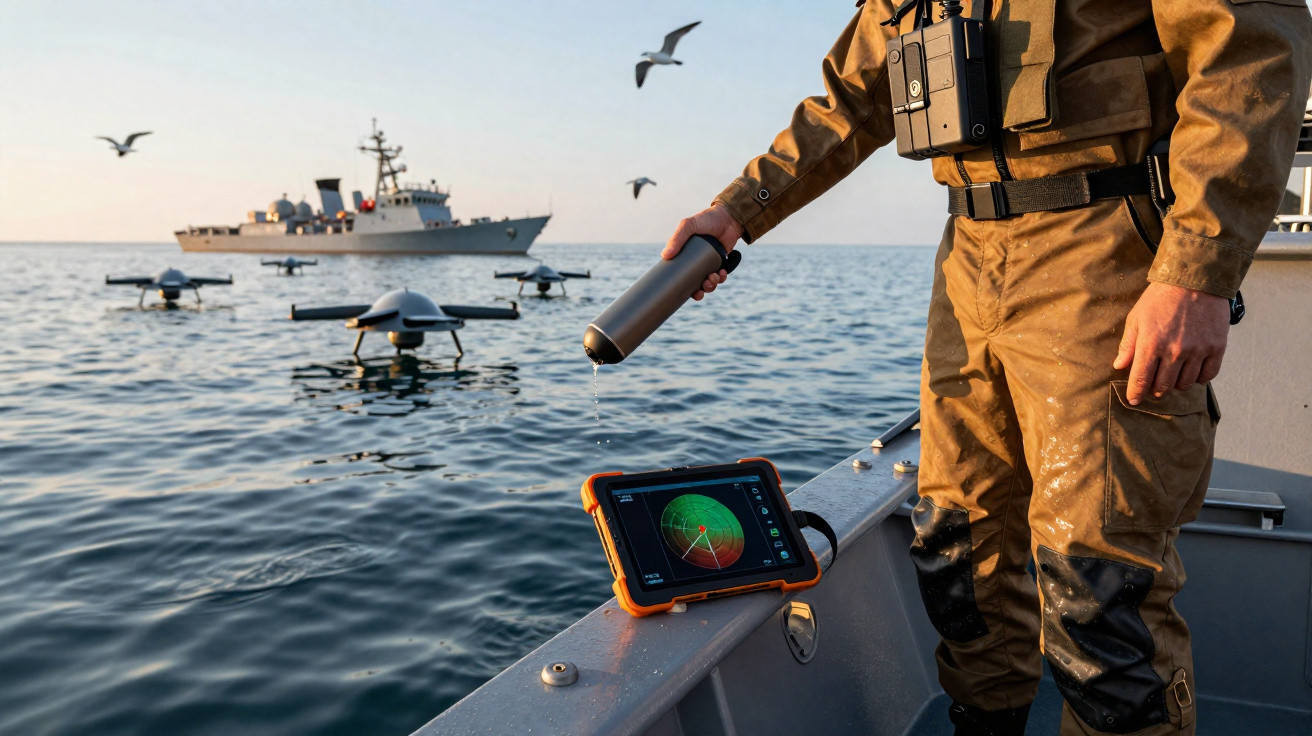
Far removed from the spectacle of aircraft carriers and hypersonic missiles, France and the UK are investing in a different form of undersea sensing capability: 76Nano, a compact, AI-driven sonar developed in just under ten months. It is now being presented as a potential benchmark for the next era of submarine warfare.
A compact sonar with major strategic ambitions
Thales, a key player in Europe’s defence sector, has achieved what officials in the industry reportedly describe as a “fast track shock” with 76Nano. The system is a reduced and updated version of the advanced Sonar 2076 suite, reworked for smaller platforms and uncrewed vessels.
Rather than being installed in the hull of a nuclear-powered attack submarine, 76Nano is sufficiently light and modular to be carried by autonomous underwater vehicles (AUVs), small patrol vessels and even intelligent buoys deployed around a maritime chokepoint.
The 76Nano is designed to give small, relatively cheap platforms the kind of underwater awareness once reserved for billion‑pound submarines.
This change could have significant implications. A navy able to deploy dozens of discreetly listening robotic systems would no longer have to depend solely on a limited number of major warships to track submarines or safeguard vital sea routes.
Thales’ 10-month sprint: an industrial shock to the system
The development timetable itself has attracted attention across defence circles. Thales states that work on 76Nano began in February 2024, produced a mature prototype by November 2024, and has moved into final testing before a public presentation scheduled for 17 December 2025.
| Milestone | Timing |
|---|---|
| Project launch | February 2024 |
| Prototype completed | November 2024 |
| Official presentation | 17 December 2025 |
| Expected operational entry | From 2026 |
Such speed is unusual in a sector more accustomed to development programmes lasting a decade or longer. Thales drew on established acoustic technologies and algorithms from its existing sonar range, before miniaturising and repackaging them for alternative platforms, thereby reducing both risk and administrative delays.
The company says that more than 7,000 employees in the UK, including roughly 4,500 engineers, have contributed to the broader sonar environment underpinning 76Nano. In France, the programme is framed politically as strengthening “undersea sovereignty”, retaining vital acoustic expertise in Europe rather than depending on American suppliers.
A new approach to stealth: listening without speaking
76Nano’s most valued feature is its capacity to listen while remaining almost acoustically undetectable itself. Conventional anti-submarine warfare often relies on active sonar, in which a vessel emits a loud “ping” before listening for the returning echo. Although this may expose a submarine, it can also disclose the hunter’s own position.
Instead, 76Nano operates mainly through passive listening. Its sensors identify minute variations in underwater sound and vibration, including propeller-blade tones and pump frequencies originating deep within a submarine hull.
The combination of low acoustic signature and advanced passive detection effectively turns the sonar into a stealthy underwater spying tool.
Thales combines the hardware with machine-learning algorithms intended to separate a diesel-electric submarine from merchant shipping, whales and ambient ocean noise. The objective is to provide early warning without alerting an opponent that it is under observation.
AI at the heart of underwater decision-making
From raw noise to an immediate threat picture
76Nano differs from older equipment in the way it processes information. Rather than transmitting a mass of raw acoustic data to operators who must assess complicated traces visually, its onboard AI processes the signal in advance.
The system measures incoming sound patterns against a continuously updated library of acoustic “signatures”. A Russian attack submarine, Chinese research vessel and NATO frigate each have distinct sonic fingerprints. Given sufficient data, the AI can identify those fingerprints in seconds.
- Noise filtering limits disruption from waves, wind and civilian maritime traffic.
- Classification algorithms indicate the vessel type considered most likely.
- Confidence scores allow human operators to assess the reliability of an alert.
- Tracking functions monitor targets over broad areas with limited human involvement.
That rapid processing is important in contested waters, where a submarine may have only a brief opportunity to decide whether it has been found and whether to alter its depth, route or mission profile.
Human control, machine assistance
Despite its substantial use of AI, naval forces are keen to emphasise that commanders remain in control. Operators may alter sensitivity settings, establish conditions for escalating an alert and compare AI findings with their own judgement and experience.
The more substantial change concerns workload: duties that previously required an entire team of sonar specialists aboard a frigate could be managed from one shore-based operations room using drones equipped with 76Nano.
Open, modular, and designed for swarming
Plug-and-play for almost any platform
The 76Nano architecture has deliberately been made open. Instead of being tied to a single hull design or a particular country, it can be “plugged” into numerous platforms: large submarines, coastal patrol boats, uncrewed underwater vehicles, uncrewed surface vessels and fixed nodes on the seabed.
Thales refers to arrays of as many as 48 receiver modules positioned along the bow and flanks of large underwater drones. This networked arrangement creates a broad acoustic aperture, strengthening the system’s ability to find and follow quiet targets at distance.
The same core sonar can sit on a French unmanned drone in the Mediterranean, a British surface ship in the North Atlantic, or a smart buoy in the Baltic.
That adaptability aligns with NATO’s move towards “distributed” maritime operations, where capabilities are dispersed among numerous smaller connected assets instead of being concentrated on a handful of high-value vessels.
French revival, British strategy
In political terms, 76Nano is being portrayed as a twofold success: a technological showcase for the Royal Navy and a sign of renewed French industrial strength beneath the sea. The system is to be presented to British officers under the “Atlantic Bastion” concept, intended to secure NATO’s North Atlantic sea routes against ever more capable Russian submarines.
Paris presents the matter somewhat differently. French officials regard sophisticated underwater acoustics as fundamental to the nation’s nuclear deterrent and intelligence stance. By playing a leading role in 76Nano, France strengthens its assertion that it is a European reference point in undersea defence, even amid tightening budgets.
The micro-sonar also offers France an additional export product alongside its submarines and frigates, aimed at countries unable to finance large fleets but still seeking to protect their exclusive economic zones from covert incursions.
Asymmetric defence on a budget
Cost is among 76Nano’s strongest attractions for medium-sized navies. Precise figures remain classified, but defence officials say that a network of uncrewed systems carrying micro-sonars is considerably cheaper than purchasing and manning additional submarines or frigates.
This makes 76Nano an “asymmetric” capability. A coastal nation with limited means could distribute a combination of seabed sensors, underwater drones and small vessels throughout its waters, all contributing to a shared undersea picture. A more powerful adversary would then have to assume that it was under surveillance, even with no major warship in sight.
By 2026, NATO planners expect micro‑sonar networks to become a central layer of undersea surveillance, sitting between satellites above and classic submarines below.
What this means in practice: a scenario in the Baltic
Consider a tense week in the Baltic Sea, with reports of unidentified underwater activity close to important gas pipelines. Instead of immediately deploying a high-value frigate, a NATO coastal state sends out several uncrewed underwater vehicles fitted with 76Nano, alongside a small number of intelligent buoys forming passive acoustic nets.
Within hours, the network starts charting noise patterns from merchant shipping routes, fishing vessels and routine naval patrols. Against that background, a weak but constant tone emerges, travelling slowly at depth and quietly. The AI identifies a probable submarine signature, checks it against known libraries and assigns a high-probability match to a foreign diesel-electric design.
Commanders could then decide whether to shadow the contact, dispatch a crewed submarine to investigate, or merely observe and record it for possible future diplomatic use. Political escalation can remain managed while the coastal state shows that its waters are not a blind spot.
Key terms behind the technology
Several technical concepts are central to the 76Nano story:
- Passive sonar: detecting underwater sounds without transmitting pulses. It is more discreet but depends on noises generated by the targets themselves.
- Active sonar: transmitting sound waves and listening for their echoes. It is highly accurate, but immediately reveals that a search is taking place.
- Acoustic signature: the distinctive mixture of sounds produced by a vessel, from engine noise to propeller cavitation. It is comparable to a fingerprint.
- Unmanned underwater vehicle (UUV): an uncrewed submarine drone operated autonomously or through remote control.
These ideas help to show why miniaturised, AI-driven sonar matters: it shifts the balance away from a small number of powerful, conspicuous assets and towards distributed, quiet sensor networks that may remain almost unnoticed until required.
Risks, limits and future questions
76Nano also carries important limitations. AI-based classification may incorrectly identify contacts, particularly in crowded coastal waters where numerous sounds overlap. False positives could generate political tension if a fishing vessel is labelled as a submarine, or the reverse occurs.
There is also a danger of escalation in the undersea “cat-and-mouse” contest. As NATO countries place advanced listening stations across important straits and seabeds, rival states are likely to answer with quieter submarines, decoy systems and cyber capabilities intended to deceive or compromise sonar networks.
For France and its allies, the calculation is that retaining a leading edge in undersea perception through projects such as 76Nano is less expensive than allowing rivals to gain an unseen advantage in the one environment where nuclear forces still operate largely out of sight.






Comments
No comments yet. Be the first to comment!
Leave a Comment