
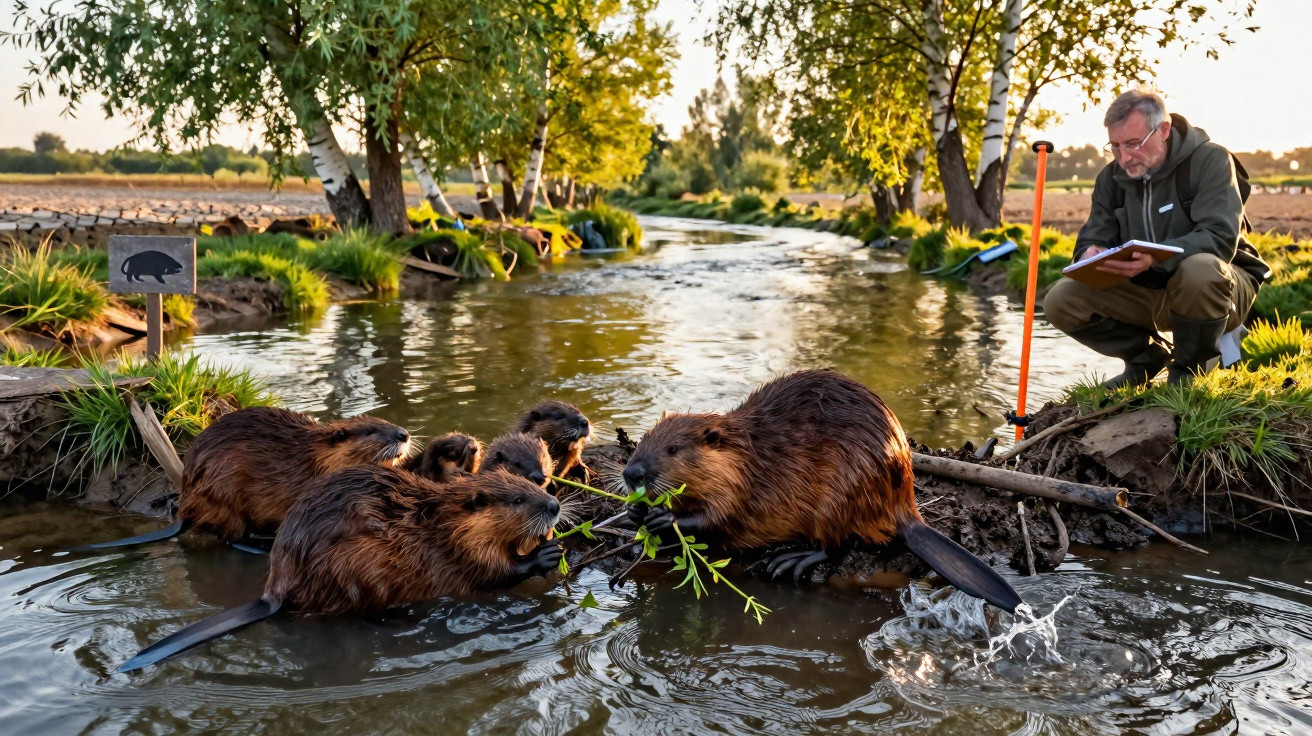
It begins with the crisp snap of teeth against willow. In the shallow water, dark forms move like small, fur-covered submarines, hauling branches twice their own length. By late morning, a muddy bank that seemed lifeless the day before is alive with activity: water curls around a newly built dam, dragonflies pause in the air, and a heron probes the fresh shallows for its meal.
Behind this peaceful picture, somewhere, sits a spreadsheet. On it, conservation teams have now logged more than 2,300 beavers reintroduced throughout Europe, from Scotland to Spain.
These animals are doing more than merely surviving.
They are reshaping rivers as it happens.
And the changes around them are arriving sooner than anyone anticipated.
When beavers return, the landscape changes
Follow a stream occupied by beavers and the shift is noticeable before it is fully visible. The soil feels damper, the air cooler, and the water no longer sounds like one uninterrupted rush but a layered, gentle babble. There are ponds, side channels and tiny flows threading through the grass. Trees lean at odd, half-cut angles, seemingly paused in mid-fall and abandoned by gravity. To anyone raised to see straight banks and freely flowing water as a tidy river, it can look untidy, even somehow wrong.
Then the frogs become apparent.
So do the birds that were absent last year.
During the past decade, NGOs and public agencies have discreetly relocated or supported more than 2,300 Eurasian beavers across Europe. Germany, the UK, the Netherlands, Belgium, Switzerland, and parts of Spain and Portugal now contain licensed releases or natural recolonisation aided by people. In the Scottish Highlands, monitoring teams saw a single experimental family on the River Tay grow into dozens of territories. In the Netherlands, biologists documented a surge in new side channels and pools across land that had been drained and straightened for decades.
At a Bavarian farm, one beaver family transformed a carefully maintained ditch into a succession of ponds that remained wet through a harsh summer. Within three seasons, local volunteers had noted the return of dragonflies, nesting kingfishers and a sharp rise in amphibian numbers. There was no concrete scheme behind it, nor a million-euro engineering programme. A handful of persistent rodents, working largely at night, made it happen.
Ecologists have good reason to describe beavers as “ecosystem engineers”. Each dam reduces the speed of water, distributes it across the land and helps it soak into the ground rather than surge downstream. That straightforward action rewrites the landscape’s entire pattern. Flood peaks fall. Summer baseflows increase. Sediment that previously choked channels downstream begins to settle in quieter ponds, creating fresh wetland soils. As standing water expands, moisture-loving plants return. Insects follow those plants. Fish gain new places to shelter. Birds come for both the insects and fish. The web becomes denser, one muddy knot at a time.
What may appear chaotic to an occasional walker is, over a longer period, the restoration of wetland processes that have long been broken.
How beavers discreetly repair deliberate human damage
A beaver’s basic “method” is almost comically straightforward. Locate running water. Fell wood. Pile up branches. Seal them with mud. Listen. When the sound of flowing water remains loud, continue building. When it quietens to a soft trickle, pause and chew. This instinctive feedback system shaped rivers long before people began channelling them with excavators and concrete. Humans pursue flood-control targets and deadlines; beavers simply respond to sound and flow, altering their structures day by day.
Technically, each dam is a modest experiment.
Conservation teams in places including Devon, England, and Flanders, Belgium, are increasingly working with this “method” rather than resisting it. They select release sites with sufficient trees, low-gradient streams and a degree of acceptance among nearby residents. Where water could rise too high and endanger roads or crops, they install flow devices - straightforward pipes passing through or around dams. Then they allow the animals to fine-tune the system. Much of the theory surrounding “rewilding” disappears when you see a beaver repairing a leak at 3 a.m. while you shiver through a monitoring shift.
The concerns and disputes are genuine. Farmers fear flooded fields, obstructed culverts and gnawed orchard trees. Anglers argue that dams could prevent fish from passing. Those living beside orderly drainage channels can recoil at the prospect of twisted, waterlogged disorder at the end of a garden. During a wet autumn in western France, one village blamed rising water on “those imported beavers”, although rainfall records indicated otherwise. We’ve all had that moment where a new thing arrives in our routine and the first instinct is to push it away.
Over the past five years, project teams have become much more candid about these tensions. Many now arrange discussions early, establish compensation arrangements and offer practical help: orchard tree guards, rapid-response teams to lower dams near homes, and open visits where neighbours can see the changes first-hand. Let’s be honest: nobody really does this every day. Most people are occupied; they encounter “nature” between emails or while doing the school run. When a person’s first experience of beavers is a flooded footpath or a chewed fence post, the narrative can turn negative very quickly.
Those narratives are gradually changing. In a central Spanish valley, a farmer who initially called for the removal of “those damned animals” now discreetly identifies the new spring-fed area where his cattle drink throughout August. Monitoring in Norway has found that salmon can, and do, pass many beaver dams, using side channels or moving through during higher flows. If dams genuinely obstruct important migration routes, they can be manually altered within minutes. The reality is less clear-cut than headlines imply.
“The beavers are doing the heavy lifting for free,” says a river restoration specialist in the Czech Republic. “We just negotiate with the neighbours.”
“We spent decades paying engineers to straighten rivers and push water away as fast as possible,” says Dutch ecologist Marijke van der Veen. “Now climate change hits, and suddenly the slow, messy, leaky system the beavers build looks like resilience. They’re not bringing back the past. They’re prototyping the kind of future landscapes we might actually survive in.”
For communities, the useful lessons are remarkably practical:
- Begin discussions with landowners well before any release takes place.
- Pair beaver projects with straightforward measures: flow devices, tree guards and modest buffer zones.
- Offer local guides and open walks so people can see dams rather than only reading about them.
- Monitor both the advantages - water storage and biodiversity - and the difficulties, such as flooded tracks, using simple and transparent data.
- Regard beavers as water-management partners, rather than mascots or pests.
What happens when 2,300 beavers become 20,000?
Nobody realistically expects the total to remain at 2,300. Beavers reproduce. Kits venture out. Territories grow. In areas of Bavaria and Poland, this spread can already be seen in satellite imagery: narrow blue stream lines becoming strings of ponds and wetlands. During hot summers, these areas appear as cool, damp marks amid grey, drought-stricken farmland. For water managers studying charts of drought and flash flooding, those marks increasingly resemble a plan.
Within this ecological tipping point lies a social one too.
As beavers extend their range, local political debate moves from “Should we have them?” to “Where do we want them most?” and “Where are they a genuine problem?” That is a fundamentally different discussion. It requires regions to consider maps and catchments rather than isolated grievances. Certain flood-prone urban areas may become intentional beaver-free corridors. Further upstream, entire headwater catchments could be allowed to become wild, with beavers as numerous as midges and converting rapid spates into slow, soaking flows. Between these extremes will be difficult negotiations, uneven pilot schemes and occasional court cases.
It will not be orderly. It seldom is when animals take on work once given to contractors.
At a human level, the beaver’s return reaches beyond water-management reports. Families stand beside new pond margins, children watching a flat tail disturb the surface, and their idea of what is “normal” moves by a few centimetres. Small towns that once saw their wetlands vanish now run weekend walks marketed as “Beaver Safaris”. Young biologists raised without local large mammals suddenly follow heavy slides through reed beds at dawn. A farmer may grumble about a flooded corner of a field while, in the same sentence, admitting that birdsong at 5 a.m. has doubled.
None of this removes the difficult realities. Calls about blocked culverts will continue. Some schemes will not succeed. Some beavers will be relocated again or, in extreme circumstances, killed. The romantic notion of a “returned animal” will meet the ordinary constraints of roads, drains and deadlines. Still, somewhere between the spreadsheets and the sound of chewing in the darkness, one quiet question continues to emerge.
How much control are we truly prepared to share with another species if it begins, quietly, to make our world more liveable?
| Key point | Detail | Why it matters to the reader |
|---|---|---|
| Beavers reshape water | Dams slow rivers, spread water sideways, and recharge groundwater | Helps explain why these animals matter for floods, drought and climate |
| Rewilding in practice | Over 2,300 beavers reintroduced in managed projects across Europe | Shows that large-scale ecological change is already under way, not merely theoretical |
| Living with conflict | Tools such as flow devices, tree guards and local dialogue reduce problems | Provides practical ideas for communities facing new or returning beaver populations |
FAQ:
Are these reintroduced beavers the same species that once lived in Europe? These projects focus on the Eurasian beaver (Castor fiber), which is native to Europe and parts of Asia. Hunting reduced many populations to tiny surviving groups, so current releases use animals from those lineages rather than North American beavers.
Do beaver dams always block fish such as salmon and trout? Research in several countries shows that many fish species can travel around or through beaver dams, particularly during higher flows. When a particular dam demonstrably blocks an important migration route, it can often be notched or partially opened by hand.
Will beavers flood my land or garden? They can increase water levels locally, especially along small streams. In sensitive locations, simple steps such as flow-control pipes through dams, small embankments or moving dams a short distance can significantly reduce unwanted flooding.
Who pays to manage conflicts involving beavers? This differs between countries. Some regions provide public funding, insurance-style arrangements or support from conservation groups for measures such as tree guards, dam management and, in rare instances, compensation for crop losses.
Can local communities take part in beaver projects? Yes. Many projects depend on volunteers for monitoring, camera trapping, dam mapping and conversations with landowners. Guided walks, school sessions and citizen-science surveys are increasingly common ways to get involved.





Comments
No comments yet. Be the first to comment!
Leave a Comment