
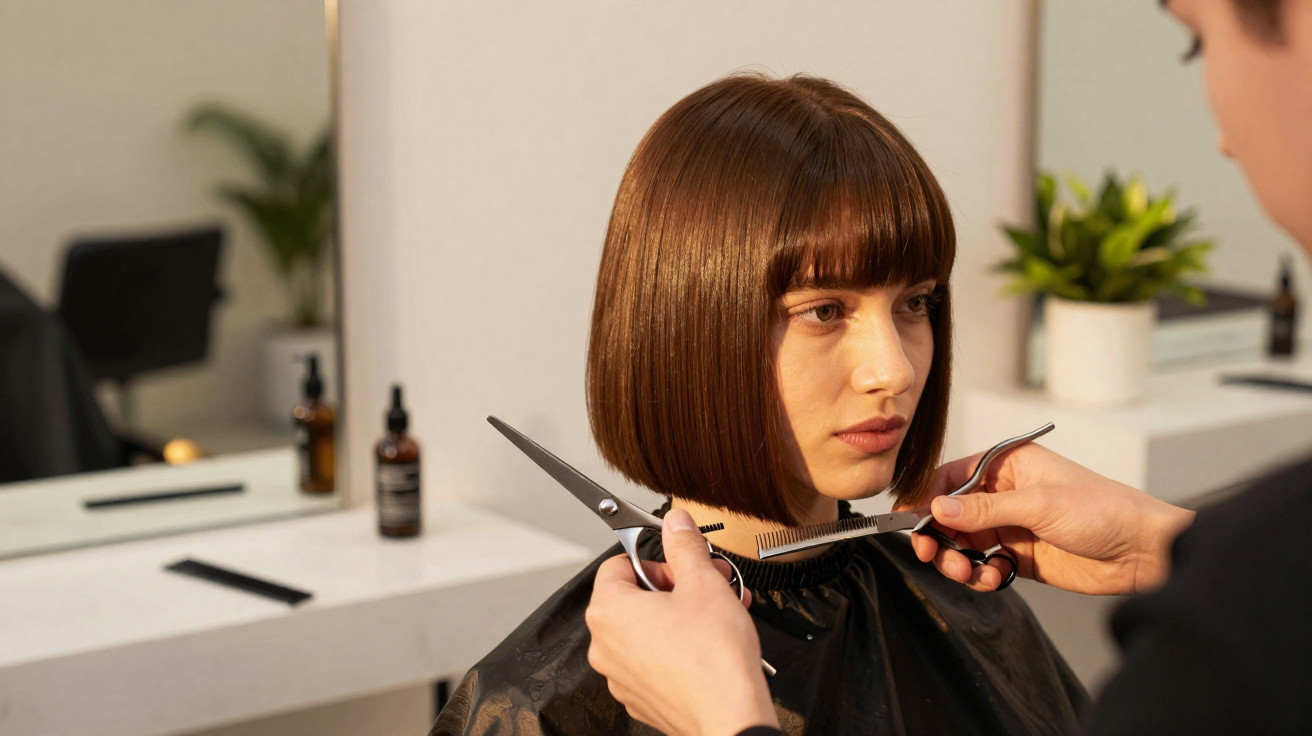
A Pinterest board fills her phone screen, packed with the same cut: the same cool, swaying silhouette. The stylist gives a quiet laugh: “You’re the fourth one today asking for this bob.” Outside, a cyclist passes by wearing precisely the same jaw-grazing shape. It is beginning to seem less like a coincidence than a low-key revolution.
Pinterest makes the pattern more obvious than any salon mirror: searches for this bob have surged by more than +85%. The cut comes with a name, an attitude and a promise - and it is poised to define 2026.
There is something about this crisp, uncomplicated line that is clearly striking a chord.
The bob that took over Pinterest: why this cut is everywhere
The style Pinterest is backing for 2026 is not simply any “bob”. It is a highly specific version: sleek, gently rounded and skimming the jaw, with its length sitting between the chin and the top of the neck. It is neither fully French-girl nor truly blunt; think of a refined “air bob”, with movement but barely any layers.
From the side, the cut forms a soft C-shape that frames the face while revealing the neck. Viewed head-on, it hangs like a curtain, occasionally with a relaxed centre parting and sometimes swept easily to one side. It appears immaculate in photographs, yet has a deliberately undone quality in everyday life. A handful of flyaways. A little bend. Those details are what make it feel current.
Pinterest trend dashboards have made this cut hard to miss. Boards titled “2026 haircut”, “new year, new hair” and “post-breakup bob” return to the same inspirations: Hailey-inspired lengths, the Korean-style air bob and British Vogue editorial crops. The platform reports +85% searches for this silhouette, particularly among women aged 20–38 preparing for “big change” moments.
Look beyond the pins and their accompanying mini-stories are strikingly alike. One user saves reference images before returning to work after maternity leave. Another is getting ready to move abroad. Someone marks the end of a long situationship with a screenshot captioned, “She’s gone, I’m cutting it.” This bob is not so much a hairstyle as a reset button.
Why this style, and why at this moment? The answer is almost ruthlessly straightforward. After years of elaborate face-framing layers, bold money pieces and long, demanding lengths, people are weary. The 2026 bob succeeds because it is short enough to feel transformative, yet long enough to tuck behind the ear or secure with a clip.
It is exceptionally photogenic, which counts in a time when every brunch finishes with a group selfie. With suitable adjustments, it suits straight, wavy and lightly curly hair. It also communicates an unmistakable visual message: “I’ve edited my life. I’ve cut what weighed me down.” In an age preoccupied with decluttering and clean lines, hair is simply following the same direction.
How to get the 2026 Pinterest bob without regretting it three weeks later
The first meaningful step towards a 2026 bob takes place before you sit in the salon chair. It happens on your phone, five minutes ahead of the appointment, as you decide which photographs to show. Choose three to five pictures that genuinely resemble your own texture and face shape, rather than only the images you wish matched them.
Study the ends closely: are they razor-sharp, very blunt or subtly softened? Check the back: is it stacked, or close to one length? In profile, note exactly where the hair meets the jaw. At the salon, be direct: “I want it here,” as you point to your collarbone or chin. The more literal your instructions are, the less scope there is for confusion.
As the stylist begins to cut, notice your reaction as the length comes away. This is often when your heart starts to beat a little faster and you question whether you have gone too far. Take a breath, lean back and allow a few more snips. Once they can see their neck again, many people find that their “perfect” length is actually one finger higher than they had expected.
One client called that moment “like deleting 400 old screenshots in my brain.” In practical terms, the 2026 bob changes your routine too: it dries more quickly, needs fewer products and alters how you use hair accessories. Those small everyday differences are part of its lasting appeal.
Maintenance has its own quiet rationale. Pinterest-style pins may appear to exist in a cloud of effortless perfection, but stylists cutting this bob all day understand what goes on behind the scenes. To maintain that precise line, you will need a trim every 6 to 8 weeks.
Let’s be honest: hardly anyone actually does that every time. Instead, ask for a cut that remains flattering as it grows out, with ends that still sit well at 8 or even 10 weeks. A light under-curve at the bottom, created with scissors rather than straighteners, enables the bob to retain its form without continual styling. That is the unseen construction behind all those “I just woke up like this” pins.
Living with the cut: styling tips, mistakes to avoid and the emotions involved
For everyday styling, the best approach for this 2026 bob is almost unexciting: rough-dry first and style afterwards. Towel-dry your hair, then blow-dry it upside down until it is around 80% dry. Turn upright, then use a flat or paddle brush to smooth the top layer, guiding the ends slightly inwards.
A pea-sized amount of lightweight cream or serum through the mid-lengths will settle frizz without removing movement. If your hair is wavy, twist two or three loose sections at the front while it remains damp, then leave them to air-dry for that gentle Pinterest curve. There is no need for a full blow-dry unless you truly enjoy doing one.
The regret people most often have with this cut is taking off too much length too quickly. On paper, jaw length sounds stylish. In the bathroom mirror, once it starts flicking out at the shoulders or reveals every inch of your neck, it may feel severe. On a human level, that is a great deal of change to make all at once.
A gentler option is to request a “test bob” that falls one or two centimetres below your eventual ideal length. Wear it for three weeks. Become accustomed to seeing your features in a different way. If you still want to go shorter afterwards, arrange the small adjustment. Over-smoothing is another common pitfall: ultra-flat, rigid bobs can date the look, making it feel less 2026 and more 2006.
One London stylist captured the idea in a memorable sentence:
“The secret of this bob isn’t the scissors, it’s the permission people feel to show their face again.”
Beneath all the discussion of lengths and volume, that is what many people are really saving: a version of themselves that appears clear, edited and unapologetic.
A few straightforward touchstones can help preserve both the style and your peace of mind:
- Schedule the cut two to three weeks before a major event, rather than the day before.
- Take one photograph you love of yourself with the new bob on a “good hair day”.
- Keep it in a dedicated album for mornings when doubt starts to creep in.
The bob as a sign of life, not merely a haircut
This bob is taking off on Pinterest because it connects with something beyond hair: the wish for a clean line in a chaotic world. The +85% increase in searches is certainly a data point, but it is also a collective chorus of small, private choices. Cut this. Keep that. Begin again here.
On a difficult day, changing your hair will not solve your life. On a good day, however, it can become a visible reminder that you are allowed to change. We have all experienced the moment when the person in the mirror no longer reflects who we feel we have become inside. The 2026 bob offers one swift, tangible response to that disconnect.
What is compelling is the way social platforms transform intensely personal acts into a shared vocabulary. One woman’s break-up bob becomes another’s “new job” cut, or an “I turned 40 and I’m done shrinking myself” cut. The silhouette remains the same, while different stories are placed over it. This is why the trend is unlikely to disappear overnight: it is connected to too many emotional impulses.
As you scroll through the pins, the underlying messages are almost visible: “I want to be seen.” “I’m ready to change something.” “I’m tired of hiding behind my hair.” That is likely the true reason this particular bob - with its direct, open outline around the face - is expected to dominate 2026.
Whether you book the appointment or simply save another pin, one question stays quietly present: what might it feel like to let something fall away and live as a lighter version of yourself?
| Key point | Detail | Why it matters to the reader |
|---|---|---|
| The shape of the 2026 bob | A short, lightly rounded bob that falls between the chin and the top of the neck | To picture the cut precisely before requesting it |
| The “reset” effect | A style associated with major life turning points and the desire for change | To understand why this trend resonates emotionally |
| A realistic routine | Trims every 6–8 weeks, straightforward drying and minimal styling | To decide whether this cut genuinely suits everyday life |
FAQ:
- Will the 2026 Pinterest bob suit a round face? Yes, provided you retain some length beneath the chin and avoid heavy, straight-across fringes; subtle layers at the front can slim and lengthen the face.
- Can I pull this bob into a ponytail or bun? You can usually create a low, messy nub or a half-up style; if tying it back is essential, ask your stylist to keep an extra centimetre or two of length.
- Is this cut high-maintenance for wavy or curly hair? It can look beautiful with waves and soft curls when it is cut for your texture, prioritising shape and weight removal over strict bluntness.
- What should I tell my hairdresser to avoid misunderstandings? Take 3–5 reference photographs, show where you want the ends to sit on your neck, and use clear phrases such as “no stacked back” or “soft ends, not razor-sharp”.
- How do I know if I won’t regret going shorter? Begin with a slightly longer “test bob”, live with it for a few weeks and only then decide whether to move to the sharper, jaw-skimming version.





Comments
No comments yet. Be the first to comment!
Leave a Comment