
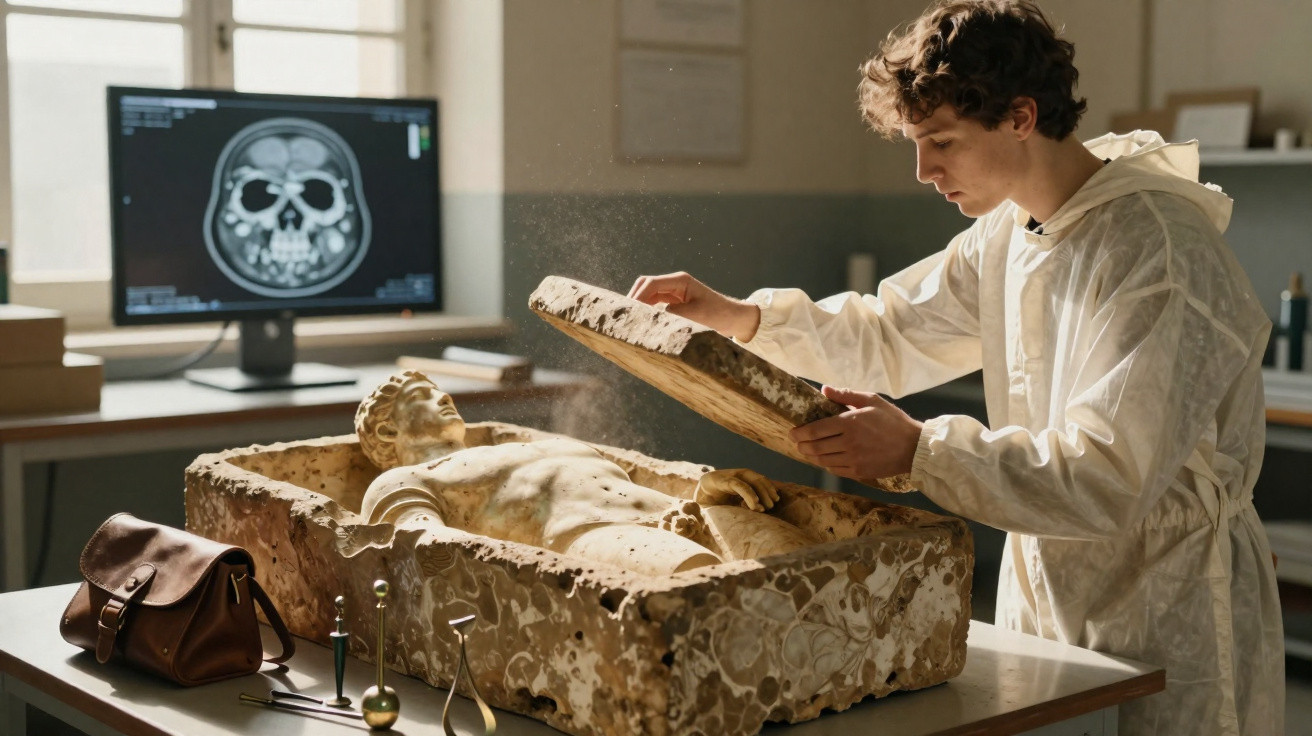
More than sixty years after excavations at the so-called Garden of the Fugitives in Pompeii, the city destroyed by the eruption of Vesuvius in AD 79, researchers have identified the occupation of one of the victims: a doctor who had been carrying a number of tools.
A doctor among the Garden of the Fugitives victims
The discovery followed an examination of a small box concealed inside the plaster cast of a human body unearthed during investigations directed by Amedeo Maiuri in 1961, according to a statement issued by the Pompeii Archaeological Park on Friday.
The area, subsequently named the Garden of the Fugitives and then occupied by a vineyard, yielded plaster casts of fourteen people.
These individuals are thought to have been caught in the pyroclastic flow as they made a desperate attempt to escape.
Medical tools found inside the small box
The finding became possible through fresh research into the small box, which had remained unexamined until now.
Made from organic material and incorporating metal components, it was discovered beside a fabric pouch containing bronze and silver coins, along with a set of items consistent with a medical kit.
X-ray examinations and computed tomography scans identified a small slate tablet within the box, used to prepare medicinal or cosmetic substances, as well as small metal objects interpreted as surgical instruments.
"These elements support the hypothesis that the victim was a doctor, providing a valuable and rare clue to his profession," archaeology specialists explained.
Advanced imaging reveals the box’s mechanism
The use of advanced diagnostic technology, including computed tomography assisted by artificial intelligence and 3D reconstructions, made it possible to examine the cast’s contents without compromising its integrity.
"This approach opens up new perspectives for studying the Pompeii casts and has revealed previously unknown details of the box’s refined mechanical structure, which features a sophisticated locking system with a toothed wheel," the statement said.
"This man took his tools with him so that, thanks to his profession, he would be prepared to rebuild his life elsewhere, but perhaps also to help others. We dedicate this small but significant discovery to all the women and men who still practise this profession today with a strong sense of responsibility and service to the community," said Gabriel Zuchtriegel, director of the archaeological park.






Comments
No comments yet. Be the first to comment!
Leave a Comment