
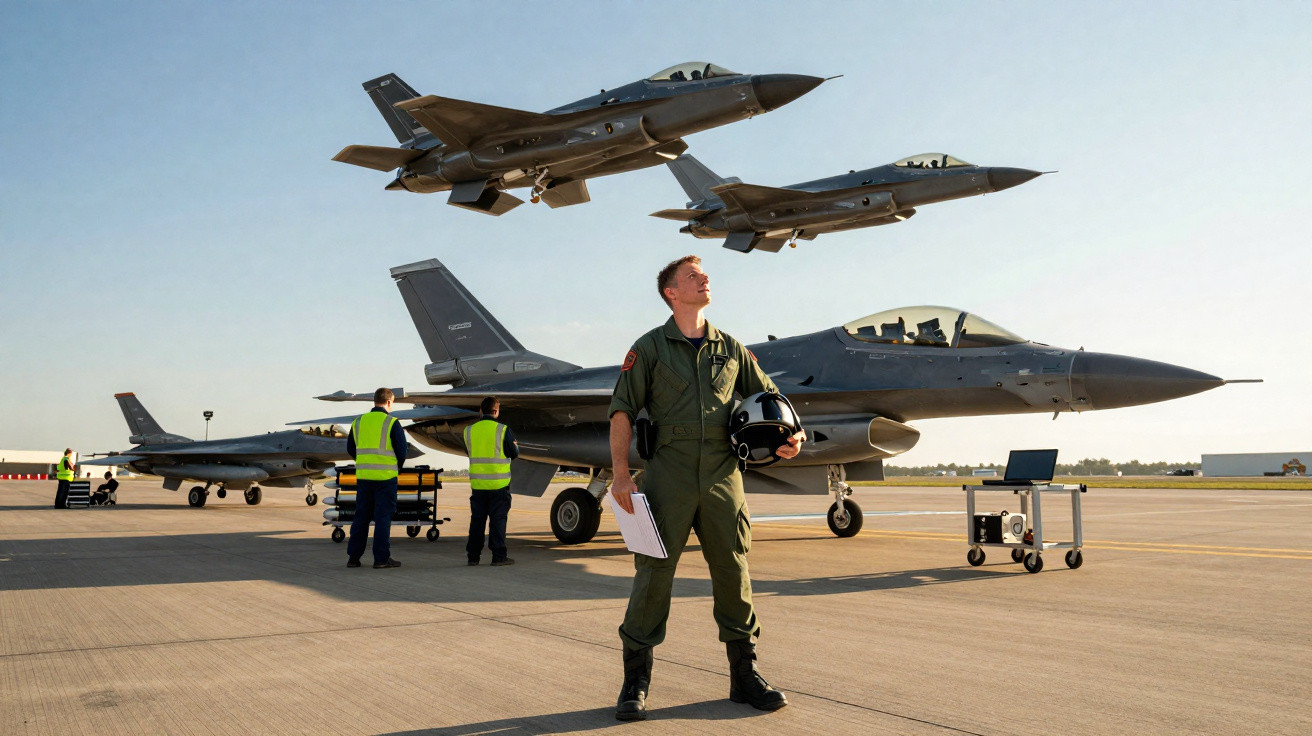
F-16 Fighting Falcon fighters from Holloman Air Force Base and F-35A Lightning II aircraft from Luke Air Force Base have launched a week-long programme of joint training exercises intended to enhance interoperability between the U.S. Air Force’s (USAF) fourth- and fifth-generation platforms.
F-16 Fighting Falcon and F-35A Lightning II joint training
These manoeuvres are intended to sharpen the USAF’s capacity to plan and conduct complex combat operations in forward-deployed settings. Airmen from a range of specialisms are participating, coordinating the planning, generation and execution of missions that mirror genuine operational requirements.
Training centres on bringing together aircraft with differing technological strengths. The F-35A offers advanced sensors and data-fusion capabilities, enabling threats to be identified, tracked and shared in real time. The F-16s, meanwhile, provide flexibility and versatility as multirole aircraft. Combining the two systems is intended to improve information exchange and tactical coordination in contested environments.
“This type of joint training is critical,” said Colonel John Ethridge, commander of the 49th Wing at Holloman Air Force Base. “It ensures that our airmen can operate together seamlessly, regardless of the aircraft or home base, and adapt quickly to mission requirements anywhere in the world.”
Brigadier General David Berkland, from the 56th Fighter Wing command, stressed the value of this early form of integration: “Mastering fighter integration now, during the training phase, prepares our pilots for greater lethality when they deploy.”
Ground crews and mission generation
Successful air operations also rely on coordinated activity on the ground. Maintenance personnel from both bases work together to keep the aircraft ready for missions, completing inspections, repairs and sortie-generation work to demanding schedules. Weapons teams also equip the aircraft with the required munitions, ensuring every sortie can be carried out at full capability.
Pilots flying both platforms highlighted the benefits of joint training, saying that such missions foster trust, communication and a shared understanding of each aircraft’s role in a combat situation. The experience is equally important for command-and-control teams, which must coordinate airspace, logistics and operational schedules across several units.
Readiness for operational deployment
By operating as an integrated force in training, airmen strengthen capabilities that can be applied directly to real-world missions, where rapid deployment, integration with other units and sustained combat power in complex environments are vital.
“This is how we maintain readiness,” Berkland concluded. “We build ready teams through realistic, integrated, disciplined training, prepared to act wherever airpower is required.”
Images sourced from DVIDS /
You may be interested in: *Lockheed Martin aims to reach an annual production of 400 THAAD ballistic missile interceptors for the U.S. Army*


Comments
No comments yet. Be the first to comment!
Leave a Comment