
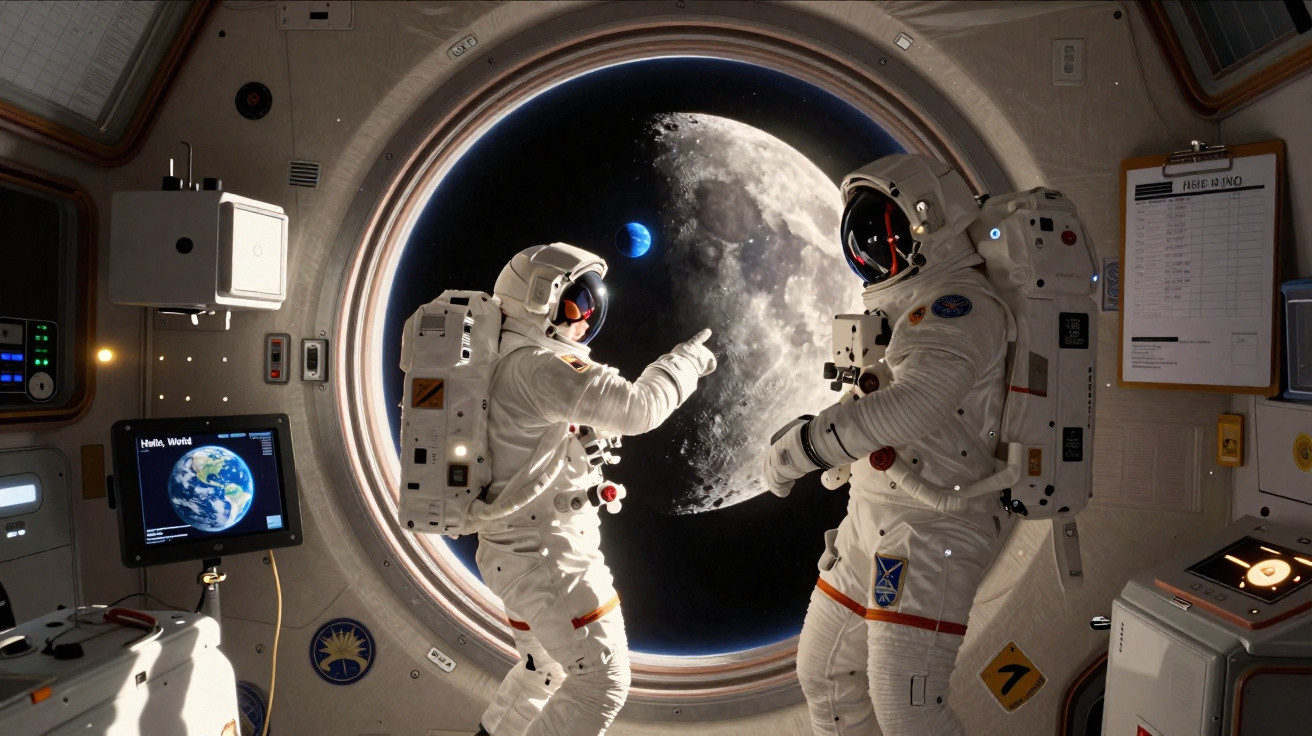
The Artemis II mission has now taken people farther from Earth than humans have ever travelled before.
At 17:56 UTC on Monday 6 April 2026, the Orion spacecraft Integrity, with its four astronauts aboard, exceeded the 400,171 kilometres (248,655 miles) milestone established by Apollo 13 in 1970.
Artemis II sets a new human distance record
NASA reports that the mission attained its greatest distance from Earth at 23:02 UTC, reaching 406,771 kilometres while travelling beyond the Moon’s far side. This placed the spacecraft 6,616 kilometres beyond the Apollo 13 record.
By comparison, the Moon lies around 384,400 kilometres from Earth on average, so Orion travelled tens of thousands of kilometres farther out.
"As we surpass the furthest distance humans have ever traveled from planet Earth, we do so in honoring the extraordinary efforts and feats of our predecessors in human space exploration," Canadian Space Agency mission specialist Jeremy Hansen said in a statement.
"We will continue our journey even further into space before Mother Earth succeeds in pulling us back to everything that we hold dear. But we most importantly choose this moment to challenge this generation and the next to make sure this record is not long-lived."
While the spacecraft passed behind the Moon, its signal was obstructed by the lunar body, cutting contact with Earth for roughly 40 minutes.
At 23:24 UTC, Integrity reappeared and its crew witnessed a view that very few people have had the privilege of seeing directly: Earth rising above the Moon’s limb.
Contact has been restored with the vehicle and its four astronauts: mission commander Reid Wiseman, pilot Victor Glover, and mission specialists Christina Koch and Jeremy Hansen.
NASA states that every system is nominal, an engineering expression meaning that they are functioning within anticipated parameters.
Orion Integrity tests systems for lunar return
Although the achievement is remarkable and inspiring, Integrity has much more at stake. As the first crewed flight in the Artemis programme, Artemis II marks a vital stage in the effort to return people to the lunar surface and provides an essential test of the systems intended to transport and support astronauts throughout the journey.
It is also the first human deep-space mission since the Apollo programme ended in 1972. The flight will allow mission planners to assess how this kind of journey affects a crew required to live and work together in confined accommodation far from home.
To date, the crew has needed to show adaptability when confronting several unexpectedly ordinary problems, among them Outlook troubleshooting and toilet issues.
Yet alongside the everyday challenges have come extraordinary moments. Passing behind the lunar far side, Integrity brought the astronauts within 6,545 kilometres of the Moon’s surface.
During their flyby, the astronauts could make out craters on the lunar surface and suggested names for two of them. They propose naming one after Integrity, the Orion spacecraft carrying them, and the other after Wiseman’s late wife, Carroll. The proposed names will be put before the International Astronomical Union for consideration.
The crew has also watched a solar eclipse, as the Moon moved between Integrity and the Sun.
Naturally, there is also the new iconic Earth image, "Hello, World", photographed by Wiseman on 3 April as the spacecraft travelled away from the planet after a translunar injection burn.
It is the first image of the full planet as a complete sphere captured by a human since Apollo.
Artemis III and Artemis IV missions ahead
The programme’s next phase, Artemis III, is currently planned for 2027. It will operate nearer to Earth, sending a crew in the Orion spacecraft aboard the SLS rocket into low Earth orbit to test rendezvous and docking procedures with commercial spacecraft designed for future lunar landing operations.
Artemis IV, the fourth phase, is presently aimed at early 2028. NASA says it is intended to attempt a crewed landing near the Moon’s south pole, where astronauts would undertake scientific observations and gather samples.
Before that, however, Integrity must return its crew safely to Earth. This is arguably the mission’s riskiest part: a high-speed re-entry followed by a Pacific Ocean splashdown off the San Diego coast, slowed by parachutes released in two stages. It is expected to happen on 10 April.
"At NASA, we dare to reach higher, explore farther, and achieve the impossible. That's embodied perfectly by our Artemis II astronauts – Reid, Victor, Christina, and Jeremy. They are charting new frontiers for all humanity," says Lori Glaze, acting associate administrator for Exploration Systems Development Mission Directorate at NASA.
"Their dedication is about more than breaking records – it's fueling our hope for a bold future."




Comments
No comments yet. Be the first to comment!
Leave a Comment