
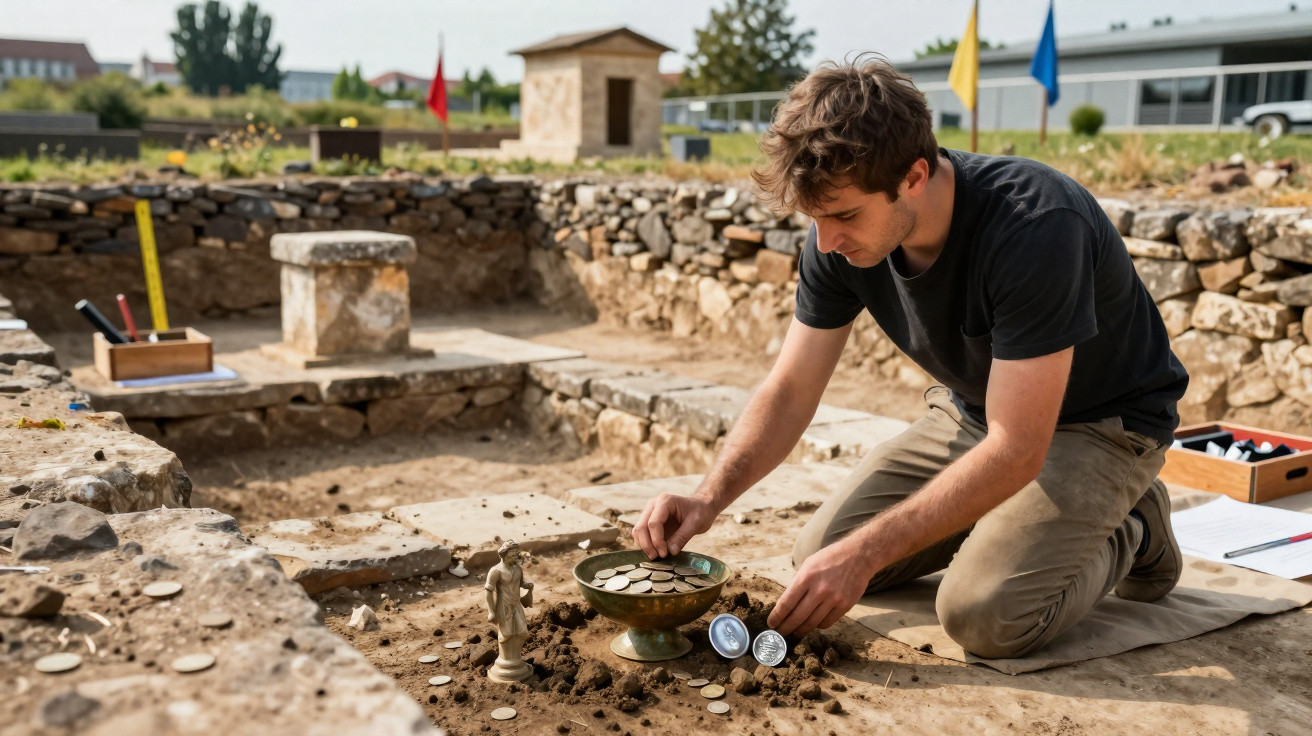
Researchers say a Roman sanctuary discovered beneath a school site in Frankfurt, Germany, has revealed temples, ritual pits, evidence of feasting and a human skeleton inside a well.
Together, these finds recast the Roman centre of the city as a sacred district whose final period appears far more unusual than previously thought.
Roman sanctuary buried in Germany
Excavators uncovered a walled sanctuary beneath Frankfurt, Germany’s new Römerstadtschule, positioned in the centre of the ancient settlement.
Archaeologist Markus Scholz of Goethe University Frankfurt says that, when assessed together, the walls, pits and offerings indicate that the complex occupied the location where a forum had long been anticipated.
The Roman surface level remained almost undisturbed, allowing the buildings, pits and refilled wells to retain a single, interlinked sequence of events.
This exceptional continuity strengthens the argument that the activities at the site were not simply part of normal urban life.
Buildings without parallels
Within the enclosure were 11 stone structures, built in several phases and arranged in a configuration unmatched elsewhere in neighbouring Roman provinces.
Over 5,000 pieces of painted plaster, together with bronze fittings, indicate that certain rooms were vividly decorated rather than plain functional spaces.
“In most Roman cities, the urban center was defined by a forum. Nida presents a striking exception,” said Prof. Dr. Markus Scholz, archaeologist and historian of the Roman provinces at Goethe University Frankfurt.
If temples, rather than a market square, formed the focus of the city centre, public religion may have structured everyday life in a direct way.
Where offerings landed
Roughly 70 shafts and ten pits were cut into the area, with each containing varying combinations of pottery, ash, bones and earth.
Archaeologists describe these deliberately filled features as depositions: intentional placements associated with worship or events marking closure.
Fish bones, bird remains, plant evidence and smashed vessels point to meals being consumed nearby before portions were placed into the pits.
This arrangement makes apparent food waste evidence of interaction with deities, while also bringing the more difficult question of sacrifice into view.
Coins and clasps
A 2025 study of 65 brooches from the sanctuary used these clothing fasteners to investigate recurring ritual practices.
Together with 254 coins, the brooches probably represented individual offerings, as people frequently gave up prized possessions in places where they sought divine notice.
Several remained unbroken, an important detail because discarded damaged objects and gifts placed deliberately may have very different meanings.
Examining the location of every item enables researchers to assess whether worshippers preferred particular structures, pits or stages in the sanctuary’s history.
The hardest clue
A bronze figure of Diana, a dedication dated 9 September 246, and a human skeleton were found in one well.
Coins from its fill indicate that the well remained in use until at least 249, dating the remains to the sanctuary’s later years.
Although Roman religion did involve sacrifice, direct indications of human victims in this region are sufficiently uncommon to require caution.
Nevertheless, the presence together of a body, a goddess and dated offerings means the well cannot be dismissed as an ordinary rubbish deposit.
Many gods together
Images and inscriptions indicate that several Greek gods were honoured at the sanctuary.
Rather than being dedicated to a single cult, the complex seems to have accommodated several divine patrons within the same civic centre.
“The complex likely functioned as the spiritual heart of the settlement and may even have served a wider regional role,” Scholz said.
Such variety may explain why soldiers, merchants, residents and travellers could have deposited distinct types of offering.
A frontier capital
Roman Nida started as a military base in the 70s before developing into a thriving civilian capital. During the second and third centuries, it became the political, economic and religious hub of a wider area.
Its cultural diversity was significant because frontier settlements brought together soldiers, traders, migrants and local households with differing religious practices.
In a city of this sort, placing temples at its core made religion public infrastructure, not mere background ornament.
Another signal nearby
A silver inscription from Nida’s cemetery, dated between 230 and 260 AD, is the earliest Christian text found north of the Alps.
The amulet demonstrates that the city supported markedly different sacred traditions in its final generations rather than one neat religious identity.
While one discovery uses Christian language, the sanctuary communicates through bones, pits, paint, metal and silence.
Viewed together, the evidence makes late Roman Frankfurt appear less orderly and considerably more densely filled with belief.
What the samples say
Researchers have so far gathered 150 samples of animal and plant material, since food remains can record decisions that people never documented in writing.
Charred seeds may identify crops or imports, whereas bones can show which animals were chosen, consumed or deposited intact.
Five early-career scholars will contribute to the three-year project, providing the sanctuary with the specialist scrutiny needed to link spaces, meals and offerings.
When these strands of evidence are brought together, it should be possible to distinguish routine debris from ritual actions with far greater certainty.
Lessons from this Roman sanctuary
The importance of the sanctuary lies not in proving one sensational account, but in preserving the layered ways in which a frontier city practised religion.
As further material emerges, Nida could reveal how Roman worship brought people together, set them apart and was deliberately ended.




Comments
No comments yet. Be the first to comment!
Leave a Comment