
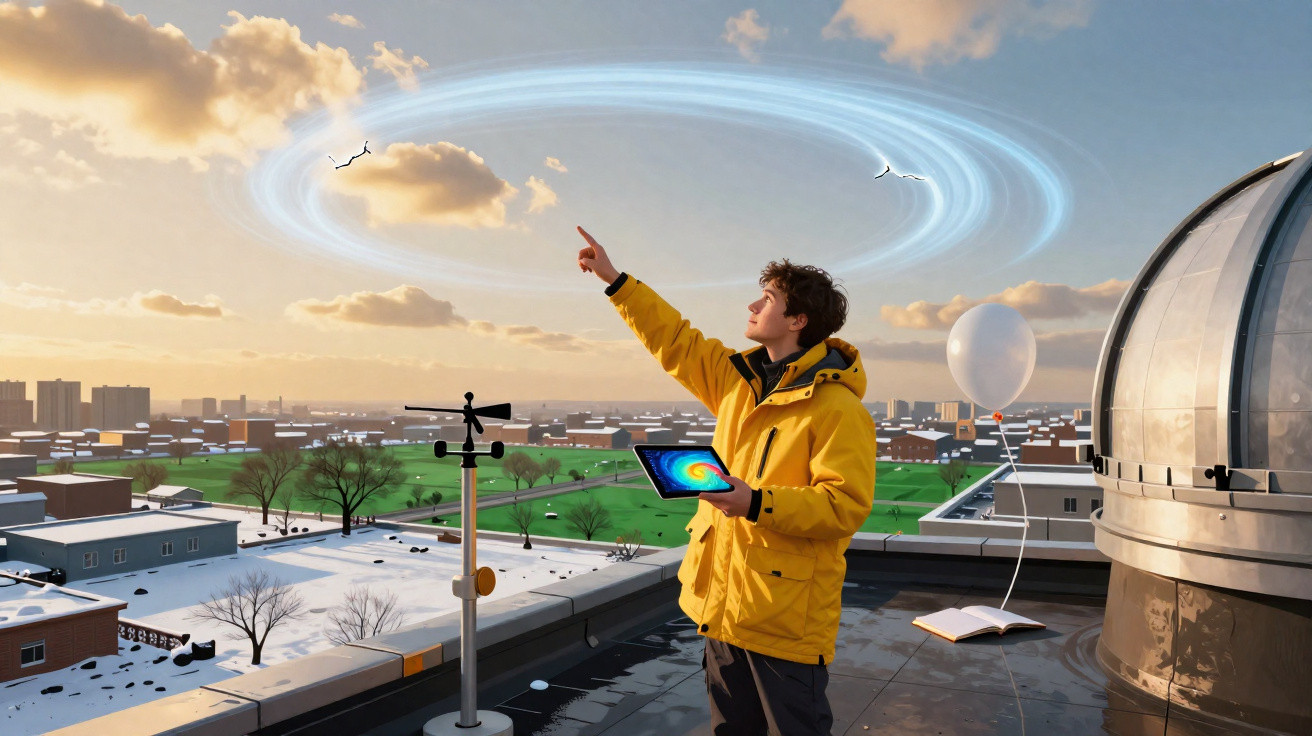
The earliest warning did not arrive with a cinematic blizzard. It appeared instead as an unremarkable chart on a researcher's laptop in Boulder, Colorado. Curves that normally rose and fell with the seasons were beginning to droop and level out. An experienced atmospheric scientist moved closer to the screen, magnified the data and rang a colleague before removing his headphones. The display suggested that the winter winds circling the Arctic - the stratospheric framework of the polar vortex - were no longer following their usual pattern.
The roads outside were dry and quiet. Indoors, however, projections for future winters had abruptly become more complicated, unusual and uncertain. A circulation system that helps steady weather across whole hemispheres appeared to be wavering.
Not the sort of wavering that remains neatly confined to the pole.
When the sky's “invisible fence” begins to weaken
When atmospheric researchers explain winter, snow is rarely their starting point. Instead, they point to an unseen current of wind rotating around the poles far above commercial aircraft, holding frigid air in place like an invisible barrier. This system - the polar vortex and its linked polar circulation - will not appear on a weather app. Nevertheless, it has a quiet influence on whether January brings mild drizzle or fierce Arctic air.
That barrier is now showing troubling signs of strain. Winds expected to remain powerful and steady are fluctuating and decelerating. Pressure systems are shifting away from their familiar winter routes. To scientists studying the atmosphere in Europe, North America and Asia, the implication is similar: the polar circulation is behaving less like a stabilising anchor and more like a roulette wheel.
Across maps of the Northern Hemisphere, the years ahead increasingly resemble a contest between stability and disorder. One recent modelling study concluded that stratospheric polar vortex disruptions could triple the likelihood of extreme cold outbreaks in certain mid-latitude areas, despite continuing global warming. Meanwhile, some locations could remain beneath persistent warm domes, experiencing unusually snow-free winters.
Most of us recognise the experience of a local forecast switching from record warmth to sharp cold within days. To researchers, that kind of abrupt change is more than an inconvenience: it signals a wider system becoming unbalanced. As the polar circulation weakens, the familiar “normal winter” remembered by grandparents becomes less a dependable pattern and more a nostalgic account.
What, then, is actually breaking down? The polar circulation can be understood as a machine made up of layers. In the stratosphere, strong westerly winds rotate around the Arctic and Antarctic. Closer to the surface, the jet stream loops around continents under the influence of that higher-level structure. As greenhouse gases retain additional heat, the Arctic is warming around four times faster than the global average. This reduces the temperature difference between the poles and the equator, weakening the energy source behind those circling winds.
As that contrast declines, circulation can decelerate, bend or split into uneven sections. Waves rising from lower levels - produced by mountains, storms and contrasts between land and sea - can strike the vortex with greater force, damaging it from within. What used to be a resilient spinning top is starting to look more like a wobbly plate on a stick.
How researchers monitor an unseen polar vortex “collapse”
Atmospheric researchers follow this invisible process through vertical atmospheric profiles. They measure wind speeds at 10 hPa over 60°N, examine geopotential-height anomalies and compare decades of reanalysis data with current satellite observations. A central, almost habitual task is straightforward: set today's profile against the long-term winter average, then compare it with major disruption years such as 2009, 2013 or the severe 2020 event.
When the plotted data begin to resemble earlier failures - with weaker winds, rapid warming above the pole and reversed flow - alerts start circulating. They do not take the form of flashing warning lamps, but emerge in Slack discussions, 3 a.m. emails and rapidly revised preprints. The scientific description may be “major sudden stratospheric warming”. In everyday terms, the spine of the polar circulation has temporarily snapped.
For those outside atmospheric science, this may seem remote and theoretical. Yet the errors made when interpreting these warnings are very familiar. We often assume last winter provides a blueprint for the next, become attached to local expectations - “it always snows here by December”, “our winters are usually mild” - and take it personally when the atmosphere does not comply.
Realistically, few people study seasonal outlooks line by line before arranging a ski holiday or buying heating oil. For farmers deciding on winter crops, councils setting snow-clearance budgets and grid operators preparing for peaks in demand, however, subtle signs of a weakened polar vortex are far from academic. They can determine whether there is time to adapt or whether communities are caught unprepared.
At laboratory meetings and conferences, scientists use measured language, although the unease beneath it is clear. During a virtual workshop last year, one European researcher stated it plainly:
“If the polar circulation keeps trending this way, we’re not just talking about a rough winter or two. We’re talking about a background state where winter becomes structurally less predictable for entire hemispheres.”
Around that observation, researchers are quietly outlining the information readers need most.
- Signals: Decelerating stratospheric winds, increasingly frequent vortex disruptions and rising polar temperatures.
- Impacts: Greater chances of severe cold snaps, long-lasting warm spells and disturbed storm tracks.
- What you can do: Use reliable seasonal outlooks, urge local authorities to improve resilience, and vary the ways your home is heated, cooled and powered.
This is not a simple narrative of heroes and villains. It is a gradual change in winter's underlying physics, entering daily life in ways that do not fit tidy headlines.
What an unstable winter climate means for everyone else
Picture a mild January afternoon in a city park, with children playing football over muddy ground where snow once lay for months, and the scale of the shift becomes unexpectedly personal. Somewhere tens of kilometres overhead, the polar circulation that once kept winter within a partly reliable rhythm is fraying. In some years, this may mean strangely warm holidays, bare ski slopes and allergy seasons that never fully end. In others, it may arrive as abrupt ice storms, electricity grids under extreme pressure and emergency departments overwhelmed by cold-related injuries.
The most difficult aspect is that this is not a story about one winter. It is a gradual alteration of the climate's architecture, a slow “redecoration” of the atmosphere that repeatedly changes what we consider normal. People exchange stories of tulips flowering too soon, burst pipes in areas that rarely froze before, and flights diverted around unusual bends in the jet stream. No individual anecdote proves a polar circulation collapse. Taken together, they suggest a society gradually recognising that its seasons no longer run to the old timetable.
| Key point | Detail | Value for the reader |
|---|---|---|
| Polar circulation is weakening | The Arctic is warming faster than the globe, reducing the temperature contrast that drives powerful circumpolar winds | Explains why winters can feel less stable and more vulnerable to extremes |
| Weather patterns become more erratic | A disrupted vortex and jet stream may bring severe cold snaps to some regions and persistent winter warmth to others | Provides context for confusing local weather and helps set expectations for future winters |
| Preparation beats prediction | Seasonal outlooks, varied energy sources and pressure on authorities to improve resilience can reduce vulnerability | Converts a distant atmospheric change into practical action for households and communities |
FAQ:
- Is the polar vortex “collapsing” right now? Not as one single dramatic episode, but researchers are observing concerning trends: slower average winds, more regular disruptions and polar warming that weakens the circulation's stability.
- Does weaker polar circulation mean every winter will be colder? No. Winters continue to warm globally. The change is in the pattern: some places could experience sharper cold snaps, while others have unusually mild winters with little snow.
- Can it explain the strange flip-flop weather at home? It is an important part of the picture. A disturbed jet stream associated with changes in polar circulation can produce rapid switches from warm to cold, or dry to stormy, in only a few days.
- Is human-driven climate change definitely responsible? Most evidence indicates a strong connection between Arctic amplification - caused chiefly by greenhouse gas emissions - and a less stable polar circulation, although researchers continue to debate certain details.
- What can ordinary people realistically do about something this huge? There are two routes: reduce emissions where possible and advocate systemic change, while adapting locally through better home insulation, backup heating or cooling options and closer attention to seasonal risk forecasts.



Comments
No comments yet. Be the first to comment!
Leave a Comment