
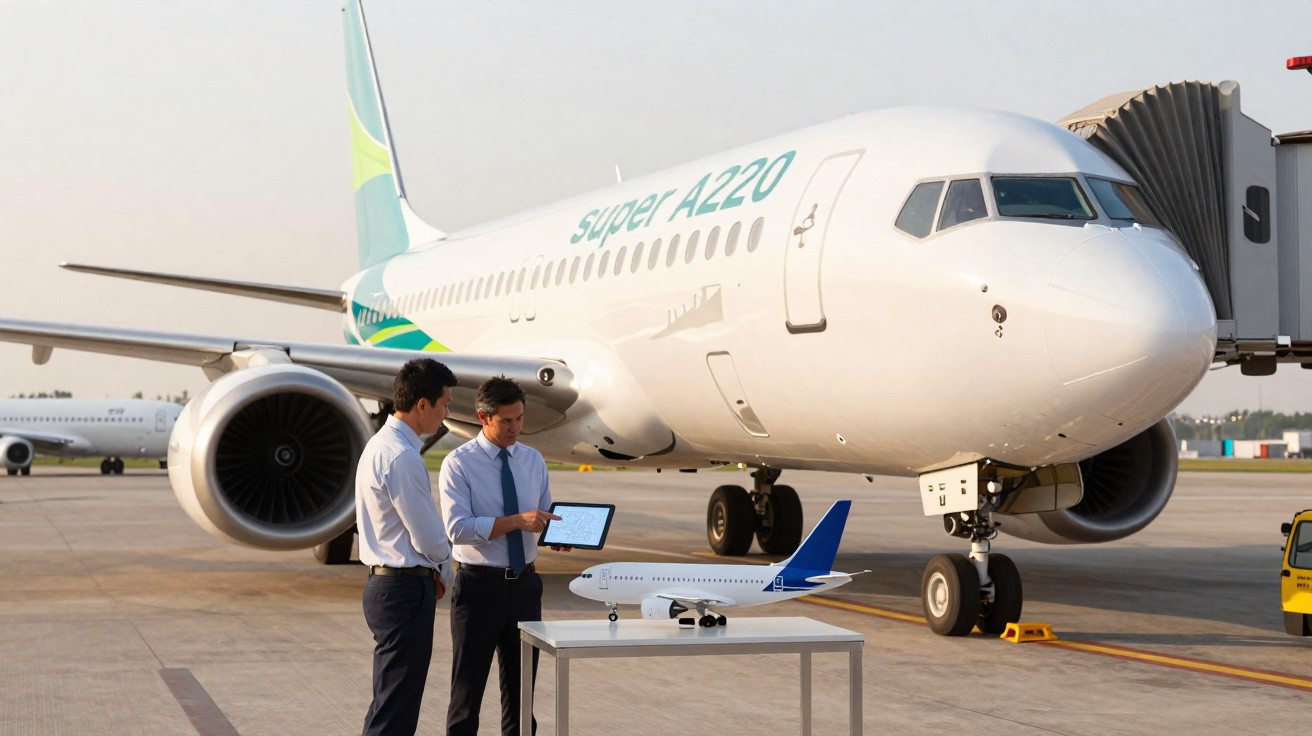
Airbus is considering a major stretch of its smallest jet, a step that could subtly reshape the most profitable part of short-haul aviation.
The European aircraft manufacturer is canvassing airlines about an extended “A220-500” – a potential super A220 targeted directly at the 150–180-seat segment that underpins profitability for carriers worldwide.
The discreet emergence of a “super A220”
For several months, clues have emerged from Toulouse and Montreal. There has been no launch and no formal approval, but the message has been consistent: Airbus is examining a bigger member of the A220 family, formerly called the Bombardier CSeries.
The A220-300 currently accommodates approximately 130–150 passengers, while the A320neo above it is generally fitted with 150–180 seats. Several airlines regard the space between those aircraft as a difficult gap that is not ideally covered.
Unfilled space between the current A220-300 and the A320neo could be where Airbus makes its next big move.
The mooted A220-500 would lengthen the current fuselage and provide space for about 150–180 passengers. For airlines, this capacity range is especially valuable, suiting frequent domestic services as well as heavily travelled European and Asian trunk routes.
Its appeal would extend beyond additional seating rows. A stretched A220 could still be lighter than an A320, thanks to its modern, carbon-heavy structure, economical geared turbofan engines and a cabin that already receives strong passenger ratings.
Why several tonnes can make such a difference
The economics of commercial aviation leave little room for error. Each additional tonne of aircraft weight brings greater fuel consumption, increased airport fees and narrower operating margins at hot-and-high airports or from short runways.
The A220 has established a reputation for economical fuel use and low cabin noise. Operators including Swiss, airBaltic and Delta have reported robust in-service results, financially as well as operationally.
On many routes, shaving just a few percent off trip cost can turn a marginal route into a money‑maker.
An A220 stretch optimised for 150–180 seats could provide:
- A lower operating weight than an A320neo over comparable distances
- Per-seat fuel consumption below that of many existing single-aisle aircraft
- Cabin comfort more akin to a widebody than a conventional 737
- Sufficient range for most European, US domestic and intra-Asian operations
Much of the required technology has already been demonstrated. The airframe is in operation, the engines are flying, and airlines are familiar with the cockpit and maintenance procedures. Airbus is therefore asking not “can we build it?” but “can we build it fast enough without breaking everything else?”
From a Canadian gamble to an Airbus cornerstone
Bombardier’s ambitious project gets a new home
The A220’s origins lie with Bombardier in Canada, where it began as the CSeries: an ambitious effort to surpass ageing regional jets and challenge the lower end of the Airbus and Boeing product ranges. The CS100 first flew in 2013, followed by the larger CS300 in 2015, with Swiss becoming the launch operator in 2016.
The programme subsequently encountered serious turbulence. Costs rose sharply, while a US trade dispute put access to a vital market at risk. Bombardier sought a partner, and Airbus entered in 2017 by acquiring a 50.01% stake.
In 2018, the CSeries was renamed the A220-100 and A220-300. Airbus established a second final assembly line in Mobile, Alabama, in addition to the Canadian facility in Mirabel, near Montreal. Airbus acquired Bombardier’s remaining holding in 2020, leaving the Quebec government as the minority partner.
What began as a risky bet for Bombardier has turned into a strategic bridgehead for Airbus in the lower single‑aisle market.
An industrial challenge as well as a product choice
Production lines are already under pressure
Lengthening the A220 may appear simple on paper. In practice, however, the project would affect almost every part of Airbus’s industrial system.
A220 output is still increasing in Mirabel and Mobile, while the A320neo family continues to be Airbus’s main cash generator, producing more than 600 deliveries annually. In 2025, Airbus delivered 793 commercial aircraft, comprising 93 A220s and 607 A320-family jets. Its order backlog exceeds 8,700 aircraft.
Introducing a larger A220 would require:
- New tooling and jigs for the extended fuselage sections
- Increased capacity at both final assembly locations
- Additional strain on an already overstretched supplier network
- Engineering resources redirected from other upgrades and clean-sheet concepts
Airbus executives understand that a single mistake can have consequences for years. Delayed components or excessively optimistic production ramp-up plans could create delays and penalties across several programmes, rather than only the A220.
A gradual squeeze on Boeing’s 737
The fight for the 150–180-seat sweet spot
A familiar competitor sits behind the calculations. Boeing controls much of the 150–180-seat market through the 737-8, the central model in its 737 MAX family. Many airlines depend on aircraft in this category for most of their domestic and short-haul operations.
Airbus already leads the overall single-aisle market through the A320neo, A321neo and long-range A321XLR. Positioning a lighter, highly efficient A220-500 beneath the A320neo would offer airlines another Airbus choice in a segment Boeing protects fiercely.
If Airbus can offer two attractive choices in Boeing’s core size band, it narrows the room for the 737 MAX to stand out.
This would not be a dramatic, headline-making knockout blow. Instead, it resembles gradual encirclement: covering every lucrative niche with a purpose-built Airbus product, making it harder for airlines considering Boeing to defend that choice to shareholders.
Timing: the unseen factor
For the time being, Airbus remains cautious. Its executives are consulting airlines, evaluating industrial capacity and monitoring engine manufacturers, which are dealing with reliability and maintenance issues of their own.
The present environment is favourable. The A220 has reached operational maturity and its performance figures align with the brochures. Airlines want more seats, yet remain reluctant to move up to aircraft requiring larger crews, more fuel and higher airport charges.
A decision to launch within the next year or two could allow entry into service towards the end of the decade, depending on how extensively Airbus modifies the structure and systems. A more cautious stretch would be quicker and less expensive, whereas a more ambitious redesign could improve economics but introduce greater risk.
Another large aircraft on the drawing board: the A350-2000
The A220-500 is not the sole project being discussed within Airbus. Analysts say that the manufacturer is also assessing an A350-2000, a longer-range, higher-capacity derivative of the A350-1000 intended to seat roughly 440–460 passengers.
That aircraft would compete with Boeing’s future 777-10 and would directly pursue airlines such as Emirates, which seek greater capacity on dense long-haul routes. Early concepts mention a 5–6-metre fuselage extension, strengthened landing gear and an uprated Rolls-Royce Trent XWB engine variant.
The strategy would follow the same logic as the A220 project: develop an existing platform rather than begin anew, spreading development expenditure and avoiding another financial episode like the A380.
How the A220-500 could fit into the Airbus range
Airbus already offers an extensive aircraft catalogue. A “super A220” would fill a highly defined space between existing models:
| Size band | Current Airbus options | Potential A220-500 role |
|---|---|---|
| 120–150 seats | A220-100 / A220-300 / A319neo | Not involved |
| 150–180 seats | A320neo | Lower-weight alternative with strong efficiency on short and medium routes |
| 180–220 seats | A321neo / A321XLR | Feeds traffic upward into larger single-aisles |
| 220+ seats | A330neo / A350 family | Not involved |
For airlines, this breadth of choice creates more opportunities to match capacity accurately with demand, instead of operating larger aircraft half-empty or refusing passengers on oversold services.
What it could mean for passengers and ticket prices
Should the A220-500 proceed, travellers may barely notice its type designation at the door, although they could experience certain differences. Cabins might feature wider seats than some 737 configurations, larger windows, reduced cabin noise and improved humidity.
Economically, lower per-seat costs would give airlines more scope to operate thinner routes throughout the year rather than only during peak periods. This generally supports additional frequencies, improved timetables and, in competitive markets, pressure to restrain fares.
Some terminology, explained
Two terms repeatedly appear in this discussion: “single-aisle” and “backlog”.
Single-aisle jets have one central cabin aisle and normally accommodate 100–240 passengers. They operate most worldwide flights lasting under six hours and serve as the mainstay of domestic and regional airline networks.
Backlog is the total number of ordered aircraft that have not yet been delivered. Airbus’s backlog of more than 8,700 aircraft represents many years of committed production. It provides revenue visibility, but also makes every new programme decision sensitive because disruption can spread through thousands of deliveries.
Scenario: how an airline could deploy a super A220
Consider a European airline operating three daily services from a secondary hub to several major cities using 150-seat aircraft that are frequently full. A super A220 could add 20–30 seats while keeping trip costs close to current levels.
On busier days, those extra seats could accommodate demand without adding a fourth daily service or changing to a heavier aircraft. On quieter days, the lighter structure could still keep unit costs sufficiently low to prevent substantial losses. Across a full year, that flexibility could shift a network plan from “barely adequate” to reliably profitable.
This sort of understated calculation, repeated across dozens of airlines and thousands of routes, may ultimately determine whether Airbus pulls the trigger on the next A220 family stretch.




Comments
No comments yet. Be the first to comment!
Leave a Comment