
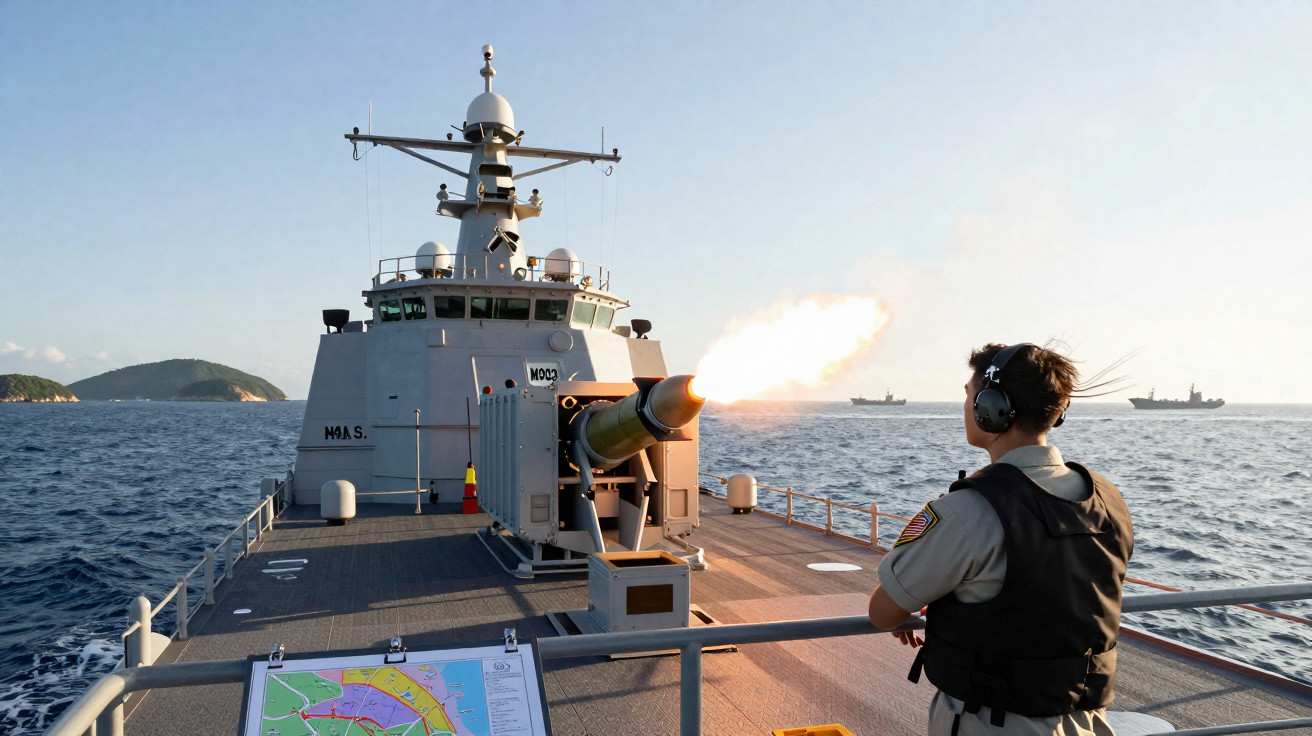
Patriot missile defence on the USS Montgomery
The United States, particularly the US Navy, has been testing an idea that until recently seemed more suited to a laboratory than a ship: placing land-based missile-defence systems aboard light vessels in a rapid, modular and “expeditionary” manner. In August 2025, Lockheed Martin carried out a demonstration integrating an M903 Patriot launcher onto USS Montgomery (LCS 8), an Independence-class Littoral Combat Ship, to showcase air and missile-defence concepts that can be deployed on demand in high-threat scenarios.
The military significance of the trial went beyond simply placing a Patriot system on a vessel. It demonstrated an operational model in which high-speed platforms can shift between operating areas and serve as mobile defence nodes, particularly in theatres where missile and drone threats require forces to be dispersed. In the configuration shown, the M903 launcher was loaded with PAC-3 MSE missiles, the interceptor the United States has been deploying against highly complex threats within the Patriot family and which the US Navy is also assessing for integration into its naval ecosystem.
Modular launchers and distributed naval defence
The US Navy demonstration involving the Patriot system is not an isolated development. It is linked to the earlier deployment of the Mk 70 Payload Delivery System, a containerised launcher from Lockheed Martin that adapts Mk 41 VLS technology - used on destroyers and cruisers - into a transportable, relocatable format. In practical terms, this approach makes it possible to add high-performance, long-range missile-defence capabilities to platforms that did not originally possess them, expanding options for long-range air defence, missile defence and even precision strike, depending on the munition integrated.
In the Indo-Pacific, where China relies on saturating defences through wave attacks, modularity could become a force multiplier. The aim is not merely to possess interceptors, but to increase the number of firing points, complicate adversary planning and rapidly move capabilities so that they are not destroyed in the first strike. For that reason, the current deployment of the PAC-3 system within the Typhon concept seeks to create a situation in which a potential saturation attack can be countered even while under fire from ballistic and hypersonic missiles. Along these lines, the United States is pursuing Pacific defence through a multi-layered approach: multiple systems, multiple munitions and multiple possible locations.
Rapidly deployable air and missile defence in the Pacific
The latest USS Montgomery test also highlighted a shift in thinking: integrating “what is already available” rather than waiting for future platforms. In combat terms, this is a direct response to an environment in which ballistic missiles, hypersonic delivery systems and drones demand shorter development cycles and solutions that can be deployed quickly, with straightforward logistics and controlled costs. Although these remain demonstrations and assessment campaigns, the appearance of an embarked Patriot and a “containerised” VLS on light ships indicates the direction of the American effort: missile defence that is more distributed, adaptable and harder to overwhelm.
Given the apparent benefits offered by this defensive arrangement - optimising capabilities by enabling a ballistic-missile defence system to be fitted to platforms that were not originally designed to carry it - the United States appears set to continue deploying these systems in the Pacific. This would establish a defensive line for strategic assets encompassing multiple platforms and multiple munitions.
You may also be interested in: The United States accelerates the development of multi-domain defences with low-cost munitions to counter drones and missiles in the Indo-Pacific




Comments
No comments yet. Be the first to comment!
Leave a Comment