
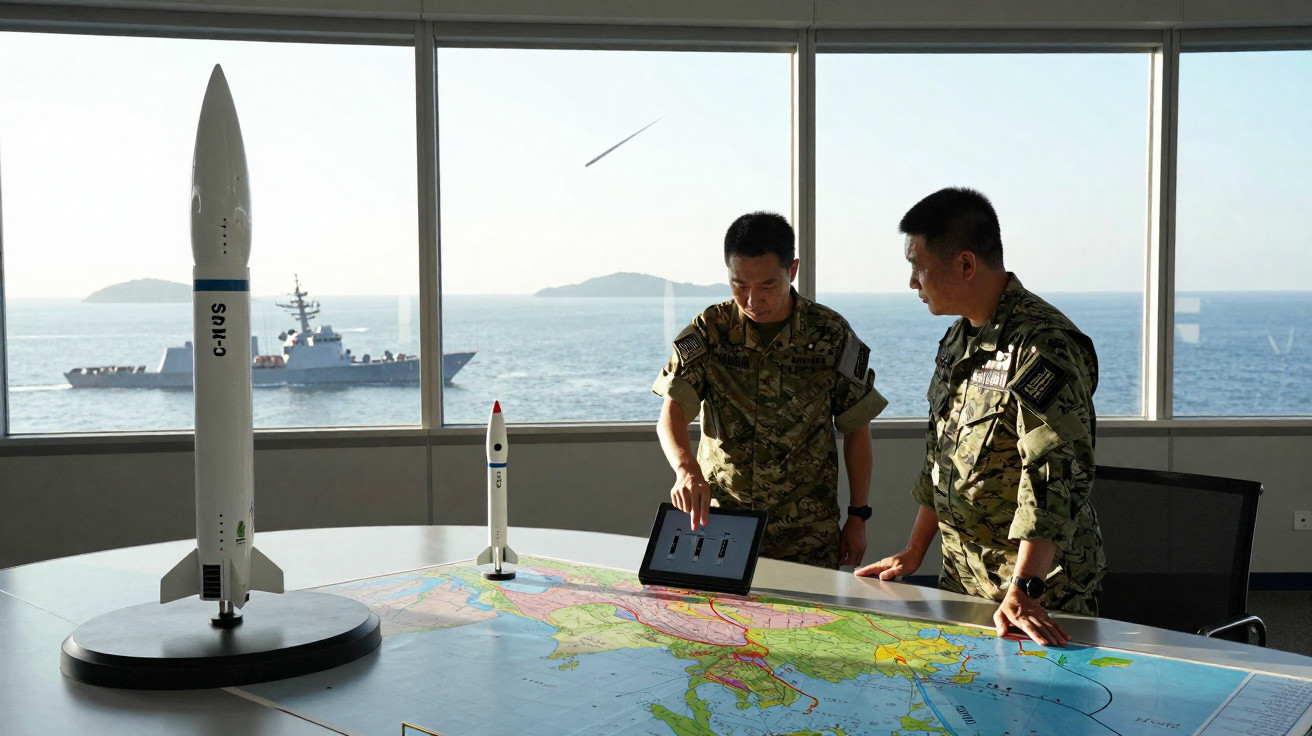
The United States and Japan have recently agreed to quadruple production of the SM-3 IIA, the most advanced anti-aircraft missile carried by their destroyers, as part of a joint strategy to strengthen deterrence in the Asia-Pacific region. The decision was included in the final document issued by the White House following the bilateral summit, which also underscored the importance of security in the Taiwan Strait.
The official text stated that Japanese Prime Minister Sanae Takaichi and US President Donald Trump agreed that “peace and stability across the Taiwan Strait are indispensable to regional security and global prosperity”. Both sides also voiced their “opposition to any unilateral attempt to change the status quo through force or intimidation”, reaffirming their shared position in the face of potential tensions in the area.
Taiwan Strait security in the US-Japan agreement
The inclusion of Taiwan in the final document represents a shift from earlier meetings, when the matter was addressed more cautiously. At a previous meeting in Tokyo in October, the United States avoided issuing an explicit statement on Taiwan amid diplomatic preparations involving China. On this occasion, however, Japan pushed for the issue to return to the joint agenda.
SM-3 Block IIA production and defence co-operation
Militarily, the agreement to increase SM-3 Block IIA output is one of the central pillars of bilateral co-operation. Jointly developed by the two countries, this ballistic missile interceptor is intended to counter short- and medium-range threats. Its manufacturing model divides industrial responsibilities, with Japan producing key components and the United States handling final integration and manufacture.
The SM-3 Block IIA belongs to a broader group of defence co-operation programmes between the two countries, including the Patriot Advanced Capability-3 (PAC-3) system, which is currently in serial production. Other notable programmes include the Advanced Medium-Range Air-to-Air Missile (AMRAAM) and the hypersonic Glide Phase Interceptor (GPI), the latter still under joint development.
AMRAAM capacity and Typhon deployment in Japan
According to the Kyodo news agency, the talks also covered Japan’s possible role in strengthening AMRAAM production capabilities. In addition, both parties confirmed the first deployment of the Typhon intermediate-range missile launch system on Japanese territory. Its use was tested during the joint “Resolute Dragon” exercise at the US base in Iwakuni in September last year.
The SM-3 Block IIA programme had already reached earlier milestones, including its first successful test in November 2022 during joint exercises off Hawaii, where the Japan Maritime Self-Defense Force validated its operational capability. More recently, in February 2026, Raytheon signed agreements with the US Department of War to expand missile production, including SM-3 missiles, as part of an industrial expansion intended to meet rising global demand for precision-guided weapons.
Images for illustrative purposes.



Comments
No comments yet. Be the first to comment!
Leave a Comment