
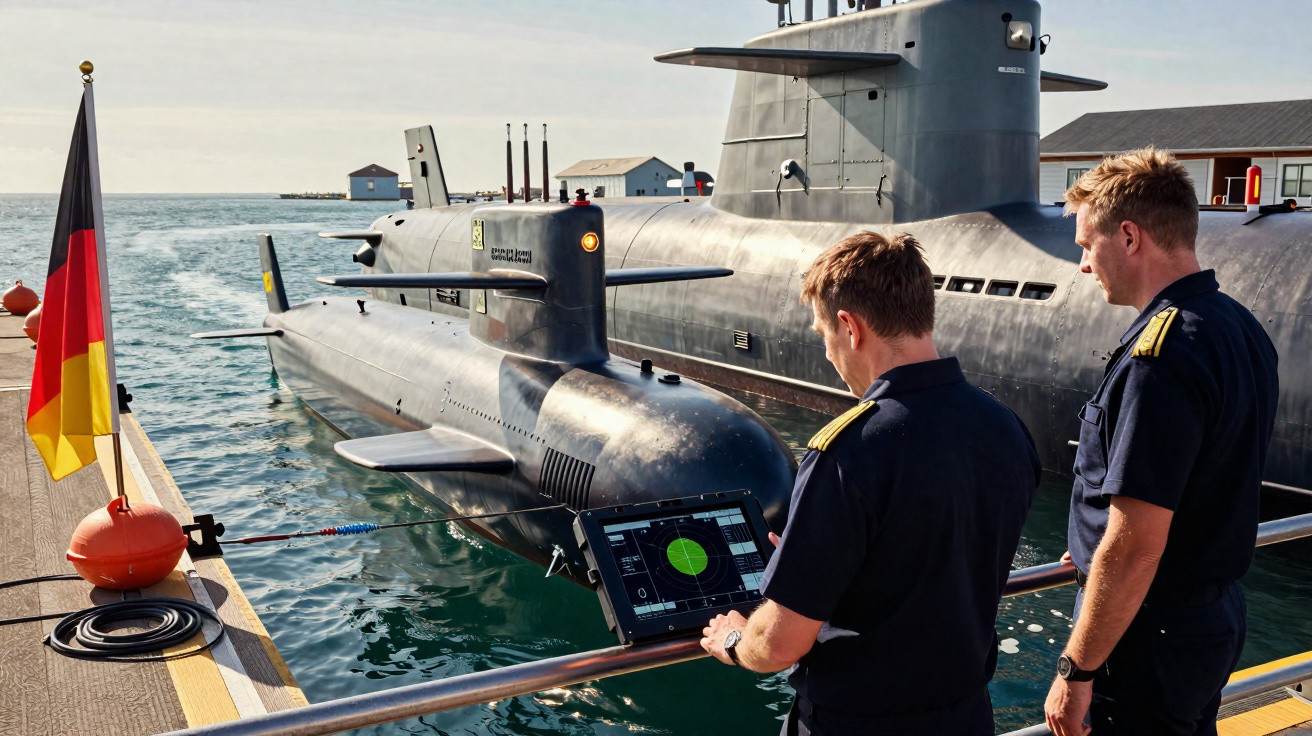
German Navy receives its first Blue Whale unmanned submarines
On Wednesday 25 February, the German Navy announced in a statement that it had received its first Israeli-made Blue Whale unmanned submarines during an official ceremony held in Eckernförde on 25 February 2026. The arrival of the Blue Whale Large Unmanned Underwater Vehicle represents a significant step in modernising the German naval force’s capabilities and integrating autonomous platforms into its operational structure.
The event was attended by Jens Plötner, State Secretary at the Federal Ministry of Defence; Michael Ozegowski, Chief Executive of TKMS ThyssenKrupp Marine Systems ATLAS Elektronik; and Boaz Levy, President and Chief Executive of Israel Aerospace Industries (IAI) ELTA Ltd. Blue Whale is currently the largest unmanned underwater vehicle acquired by the German Navy. Built for long-range reconnaissance missions, it measures 10.9 metres in length, has a diameter of 1.12 metres and weighs approximately 5.5 tonnes.
Blue Whale trials and accelerated acquisition
The system emerged from a partnership between Germany’s TKMS ThyssenKrupp Marine Systems ATLAS Elektronik and Israel Aerospace Industries (IAI) ELTA Ltd. In November 2024, the German Navy tested it in the Baltic Sea for detecting and tracking underwater targets, as well as conducting covert surface reconnaissance tasks. Following the results achieved during those trials, an accelerated procurement process was launched, culminating in the delivery of the first unit in 2026.
The Inspector of the German Navy, Vice Admiral Jan Christian Kaack, highlighted the speed of the acquisition process, stating: “With the receipt of the first Blue Whale, we are consistently implementing the Navy’s course for introducing unmanned systems underwater. We have relied on solutions proven on the market, radically shortened decision-making processes and involved the troops in defining requirements from the outset. And we did so in a few months rather than years.” The officer described the process as “light-speed procurement” and said that “the construction of a hybrid fleet begins exactly now.”
The German Navy’s hybrid fleet concept
The concept of a “hybrid fleet” refers to combining crewed platforms and autonomous systems within the naval structure, amid the transformation of modern warfare through the integration of conventional and innovative technologies, including artificial intelligence. As outlined during the ceremony, the German Navy intends to adapt its ships, submarines, helicopters, aircraft and maritime infrastructure to an evolving threat environment in which unmanned systems are assuming an increasingly important role.
Blue Whale can operate for several weeks without a crew on board and carry out a substantial proportion of missions traditionally assigned to crewed submarines. These include covert surface intelligence collection, the detection of submarines and underwater targets, acoustic intelligence gathering, and the location of naval mines on the seabed. The system is fitted with advanced sonar-based sensors and satellite links, enabling it to create a broad operational picture while also supporting the monitoring of critical underwater infrastructure.
Israeli-developed underwater capability
Development of Blue Whale began in Israel, where the Israeli Navy started using it in 2024 as part of an expansion of its underwater capabilities in response to threats in the naval domain. The vehicle was developed by ELTA, IAI’s subsidiary specialising in electronic systems, and has accumulated thousands of hours of autonomous operations. With its introduction, Germany becomes one of the few allied countries to operate this type of system, while further strengthening industrial and technological cooperation between Berlin and Jerusalem in the field of naval defence.
Cover image courtesy of the German Navy.





Comments
No comments yet. Be the first to comment!
Leave a Comment