
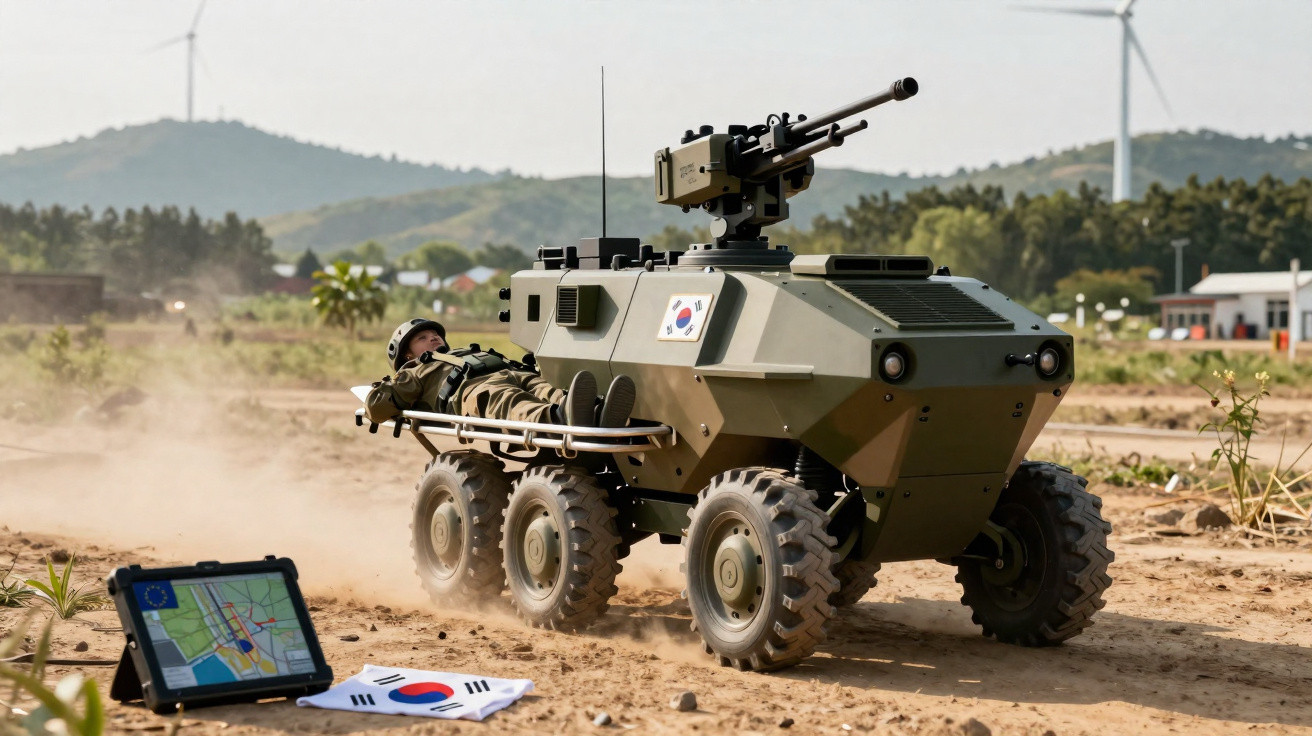
The compact electric vehicle did not roar; it moved almost silently. Even so, military officials gathered around it with the interest usually shown to next-generation fighter aircraft. Hyundai Rotem of South Korea had presented something that many European armies are still only discussing in theory: an armed, autonomous ground robot ready for battlefield use, capable of moving, firing and evacuating casualties without anyone on board.
From prototype to battlefield: South Korea accelerates development
Hyundai Rotem has developed the HR-Sherpa for several years, but the model displayed at the MSPO 2025 defence exhibition in Kielce, Poland signals a decisive transition. It is no longer merely a technology demonstrator.
The vehicle is an electric, six-wheeled unmanned ground vehicle (UGV) based on a modular chassis. An individual motor drives each wheel, providing the robot with substantial torque, a tight turning circle and improved grip across mud, rubble and snow. Its airless tyres eliminate punctures, which are a common source of failure for conventional military vehicles.
The HR-Sherpa is designed to drive, shoot, resupply and pull a wounded soldier out of danger without placing another life at risk.
South Korea’s defence acquisition agency has moved the programme through several design iterations since about 2018. Testing over varied terrain has informed the final production configuration, including a stronger frame, improved off-road suspension, enhanced autonomy software and, importantly, a standardised weapon mount.
While France debates ethics, Seoul deploys a combat-ready robot
Over recent years, France has financed trials involving unmanned ground systems from companies and programmes including Arquus, Nexter and Scorpion. These efforts concentrate on logistics, reconnaissance and manned-unmanned coordination, although the platforms are generally unarmed or only lightly equipped.
Paris also operates under substantial political and ethical restrictions on arming robots, particularly for urban operations. Its doctrinal documents emphasise strict human supervision, phased introduction and restricted combat functions. At present, French robots remain experimental additions rather than systems integrated into unit structures.
South Korea has followed another course. From the beginning, the HR-Sherpa has been conceived as a multi-role combat asset and is already in series production. Hyundai Rotem openly refers to operational trials and export ambitions rather than limiting discussion to laboratory experiments.
While French projects remain stuck in trials and concept papers, the Korean HR-Sherpa is marketed as an off-the-shelf, armed, NATO-compatible system ready for real missions.
This pace presents European planners with an awkward question: can they sustain a slow and cautious approach when competitors and partners are advancing rapidly with armed autonomous systems?
A silent, electric 6×6 designed for contested zones
The HR-Sherpa’s engineering closely reflects lessons from the current battlefields of Ukraine, Iraq and Syria, where artillery, drones and ambushes penalise any convoy that is noisy and exposed.
- Electric drive: Produces a low acoustic and thermal signature, supporting discreet movement and extended silent “watch” positions.
- Reinforced chassis: Can carry modular payloads including ammunition, sensors, stretchers or a remote weapon station.
- Airless tyres: Withstand shrapnel, nails and spikes often used in improvised explosive arrangements.
- Hybrid control: May be teleoperated or assigned autonomous functions, such as route-following and patrols.
Modularity is fundamental to the platform. The same vehicle base can conduct logistics work on one day, then support casualty evacuation or reconnaissance on the next. Such adaptability makes investment in a new vehicle category easier to justify for armies with constrained budgets.
A factory-fitted remote weapon station
The vehicle presented in Poland was equipped with a remote-controlled weapon station (RCWS) carrying a 7.62 mm machine gun and an electro-optical sighting system. From a protected location, an operator can target and fire the weapon through daytime cameras, thermal imaging and laser range-finding.
The mount can monitor a base perimeter, support advancing infantry or escort convoys. As the station is stabilised, the robot can maintain a degree of firing accuracy even when travelling slowly over uneven terrain.
The HR-Sherpa is built to keep fighting even in jammed environments, using onboard sensors and navigation software instead of relying solely on GPS.
According to Hyundai Rotem, the navigation package combines inertial measurement units, odometry, local mapping and vision-based algorithms, allowing the vehicle to establish its position when satellite signals are weak or intentionally disrupted.
Tactical autonomy for “manned-unmanned teaming”
The HR-Sherpa is intended to operate with soldiers, not replace them. In “follow-me” mode, it can follow a squad as a robotic mule while carrying ammunition or heavy equipment. In more sophisticated modes, it can move in front to assess hazardous routes or contaminated ground.
This approach aligns with NATO’s discussion of “manned-unmanned teaming”, in which crewed vehicles, ground drones and aerial drones operate as one tactical formation. Robots assume the most hazardous roles, while people retain authority over decision-making and rules of engagement.
Europe becomes a strategic target market
Hyundai Rotem already has an established presence in Europe through Poland’s order for its K2 main battle tanks. This provides the company with industrial partnerships and political channels that may also be used to promote the HR-Sherpa.
Poland, which shares a lengthy border with Belarus and is closely observing Russia’s invasion of Ukraine, is making major investments in artillery, air defence and armoured formations. An autonomous vehicle available for purchase now, capable of carrying supplies, monitoring borders and delivering remote fire support, matches those procurement priorities.
For European states looking to stretch limited manpower, a robot that can handle routine patrols, logistics and casualty evacuation has obvious appeal.
Other Eastern European NATO members, dealing with ageing Soviet-era fleets and recruitment difficulties, are likewise probable candidates for UGV acquisitions in the years ahead.
One chassis, many roles: the HR-Sherpa’s mission set
The Korean vehicle is promoted as a genuinely multi-role platform. Rather than purchasing separate specialised systems, users can reconfigure one unit by exchanging mission kits.
| Mission type | HR-Sherpa configuration |
|---|---|
| Logistics support | Flatbed or container module for ammunition, food or spare parts |
| Casualty evacuation | Rear stretcher mount with securing straps and basic medical storage |
| CBRN/ NBC detection | Specialised sensors and sampling tools for chemical, biological or radiological threats |
| Autonomous reconnaissance | Camera mast, infrared sensors and radars for 360-degree surveillance |
| Teleoperated fire support | RCWS with machine gun and optics, controlled from a command post |
| Static perimeter security | Long-endurance silent surveillance with motion detection and alarms |
This breadth of roles reflects recent conflicts, in which the same forces and limited equipment must cover urban combat, rural patrols and border security.
Moving risk from soldiers to machines
Recent wars have demonstrated that the deadliest moments are often not conventional assaults, but routine duties: resupplying front-line positions, examining a suspicious road or recovering an injured comrade under fire. These are precisely the tasks where ground robots could matter.
Using a platform such as the HR-Sherpa, a commander could send a machine into a suspected minefield, a sniper-covered street or an area polluted by toxic agents. Should the robot be struck, the cost is financial rather than human. It may also reduce the psychological burden on troops: for some soldiers, knowing a robot could retrieve them after an injury changes their assessment of danger.
The real shift is not about “killer robots” taking over the fight, but about offloading the riskiest, dullest and dirtiest tasks from human bodies to machines.
Nevertheless, an armed robot introduces tactical and ethical issues. Who bears legal responsibility if the system wrongly identifies a target? How much freedom should an autonomous mode receive if communications fail? Most current systems, including the HR-Sherpa, continue to keep a human in or on the loop for firing decisions, but the boundary between assistance and autonomy is shifting.
Key notions behind armed ground robots
Two technical concepts underpin the HR-Sherpa’s marketing proposition and are frequently confused in public discussion.
Autonomy vs. automation. Automation involves following pre-programmed instructions or repeating actions, such as travelling along a fixed patrol route. Autonomy means being able to perceive the surroundings, alter a route and make limited decisions within set rules. The HR-Sherpa employs both: it can automatically follow a tracked vehicle, while also navigating around an obstacle without awaiting human instructions.
Teleoperation. This more closely resembles operating a highly advanced remote-controlled car. An operator, potentially several kilometres away, directly drives the vehicle and aims its weapons through a control interface. Secure communication links, low latency and robust encryption are essential, though all can become vulnerabilities during electronic attack.
In an actual conflict, armies will probably combine these modes. For routine duties or safer locations, teleoperation offers commanders reassurance and control. In conditions of intense jamming or rapidly changing engagements, greater autonomy will be necessary simply to keep robots operational.
Possible scenarios: how these robots could be used in practice
Consider a NATO unit ordered to secure a small town close to the front line. Rather than sending a crewed vehicle along every exposed street, troops might deploy two HR-Sherpas. One would carry sensors and a loudspeaker, issue warnings to civilians and transmit images back. The second would remain behind it, armed and prepared to provide suppressive fire if an ambush began.
In a different case, a convoy threatened by artillery could use UGVs to transport shells and fuel between dispersed firing sites. The robots would operate mainly at night, moving quietly between tree lines and damaged buildings. Human drivers would remain farther to the rear, moving forward only after a temporary level of safety had been secured.
These are not remote science-fiction ideas. They are the type of use cases procurement officials are modelling today as they observe how quickly countries such as South Korea are moving from theory to fielded systems.


Comments
No comments yet. Be the first to comment!
Leave a Comment