
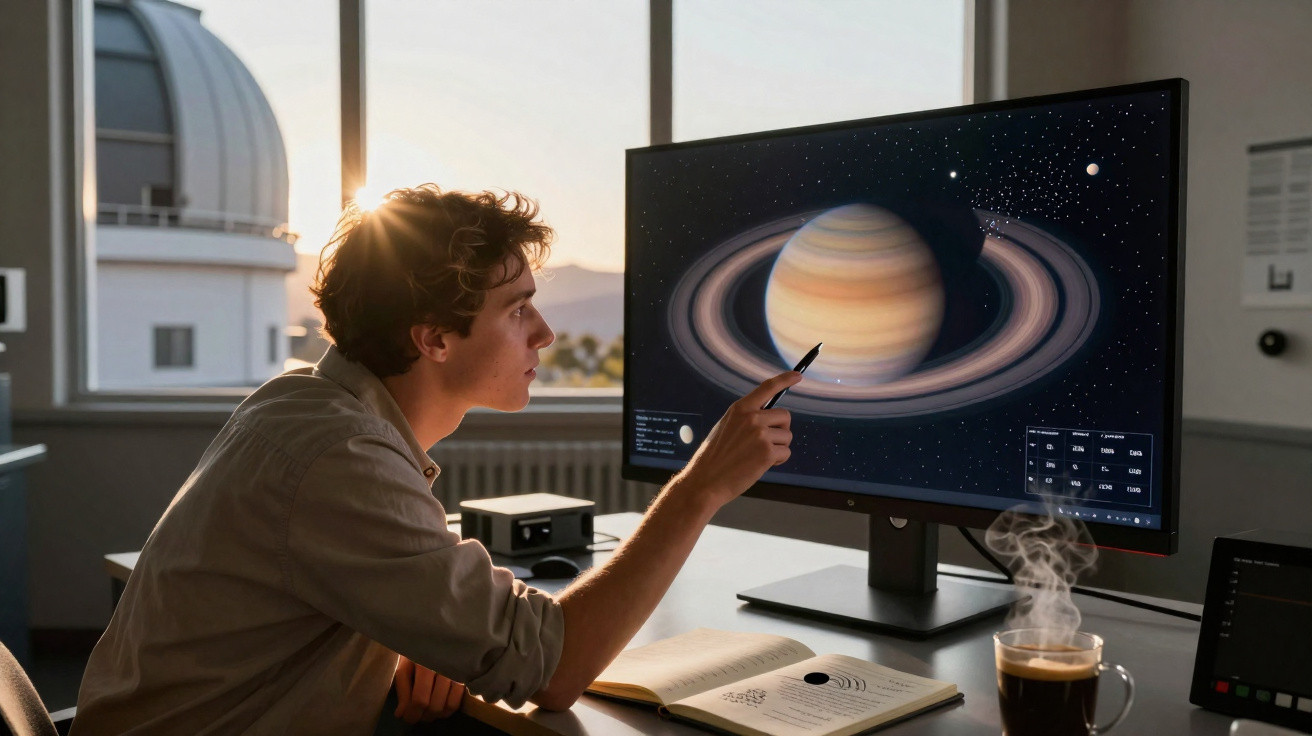
Around the two gas giants, Jupiter and Saturn, a total of twelve previously unknown moons have been identified. These objects are so small and faint that only a handful of Earth’s most powerful telescopes can detect them at all. Even so, they dramatically alter Solar System statistics – and put Saturn much further ahead in the race for the most moons.
Tiny points of light at the edge of visibility
The discoveries are split between both gas giants: four moons orbit Jupiter and eleven orbit Saturn. None of these celestial bodies is especially large – quite the reverse. Each is only about 3 kilometres across, roughly the distance many people drive to work each day.
These moons are beyond the reach of amateur astronomers. Their brightness ranges from magnitude 25 to 27. By comparison, good binoculars can reveal stars down to about magnitude 9, while smaller amateur telescopes may reach magnitude 12 or 13. Anything in the magnitude-25 range is a genuine challenge even for professionals.
“The new moons are so faint that, even in high-resolution images, they initially look like tiny image defects – until it becomes clear that they are moving.”
Turning a suspicious point of light into a confirmed moon requires patience and accuracy. Astronomers repeatedly photograph the same patch of sky over weeks and months, compare the images, and look for points that shift very slowly against the stellar background. A discovery is considered secure only when its orbit can be clearly linked to a planet.
Giant telescopes in Chile and Hawaii do the demanding work
Some of Jupiter’s new moons were detected using two of the world’s most important large telescopes: the 6.5-metre Magellan Baade Telescope in Chile and the 8-metre Subaru Telescope in Hawaii. Both observatories are located in exceptionally dark, dry places with very stable air – ideal conditions for imaging objects at the limit of visibility.
In the raw images, the moons initially blend into the noise. Their faint signals emerge only through specialised software, long exposures and many repeat observations. Researchers must then monitor their positions over an extended period. If an object moves consistently and remains close to a planet, that is strong evidence that it is a moon.
Saturn extends its clear lead in known moons
With its eleven additions, Saturn now has an impressive 285 known moons. Jupiter trails far behind with 101. The gap between the two giants is widening.
“Saturn is no longer merely the planet with the most beautiful rings – it is also the undisputed moon king of the Solar System.”
The official register of new moons is maintained by the Minor Planet Center. Following detailed checks, discoveries are published there in notices known as circulars. For the current discoveries, Saturn’s moons appear, for example, in notice MPEC 2026-F14, while several MPECs numbered F09 to F12 list new moons of Jupiter.
Saturn’s advantage is not a new development. In 2025, a team led by astronomer Edward Ashton had already reported 128 new Saturnian moons. That wave of discoveries had propelled the planet decisively past Jupiter, and the eleven now announced reinforce its lead still further.
The major planets and their moon totals
- Saturn: 285 known moons
- Jupiter: 101 known moons
- Uranus: 28 moons
- Neptune: 16 moons
- Earth: 1 moon
- Mars: 2 small moons (Phobos and Deimos)
This extreme distribution illustrates how differently planetary systems developed in the outer Solar System. The gas giants act like enormous vacuum cleaners, capturing asteroids and chunks of ice over billions of years.
A small group of researchers produces hundreds of discoveries
One striking point is that a large share of the new moons can be traced back to the work of just a few specialist teams. According to science outlets such as Space.com, Scott Sheppard and Edward Ashton have each co-discovered more than 200 moons.
Their successful approach is to search systematically far beyond the already known major moons. This is where the so-called irregular moons travel, often on strongly inclined, highly elliptical or even retrograde orbits – meaning that they move in the opposite direction to the planet’s rotation.
To establish whether a point of light is genuinely a moon, researchers must calculate its orbit precisely. If the object remains held by a planet’s gravity for months and years, it is officially recognised as a satellite and given a provisional designation.
What Jupiter’s and Saturn’s tiny moons reveal about the Solar System’s past
Although the new moons may appear unremarkable, they are regarded as time capsules. Many are likely fragments of larger celestial bodies that collided in the distant past or broke apart during close encounters. Others may originally have been asteroids travelling freely through space before Saturn or Jupiter captured them.
“Each of these moons tells a small chapter of the Solar System’s chaotic early history – together, they produce an increasingly complete picture.”
The distribution of their orbits can reveal which catastrophes occurred during the first hundred million years after the planets formed. Groups of moons with similar paths suggest that they were once a single body which was broken into several pieces.
Why new moons are being found all the time
The number of known moons is rising so rapidly not because more objects have formed recently – they have always been there. What is new is primarily the available technology:
- larger mirror telescopes with greater light-gathering power
- digital cameras equipped with extremely sensitive sensors
- improved image-processing software that extracts weak signals from noise
- faster computers capable of analysing enormous volumes of data
As a result, the boundary of what can be achieved is continually moving outwards. Where once only major moons such as Titan, Ganymede and Europa stood out, images now reveal tiny bodies just a few kilometres in diameter.
How many moons are still missing?
The current total of 442 known moons in the Solar System is likely only an interim figure. In the outer reaches of planetary orbits, far from bright rings and large satellites, researchers suspect there may be dozens, if not hundreds, more tiny moons.
Every new instrument brings such objects closer to the detection threshold. In future, space telescopes with specially optimised cameras could also be used, including successors to Hubble and James Webb. Observing above Earth’s atmosphere, they avoid the disruptive atmospheric shimmer that affects even the best ground-based sites.
Terms worth knowing
Reports about new moons often use specialist terms that can be confusing. Three key expressions help put them into context:
| Term | Meaning |
|---|---|
| Magnitude | A measurement of an object’s brightness; the higher the number, the fainter the light. |
| Irregular moon | A satellite with an unusual orbit, often distant, steeply inclined or retrograde. |
| Minor Planet Center | The international body that registers and catalogues small bodies such as asteroids and moons. |
Anyone reading reports about new moons can use these terms to judge more effectively how remarkable a discovery really is and how much work it involves.
For planetary science, the latest discoveries provide one thing above all: more data. Every new orbit, every newly determined diameter and every brightness measurement helps refine models of the Solar System’s formation and evolution. The tiny moons around Saturn and Jupiter are therefore far more than figures in a record list – they form a mosaic of clues that grows denser year by year.






Comments
No comments yet. Be the first to comment!
Leave a Comment