
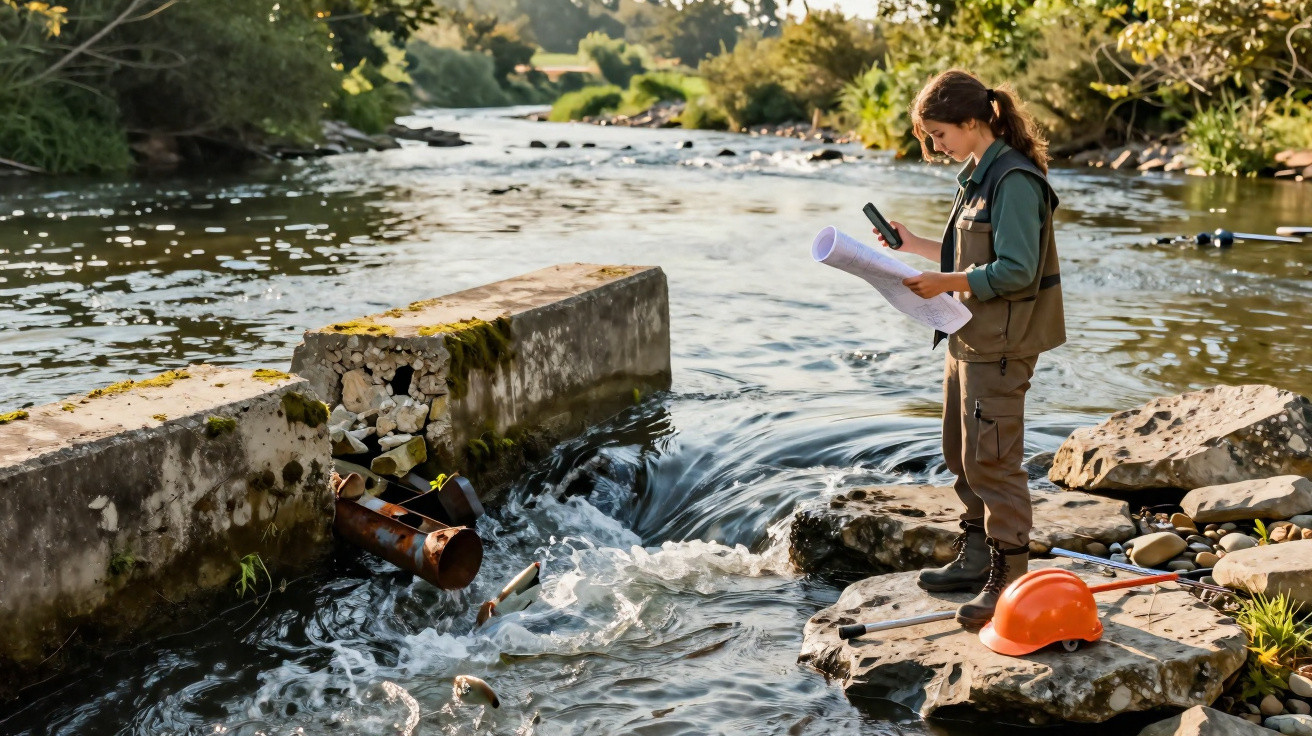
Workers retreat, spectators raise their phones and a heron beats its wings in a slow, irritated curve. Then the barrier fails. Water pours through, surging, curling and foaming into a channel that has been dry for decades. It appears disorderly, almost brutal, but those gathered on the bank begin to clap, as though a collapsing dam could possibly be cause for celebration.
Versions of this scene are now unfolding repeatedly around the world. More than 15,000 river barriers have been removed already: low dams, weirs, culverts and concrete walls once regarded as permanent fixtures. They are being cut through, hauled away and discreetly removed from the map.
What follows in these waterways is more unexpected - and more encouraging - than most people imagine.
When Rivers Remember How To Move
Several weeks after a small dam was removed in northern Spain, local people started seeing things absent since their childhood. Rather than lying in a stagnant, level pool, the water turned, rippled and chattered over stones. Children came down after school and threw sticks into the flow simply to watch them speed away. What had been a dreary brown reservoir now had the sound of life: a steady low roar replacing a weary, motionless silence.
At the riverbank, even the smell had changed. There was less of the muddy, stagnant odour and more crisp, cold air rising from flowing water. Fish began appearing in places that had contained virtually nothing for years. They were not stocked trout in a concrete pond, but wild fish making their way upstream, as though they had been waiting for permission.
This is not a single isolated wonder. In Europe alone, more than 487 barriers were removed in 2023, from Norway to Portugal, reconnecting over 430 miles of rivers. In the United States, over 2,000 dams have been removed since the late 20th century, with the rate increasing. On Washington State’s Elwha River, salmon reached ancestral spawning grounds again within a few years of two enormous dams being taken down. Some travelled farther upstream than scientists believed possible, seemingly following a route that had been closed for a century.
The shifts on small streams can feel especially immediate. After a deteriorating weir was removed, a French farmer saw eels and lampreys writhing past his fields once more. In Finland, volunteers captured footage of trout jumping a newly released rapid only weeks after demolition. Statistics tell one part of the story - miles reconnected and species returning - yet unsteady mobile-phone footage of the first fish forcing its way through a long-blocked place conveys something more instinctive.
Rivers are naturally restless, which explains why this happens. Holding them behind dams and weirs does more than store water: it locks an entire living system in place. Sediment accumulates, oxygen levels fall and migratory fish meet concrete before turning back. By removing more than 15,000 barriers worldwide, engineers and communities are effectively releasing the handbrake on thousands of watersheds. Water begins to form its own route again. Gravel shifts to create spawning beds, while cooler upstream water circulates through the channel. It resembles restarting an ecosystem that has been paused for decades.
There is a broader principle at work. Free-flowing rivers link mountains, forests, floodplains and oceans in one vast circulatory system. Once that system is divided, everything from minute aquatic insects to coastal fisheries suffers. When the connections return, recovery can spread through the landscape in subtle, unexpected ways.
How To Heal A River (Without Pretending It’s Easy)
River barrier removal does not begin with a wrecking ball. More often, it starts with an almost simple question: “What did this river look like before?” Scientists examine historic maps and faded photographs. Older local residents describe the bends and pools they knew as children. Engineers inspect the banks, identifying tree roots, former channels and concealed pipes where water may rush once the structure disappears.
Next comes the sensitive stage: designing the breach. Removing too much concrete too quickly can release a destructive surge of mud and debris. For that reason, most schemes proceed in phases: a notch in one place, a controlled opening in another, with turbidity and flow rates monitored day by day. It is better understood as surgery on a living body than demolition. The purpose is not merely to take something away, but to allow the river to find its form again.
Many people picture dam removal as a heroic before-and-after image: one spectacular blast followed by instant paradise. The truth is messier. Some landowners fear losing their glassy, still pond. Some anglers value fishing in the calm reservoir. Towns may worry about flooding or the loss of a familiar landmark. Environmental organisations can spend long evening meetings explaining why a wilder, untidier river may ultimately be safer and more ecologically rich.
At a human level, that conflict is recognisable. In the river itself, it appears when water levels fall behind a removed dam and the newly exposed banks look harsh, even unattractive, for the first year or two. There are brown mudflats and dead stumps. Let us be honest: nobody is really queuing to visit a restoration site in the middle of that stage.
Yet this is often the moment when the story begins to change quietly. Native plants establish themselves in the bare earth. Birds arrive. Gravel bars emerge. The river starts sewing a fresh pattern into the landscape, revealing that the supposedly ugly stage was simply the transition rarely shared on Instagram.
Technically, a handful of central measures repeatedly prove effective. The barrier should be cut so sediment is released steadily rather than in one rush. Riffles and pools can be recreated downstream to moderate the flow and provide fish with places to rest. Large woody debris - trunks and root wads - can stabilise banks and create shelter. Engineers now simulate these processes on computers, but when walking beside a newly freed stretch, the judgement can still come down to an old-fashioned question: does the river sound right?
Impatience is what most often catches people out. Communities anticipate immediately clear water and salmon leaping within a month of a dam’s removal. When the river remains brown for a period, or invasive plants arrive first, disappointment follows. Communication then becomes as important as concrete. Teams that offer candid updates - “The water is murky now, but here’s why that’s part of the process” - are generally better able to retain public trust.
A further common error is to frame dam removal as solely an ecological undertaking, overlooking social memory. An old mill pond may have been the setting for family picnics for 60 years. A cracked wall covered in moss may appear in a hundred wedding photographs. Pretending that these feelings do not matter only entrenches opposition. Recognising them makes it easier for people to envisage a different landscape, one shaped by moving water.
We’ve all had that moment when something we thought was permanent suddenly disappears, and we have to decide whether to mourn it, or to see what grows in the gap. River barriers embody that experience on a larger scale. They were constructed for reasons that were sensible at the time - energy, irrigation and navigation - and removing them is not an attempt to erase history. It is a decision about the futures we want water to shape.
“The first year after we took out the dam, I honestly wondered if we’d made a mistake,” admits an engineer who led a removal project in New England. “By the third year, when we saw salmon redds in places they hadn’t reached in my grandparents’ lifetime, I stopped doubting. The river just needed a chance.”
People regularly ask what they can do personally when they do not live beside a well-known dam. The response is less dramatic than a viral video, but has quiet force:
- Take an interest in nearby rivers: learn who manages them, what barriers are present and which wildlife relies on them.
- Back local organisations working on fish passages, culvert improvements or small dam removals.
- Attend public meetings where such schemes are discussed.
- Tell stories - rather than only sharing statistics - about the difference made by free-flowing water.
When A Barrier Falls, The Story Spreads
Walk beside a reconnected river and small consequences become visible, the kind that would never occur to you to include in a grant application. There may be a café owner moving a few tables closer to the newly animated bank. A child may search for crayfish in a shallow riffle that was once beneath three metres of still water. A kingfisher may flash blue above a current moving quickly enough to carry oxygen.
These small changes accumulate. Restarting fish migration is not simply a matter of one species improving its position on a conservation chart. It means nutrients brought inland from the sea can nourish riverside forests. It can mean otters and ospreys return because their prey has returned. It can allow floodplains to function again, retaining and gradually releasing water instead of forcing it against a hard, vertical wall.
Globally, the 15,000-plus barriers removed so far represent a start rather than an endpoint. Europe’s rivers alone are estimated to remain fragmented by 1.2 million obstacles. Many hydropower dams will remain, at least for the present, because they generate electricity on which societies still depend. The notable change is in the default assumption. Rather than presuming that every old weir must remain, increasing numbers of governments and communities are asking: “Does this thing still earn its place here?”
That is a quietly radical question. It challenges a century of thought in which progress meant building, hardening, straightening and controlling more. Allowing a river to run more freely can feel like conceding that we cannot control everything completely. However, it also makes room for different infrastructure: smarter floodplains, restored wetlands, fish passages that genuinely work and even micro-hydropower that does not obstruct entire watersheds.
There is an emotional current beneath these changes too. At a time when so many environmental accounts focus on loss and doors closing, dam removal is one of the unusual stories travelling in the opposite direction. Doors are opening, fish runs are beginning again and places dismissed as “dead rivers” are displaying swift, determined recovery. It doesn’t erase the damage, but it proves that some systems remember how to heal if we stop getting in the way.
The next time you cross a bridge, you may find yourself looking downstream and wondering what is upstream. Is there an old, half-forgotten barrier that no longer truly serves anyone? Is there a community still divided between affection for a quiet pond and curiosity about a living, moving river? Those 15,000 removals worldwide suggest that change is already travelling downstream - one fractured wall and one rush of cold, wild water at a time.
| Key point | Detail | Why it matters to the reader |
|---|---|---|
| Rivers recover quickly | Fish migration and habitats often recover within a few years of barrier removal | Offers tangible hope that damaged ecosystems near you can recover too |
| 15,000+ barriers removed | A global wave of dam and weir removals is reconnecting watersheds and sediment flows | Demonstrates that this is a genuine large-scale change, not a niche experiment |
| Your role matters | Local voices influence which barriers are removed and how projects develop | Encourages you to become a participant, rather than a spectator, in river restoration |
FAQ:
- Why are so many river barriers being removed now? Many dams and weirs are ageing, unsafe or no longer useful. We also now have strong evidence that their removal restores fish, improves water quality and may reduce long-term costs.
- Doesn’t hydropower make these dams essential? Some major hydropower dams will remain, but many removed barriers generate little or no energy. They are often legacy structures whose ecological impact can no longer be justified.
- Won’t taking out dams increase flood risks? In many cases, reconnecting rivers and floodplains spreads and slows floodwater, reducing peak downstream flows, although every location requires careful assessment.
- How quickly do fish return after a barrier comes down? In some rivers, migratory species such as salmon and trout have been recorded upstream during the first migration season after removal, with their numbers increasing over several years.
- What can I do if I care about a local river? Begin by finding out which barriers exist, speak to local groups or agencies, attend public meetings and support well-planned, science-based projects that reconnect streams.






Comments
No comments yet. Be the first to comment!
Leave a Comment