
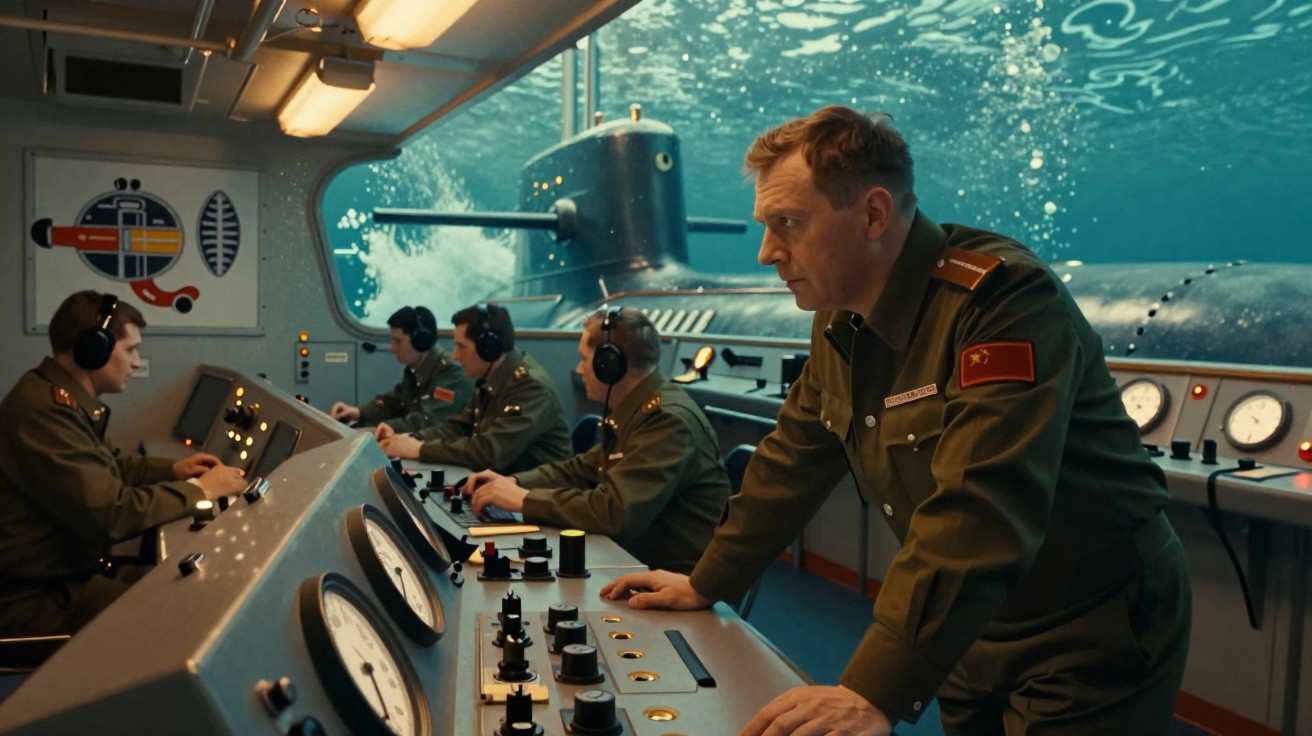
Built at extraordinary speed and kept under tight secrecy, the Soviet K-222 shocked Western navies in the early 1970s. It showed that a nuclear submarine could travel faster than many surface warships while retaining missiles able to hit targets far beyond the horizon.
The Soviet wager on sheer speed
Commissioned in 1969, K-222 emerged during a particularly tense period. The Cuban Missile Crisis remained a recent memory, the superpowers’ navies were monitoring one another across the world’s oceans, and Soviet planners sought a vessel capable of outrunning anything the US might deploy against it.
Referred to by NATO as the “Papa class”, K-222 was an attack submarine equipped with cruise missiles and nuclear weapons. Operating below the surface, it posed a threat both to carrier strike groups at sea and to strategic land targets.
It was designed as far more than an ordinary patrol submarine. The concept was a swift, heavily armed vessel that could approach rapidly, fire its weapons and disappear before opposing forces could respond.
The K-222 reached 44.7 knots in 1971 - around 82.8 km/h - a speed no combat submarine has officially matched since.
The initial engineering goal was approximately 38 knots, which was already highly ambitious for a submarine. In trials during 1971, K-222 exceeded that objective by a considerable margin. Soviet records state that the vessel “flashed” through the water at 44.7 knots, driven by a powerful nuclear reactor and aided by a streamlined hull constructed largely from titanium.
Why 80 km/h beneath the surface matters so much
Submarines must constantly overcome resistance from the water. As speed rises, so do drag and the noise produced. Driving a large armed submarine beyond 80 km/h requires enormous quantities of water to be forced around its hull under immense pressure.
- At around 25 knots (about 46 km/h), most attack submarines are already moving quickly by modern standards.
- Surface warships seldom operate at more than 30 knots for extended periods.
- At 44.7 knots, K-222 matched the speed range of fast patrol craft and certain missile boats.
For Soviet naval planners, this performance offered the prospect of a major tactical edge. Such a fast submarine could pursue carrier groups, shift swiftly between theatres and outrun many torpedoes from that era.
The crippling noise of extreme speed
Yet the characteristic that made K-222 famous also reduced its practical value. Greater speed created greater strain, and that strain created noise.
At high speed, the hull developed structural problems as immense forces acted on the titanium casing and its internal equipment. Engineers had to confront the reality that operating a submarine at these extremes reduced its service life and made maintenance substantially more difficult.
At top speed, noise levels inside K-222 reportedly reached around 100 decibels - similar to a rock concert or a jackhammer.
This was not merely a technical detail for the crew. Sustained exposure to sound between 80–100 dB is regarded as damaging to hearing, while noise from 100 to 130 dB becomes positively painful. During a lengthy patrol, with no refuge from the continuous roar, conditions were harsh.
Noise also destroys stealth from a military perspective. A submarine travelling quickly produces a prominent acoustic signature underwater, allowing enemy sonar systems to locate and target it more easily. For a service in which invisibility is paramount, this proved to be a serious compromise.
The reactor accident that determined K-222’s fate
Ironically, the noise issue was not what ultimately ended K-222’s operational service. Its decisive setback resulted from a reactor incident.
On 30 September 1980, reactor maintenance was reportedly carried out without the correct procedures being followed. This led to an uncontrolled start-up that damaged the reactor core. A nuclear submarine with a damaged reactor represents a liability no navy can overlook.
The Soviet Union kept K-222 in operation for several further years, although its future was already limited. It was removed from service in 1988 and, following years in lay-up, dismantled in 2010.
K-222 was 106.6 metres long, carried a crew of around 82 men, and still holds the speed record despite its short career.
Why no other navy replicated this record-breaker
If K-222 was exceptionally fast, why did no navy create an entire force of comparable submarines? The answer lies in the quality most valued beneath the waves: silence.
Cold War experience demonstrated that a submarine which was somewhat slower but much quieter was considerably more dangerous than a noisy speed machine. Modern attack submarines prioritise stealth, including low acoustic signatures, vibration isolation and hull forms designed to deflect sound from sonar.
Nuclear attack submarines today generally cruise at around 25 knots, or roughly 46 km/h. That speed is sufficient for following ships, patrolling sea lanes and undertaking extended covert missions.
The US Navy’s USS Seawolf, commissioned in 1997, again raised the performance limit with an estimated maximum speed of about 35 knots (64 km/h). Even so, its standing depends less on outright pace than on sophisticated quieting technology that makes it difficult to detect.
Speed versus stealth below the waves
Naval architects now regard speed almost as a secondary weapon. It is reserved for brief bursts, whether to evade, reposition or react, rather than maintained continuously.
| Submarine type | Typical top speed | Design priority |
|---|---|---|
| Soviet K-222 | 44.7 knots (~82.8 km/h) | Extreme speed, heavy armament |
| Modern nuclear attack submarine | ~25 knots (~46 km/h) | Stealth and endurance |
| High-speed US design (e.g. Seawolf) | ~35 knots (~64 km/h) | Balance of speed and low noise |
Tactically, a quiet submarine can edge close to a carrier group, rest on the seabed or follow an opponent for days without being detected. A noisy submarine travelling at 40 knots may look impressive on paper, but it can alert listening stations and patrol aircraft well before it comes within firing range.
What “nuclear submarine” actually means
The phrase is often misunderstood because it may describe two separate things:
- A submarine powered by a nuclear reactor, providing almost unlimited range and the ability to remain underwater for months.
- A submarine carrying nuclear weapons, including ballistic missile submarines that form part of a nation’s nuclear deterrent.
K-222 belonged to the first category and, according to its load-out, partly to the second as well. Nuclear propulsion enabled its high speeds, while it could also launch missiles capable of carrying nuclear warheads.
K-222’s lessons for today’s oceans
K-222’s story continues to matter in present-day naval strategy. Interest is increasing in unmanned underwater vehicles, advanced torpedoes and quieter propulsion systems, but the longstanding compromises remain: pursuing higher speed can increase noise, while seeking greater power complicates safety.
Analysts often discuss scenarios involving mixed groups of platforms, with extremely quiet submarines moving ahead while faster, noisier drones serve as decoys or scouts. Within these concepts, K-222 can appear almost like an early example of a specialised “sprint” asset, created decades prematurely and without modern materials or automation.
For those examining future naval technology, K-222 remains a striking case study. It illustrates what is possible when a state commits its entire industrial capacity to one performance target, and how rapidly that achievement can encounter the hard constraints of physics, human endurance and safety procedures.



Comments
No comments yet. Be the first to comment!
Leave a Comment