
The story of this Chinese plant that “drinks” rare earth elements sounds almost implausible. At first glance, it is merely a botanical curiosity. Behind the scenes, however, it could trigger a geopolitical earthquake.
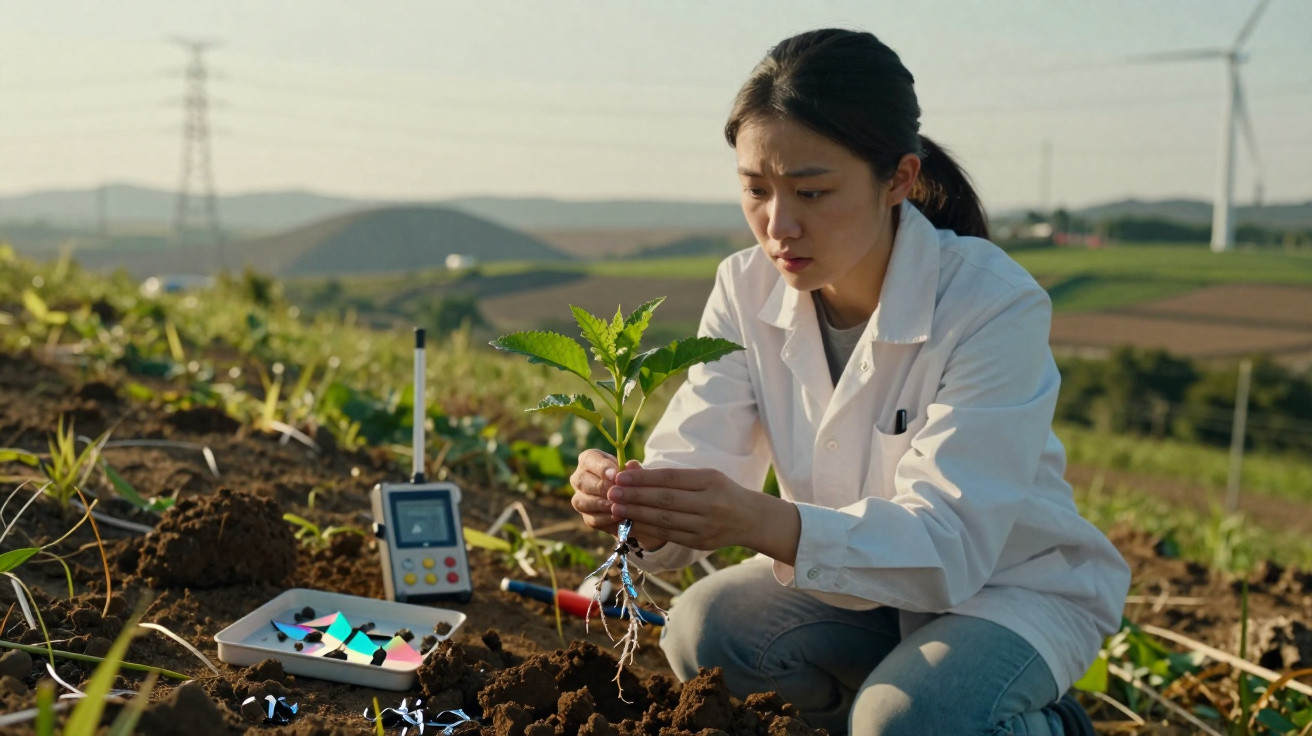
On a misty morning in southern China, researchers bend over an unremarkable clump of greenery. Its leaves are narrow and slightly metallic green; its stems are slim, almost delicate. Nothing suggests that this plant can draw from the ground concentrations of rare earth elements that would kill most other species. In a laboratory sample, its stem becomes almost a chemical inventory of the materials coveted by every major power. The researchers exchange glances. They know that their measurements will inevitably become known. And that the consequences will not be pleasant.
A “metal-magnet” plant redrawing the map
In the field, scientists portray this grass as a kind of mineral sponge. It grows in poor, contaminated soils, often land abandoned by conventional farming. Where other vegetation turns yellow, it flourishes. Above all, it stores striking quantities of rare earth elements in its tissues: metals essential to smartphones, wind turbines, electric cars and military lasers. From a distance, it is just a patch of green. Up close, it is almost a living battery.
The prospect is dizzying. Chinese researchers say that this plant could “harvest” rare earth elements without the need to excavate vast mines. Picture whole hillsides covered in vegetation, cut back regularly, burned and processed to extract the metals concealed in the ash. No blasting and no moon-like craters. Just successive crops of hyperaccumulator plants. In this vision, botany becomes a quiet industrial tool with potentially enormous yields.
On paper, the concept is straightforward. It is known as phytomining: using particular plants to remove metals from soil instead of relying on bulldozers. This is not entirely science fiction; several species have already been tested for nickel and zinc. But this discovery has emerged in today’s most sensitive arena: rare earth elements, the discreet backbone of the digital and energy transitions. China already controls a large share of this market. A plant that strengthens that lead further looks like a strategic bonus. And the whole world is beginning to tense up.
A green treasure reviving fears of a resource war
The immediate reaction is obvious: excellent, a cleaner way to recover essential metals. Rare-earth mining has a disastrous environmental record, involving toxic lakes, local communities paying the price and torn-up soils. Here, the discussion is of fields, harvests and biomass. The promise seems almost gentle. The sound of excavators is replaced by wind moving through leaves.
Yet once geopolitics enters the equation, the atmosphere changes rapidly. China already dominates rare-earth extraction and, above all, refining. It has the infrastructure, factories, engineers and logistical routes. If this plant, or an enhanced version of it, becomes integrated into that system, Beijing could tighten its grip on the supply chain still further. It is easy to envisage entire state-designated areas covered in these mineral crops and guarded as strategic facilities. Hardly the sort of place for a stroll with a picnic basket.
For Western countries, the concern is plain: what if this biological advance widens the gap even further? The United States, Europe and Japan have spent years trying to diversify their rare-earth supplies, reopen mines and expand recycling. Now a disruptive technology has arrived - but in the country they already fear as a rival in this field. Let us be honest: no one really does this every day, opening up a strategic deposit using a simple plant. This imbalance quietly feeds fears of a new race for resources, not only involving mining but also genetics and biotechnology.
How this plant could reshape our relationship with metals and social choices
In practical terms, using this kind of plant does not mean simply leaving it to grow unchecked. First, soils rich in rare earth elements must be mapped, often in regions that are already polluted or marginalised. Cultivation cycles then need to be designed: sowing, growth, harvesting, controlled incineration and filtering the ash to recover the metals. It is not glamorous; it is a complete industrial chain, but one that is more dispersed and more embedded in the landscape. Instead of digging, we grow.
Engineers discuss optimisation: selecting the right planting densities, crop combinations and irrigation methods. Biologists are already dreaming of genetically enhancing the plant so it can absorb even more metals, more quickly and from a wider range of soil types. In the middle of all this are the people living in these areas, for whom such fields will be neither simple scenery nor an abstract issue. Living beside a “rare-earth field” is nothing like living beside a wheat field.
The risks are not hypothetical. A plant that accumulates heavy metals on a massive scale can become toxic to animals, water supplies and the food chain. Who controls the spread of its seeds? What happens if it colonises unintended areas? Behind the promise of greener extraction lies a major ethical question: how far will we go to power our batteries, screens and missiles? And who gets to decide? On this point, governments often move faster than environmental safeguards.
What this discovery reveals about our hidden dependencies
For the average reader, this may seem remote from everyday life. Yet every time you unlock your smartphone or plug an electric car into a charging point, a small part of this story is being played out. One simple way to gain perspective is to look around your home: how many objects rely on invisible electronic components? Making that mental list, even once, changes how we see phrases such as “rare earth elements” and “strategic deposits”.
A more practical approach is to follow the news not by country, but by material. When reading a report, ask: what is really needed beneath it all? Lithium, cobalt, copper, rare earth elements. This lens reveals what the Chinese discovery brings into focus: our reliance on a small number of exotic elements, extracted under conditions that are often sacrificed. Faced with a miracle plant, the temptation is to applaud. The real question is whether we simply want to replace one dirty method with a “cleaner” version, without addressing our voracious appetite for gadgets and sophisticated weapons.
This plant can also be seen as a stark indicator. It shows how the boundary between nature and industry is thinning. A grass becomes a strategic instrument, almost a silent soldier in an undeclared resource war.
“It is not the plant that is dangerous; it is what we choose to do with it,” sums up a Western researcher, half admiring and half concerned.
From that point, several options make sense:
- Reduce demand for metals through large-scale recycling of our devices.
- Develop more transparent supply chains.
- Invest in technological alternatives that require fewer rare earth elements.
What if this “miracle plant” became a mirror of our age?
There is something deeply unsettling about this Chinese discovery: it brings together, in one symbol, everything troubling us in 2026. China’s understated weight in key technologies. The obsession with energy performance. The constant tension between innovation and dominance. A simple plant pulled from the soil could become the spark for a diplomatic or trade confrontation.
It can be viewed as environmental progress, an opportunity to reduce the damage caused by mines and an option for cleaning up certain soils. It can equally be seen as an accelerator of rivalries, an excuse to place still greater surveillance on areas labelled “strategic”, and another way to turn landscapes into production lines. Everything will depend on who controls the seed, the intellectual property and the processing methods - and under what rules.
What is perhaps most troubling is the reflection of ourselves in this plant. It absorbs everything we leave behind: pollutants, metals and traces of our industries, then returns them in concentrated form, ready for use once again. It is an almost perfect cycle, yet it says nothing about our frenzy for consumption and power. We can admire the scientific achievement, worry about the geopolitics and debate the biological risks. Ultimately, this grass that drinks rare earth elements asks us a blunt question: how far will we go to avoid giving up our technological comfort?
| Key point | Detail | Why it matters to the reader |
|---|---|---|
| Hyperaccumulator plant | Able to concentrate large quantities of rare earth elements in its tissues | Understand why this ordinary-looking plant has become a strategic issue |
| Phytomining | A technique for extracting metals through cultivation, harvesting and biomass processing | Visualise an alternative to conventional mining and its real-world impacts |
| Resource geopolitics | A possible strengthening of Chinese dominance over the rare-earth supply chain | Assess how this discovery could affect daily life and global tensions |
FAQ:
- Does this plant really exist, or is this media exaggeration? Yes, several species capable of accumulating rare earth elements have been identified in China, although their names and exact locations receive little publicity for strategic reasons.
- Will it replace every rare-earth mine? No, at least not in the short term: phytomining can complement conventional extraction, but industrial production volumes and speeds remain a challenge.
- Is there an environmental risk? Yes. If these plants spread without control or soils are overexploited, they could create toxicity risks for local ecosystems and animals.
- Why does this discovery concern other countries so much? Because it could reinforce global dependence on China for materials that are already vital to electronics, defence and renewable energy.
- Can I act on this issue as a citizen? Indirectly, yes: by extending the life of your devices, supporting recycling and closely following debates about critical supply chains.





Comments
No comments yet. Be the first to comment!
Leave a Comment