
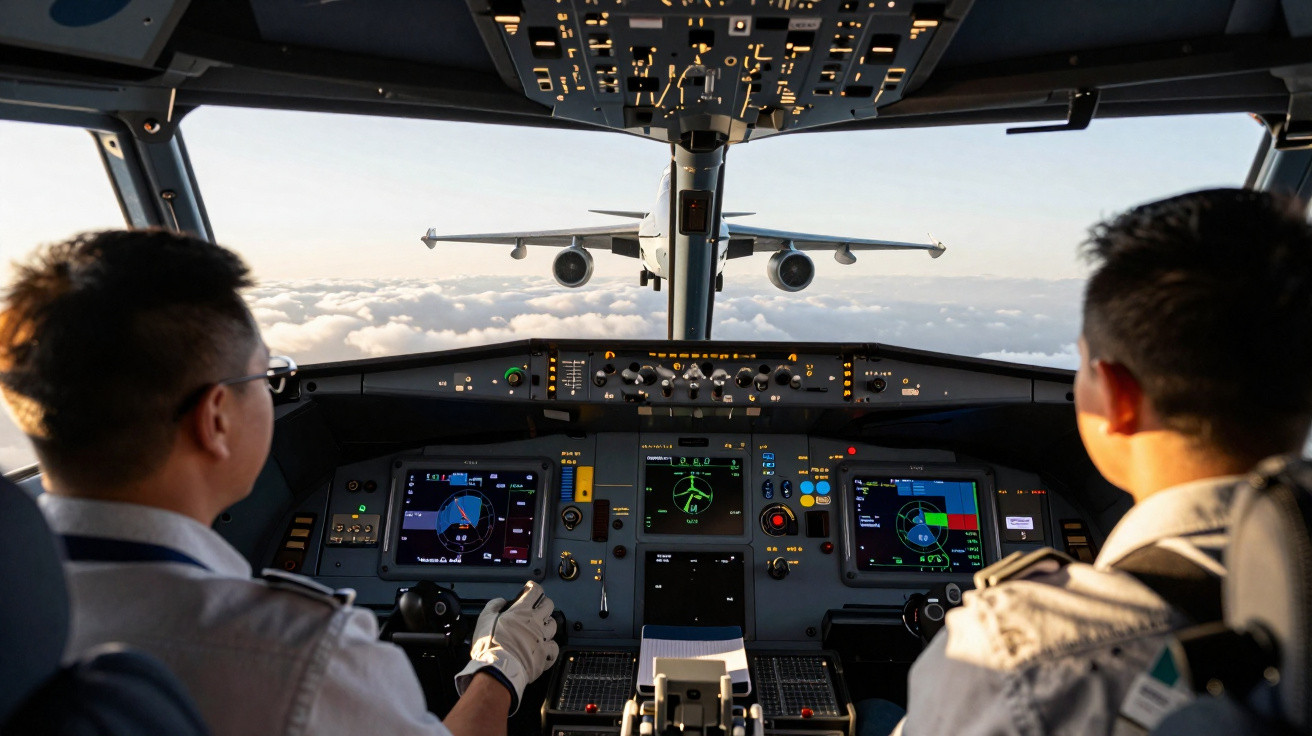
High above the clouds, a subtle transformation in air-combat logistics is taking place, driven less by pilots than by algorithms.
On 4 February 2026, Airbus and Singapore achieved a milestone that many air forces had watched for years: the world’s first certification of a fully automatic air-to-air refuelling system. The achievement puts the European manufacturer decisively ahead of its US competitor in one of military aviation’s most demanding manoeuvres.
Singapore and Airbus take air-to-air refuelling into a new era
The new technology, called A3R, or Automatic Air-to-Air Refuelling, has received official clearance for operational service aboard Singapore’s A330 MRTT tanker aircraft. The city-state’s air force is therefore the first in the world to operate a certified, fully automatic refuelling boom in routine service.
Air-to-air refuelling is still among the most difficult tasks in modern aviation. Two large aircraft must fly within a few metres of each other, frequently at speeds above 800 km/h and sometimes at night or in turbulent conditions. The tanker deploys a refuelling boom, which has to be inserted with exceptional accuracy into the receptacle of the receiving aircraft. Previously, this final and sensitive sequence relied almost entirely on the judgement and steady control of a boom operator.
A3R changes that arrangement. Using high-definition cameras, onboard image processing and advanced guidance algorithms, the system positions, steadies and connects the boom without uninterrupted manual input.
A3R keeps the human in the loop, but lets software handle the hardest seconds of the refuelling manoeuvre.
The operator continues to oversee the procedure and can immediately resume control if anything appears incorrect. However, the computer manages the majority of the approach and contact sequence, including alignment, separation and connection. This reduces the likelihood of human error at a point when even a minor mistake could damage both aircraft.
A fast-track partnership established in 2020
This advance was not achieved overnight. It is the result of a targeted collaboration begun in 2020 through Airbus’s SMART MRTT programme. Airbus required a customer willing to undertake extensive trials, accept operational risk and work closely with engineers and aircrews. Singapore joined at an early stage.
The Republic of Singapore Air Force provided its A330 MRTT tanker fleet, together with F-15 and F-16 fighters, for the trials. Singaporean pilots, technicians and engineers worked alongside Airbus personnel to assess the technology in real flight environments rather than solely in simulators.
Flight-test campaigns started in Spain before moving to Singapore’s hot, humid and frequently stormy airspace. Every sortie produced information on camera operation, tracking performance, software dependability and pilot workload. The Defence Science and Technology Agency (DSTA) served as the technical link between the armed forces and Airbus, helping to improve the algorithms and operating procedures following each test series.
INTA, Spain’s national aerospace technology institute, ultimately granted the system its formal certification. The institute validates advanced systems for European military aircraft, and its approval gives A3R credibility far beyond the Asia-Pacific region.
What A3R changes for tanker and fighter crews
The progression from manual to assisted and then automatic refuelling is more than a technical development. It changes crew responsibilities, mission preparation and overall risk in several respects:
- Less fatigue for boom operators during lengthy missions
- More uniform approaches and contacts, particularly at night
- The possibility of serving more fighters during each sortie
- Greater safety margins in poor weather or reduced visibility
- A simpler training route for new operators through automation support
For fighter pilots, more consistent and predictable boom movements reduce workload during the pressured seconds of contact. For air forces, this creates possibilities for future operations in which tankers sustain groups of crewed and uncrewed aircraft dispersed across large distances.
Automatic refuelling is a building block for future mixed fleets with drones, loyal wingmen and long-range strike aircraft sharing the same tanker.
Boeing’s KC-46A Pegasus remains in semi-automatic mode
Airbus’s progress naturally draws attention to the A330 MRTT’s principal rival, Boeing’s KC-46A Pegasus. Both aircraft are multirole tankers capable of refuelling other aircraft while carrying personnel, freight or medical evacuation equipment. Although the two platforms meet broadly similar requirements on paper, their level of technological maturity now appears markedly different.
The KC-46A has an advanced visual and control arrangement called ARO, or Automatic Boom Operator. It combines 3D high-definition cameras with a remote operator station, designed to enhance the boom operator’s situational awareness and comfort. Nevertheless, the Pegasus still depends on completely manual control for boom movement and the final connection.
This dependence on manual operation has coincided with continuing technical and programme difficulties. Since it entered service, the KC-46A has encountered:
- 3D imagery that may become deceptive or indistinct according to sunlight angle and lighting conditions
- Problems safely refuelling certain lighter aircraft
- Recurring delivery delays affecting several customers
- No certified capability for fully automatic refuelling
The US Air Force has directed a comprehensive upgrade of the Pegasus vision system, known as RVS 2.0, although it is not expected before late 2025 at the earliest. Until the upgrade has demonstrated its performance, the American tanker remains in a “semi-assisted” category: it uses sophisticated cameras but relies on human expertise for every boom movement.
How the A330 MRTT and KC-46A compare
Beyond the contest over automation, the two tankers vary in dimensions, capacity and export history. Airbus has converted the widebody A330-200 into a high-capacity tanker, whereas Boeing developed the KC-46A from the smaller 767-2C airframe.
| Criterion | Airbus A330 MRTT | Boeing KC-46A Pegasus |
|---|---|---|
| Base aircraft | Airbus A330-200 | Boeing 767-2C |
| Fuel capacity (approx.) | ≈ 111 tonnes in wings and tanks | ≈ 96 tonnes |
| Maximum troop capacity | Up to around 260 passengers | Lower, due to smaller cabin |
| Main role | Multirole tanker and strategic transport | Tanker for US Air Force plus transport |
| Customer base | More than 15 countries across three continents | Mostly United States, plus a few others |
| Orders (rough) | About 75 aircraft | About 150, mainly for USAF |
| Deliveries (rough) | More than 60 in service | Several dozen in service |
| Key strength | Large fuel and passenger capacity, strong export profile | Tight integration with US logistics and doctrine |
For export customers, A3R’s new certification is a point of distinction. It indicates that buyers can obtain not just greater fuel and passenger capacity, but also a refuelling architecture prepared for future concepts such as autonomous combat drones and networked fighter formations.
What automatic refuelling means for future air warfare
Automatic air-to-air refuelling is less about removing crews than making a vulnerable stage of complex missions more stable. Long-range air operations depend on exact timing between tankers and strike formations, and small delays can spread through an entire formation while cutting time over the target.
By allowing automation to manage the most demanding stage of refuelling, tankers could potentially support more aircraft on each sortie and handle more complicated refuelling brackets. For smaller air forces such as Singapore’s, this means making better use of every high-value asset. A single tanker sortie could safely keep more fighters airborne for longer, extending patrol or strike missions across broad maritime areas.
In an Indo-Pacific crisis, every extra minute a fighter can stay on station thanks to efficient refuelling becomes a strategic asset.
Automatic refuelling also fits with increasing interest in unmanned combat aircraft. Autonomous and remotely piloted platforms will still require fuel. A system such as A3R, built around sensor fusion and algorithmic control, could be adapted for drones without a person aboard to respond instantly to small boom movements.
Key terms: boom, probe and certification
This milestone relies on several technical concepts that are often overlooked.
A “boom” is a rigid telescopic tube that extends from the rear of a tanker aircraft. Traditionally, a boom operator directs it with small control surfaces to align it with the receiving aircraft. Another, older approach uses a flexible hose and a “drogue” basket, into which the receiving aircraft inserts a probe. A3R is centred on boom control, where the precision requirement is greatest.
Certification is also more than a rubber stamp. For a system such as A3R, it requires proof of safe operation across a broad range of speeds, altitudes, lighting conditions, weather and aircraft types. Test authorities assess the system’s response to sensor failures, unexpected pilot actions and sudden manoeuvres. The designation “certified for operational use” is only applied once those behaviours have been documented and found acceptable.
Benefits, risks and the next steps
Automation in combat aviation inevitably prompts questions about trust, failure modes and cyber risks. An automatic refuelling system needs robust safeguards so that a fault results in a safe disconnect rather than a collision. It must also have strong defences against malicious disruption of its sensors or software.
Operationally, the advantages are clear. Crews face a lower cognitive burden and receive more predictable tanker behaviour. Air forces obtain greater flexibility to plan missions with fewer aircraft. Training pipelines can focus more on supervising automated systems instead of developing a limited group of elite manual operators through thousands of training hours.
One scenario frequently discussed in defence circles connects automatic refuelling with “loyal wingman” drones operating beside crewed fighters. In this arrangement, an A330 MRTT fitted with A3R could refuel both piloted jets and autonomous partners on the same mission. Such a combination would extend the effective reach of a limited fighter force and make an adversary’s planning more difficult.
For Airbus, Singapore’s certification provides a reference case for prospective customers across Europe, the Middle East and Asia-Pacific. For Boeing, it presents a challenge: achieve or surpass this degree of automation, or risk the tanker market shifting further towards a competitor with a clear technological advantage in one of aviation’s most difficult tasks.


Comments
No comments yet. Be the first to comment!
Leave a Comment