
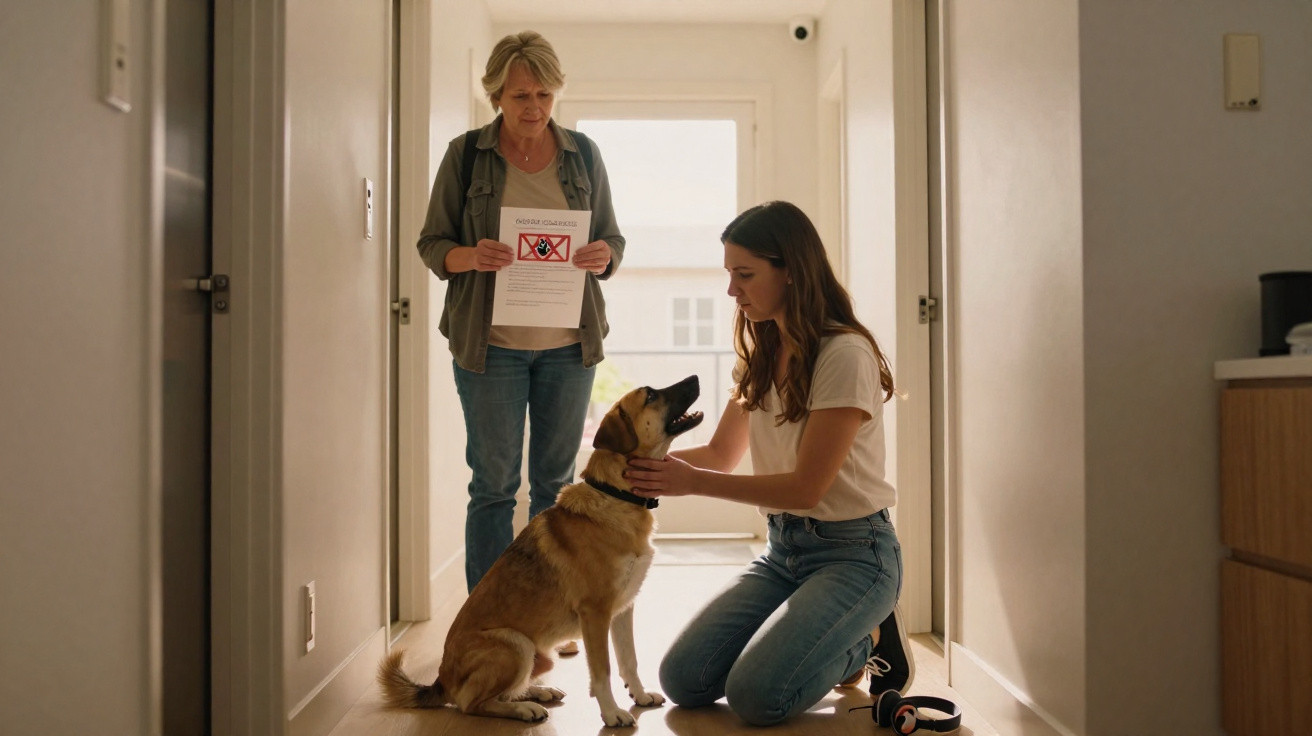
On a short street where every resident knows every other resident’s dog by name, the atmosphere shifts in a single night. Neighbours who once exchanged spare keys begin sending one another screenshots of noise complaints. Pet owners speak more quietly in the corridor. Windows are shut, not to keep out the cold, but because people fear somebody may be listening for their dog to bark.
The new regulation appears without fanfare, couched in dry legal wording that conceals how harsh it could be in day-to-day life. It sets one neighbour’s comfort against another’s companion. Noise is weighed against loneliness, and allergies against emotional support. On paper, the decision seems abstract; in reality, it quickly becomes personal.
The rule that makes everyday pets potential problems
At first, the “shocking new rule” seems straightforward: once neighbours submit a specified number of complaints about a pet, the authorities may require the animal to be removed from the building, or even from its home. Ostensibly, the measure concerns peace and quiet. Look closer, though, and it becomes a question of whose comfort matters most.
In many cities, proposed versions of these rules refer to barking limits, compulsory behaviour assessments and tight deadlines for answering complaints. A dog barking continuously for over ten minutes. A cat wandering along communal corridors. A parrot shouting swear words through walls thin as paper. Everyday animal habits can suddenly become legal proof.
Consider a medium-rise block of flats in a gentrifying area. For years, its residents have accepted the familiar soundtrack of children, footsteps and the occasional argument late at night. A new group of remote workers then moves in, needing quiet for video calls and screen-based work. A golden retriever on the second floor begins appearing in the council’s online reporting system. She has not changed; the building around her has.
Her owner, Alex, receives notices: initially a “friendly reminder”, followed by a “formal warning”. The third letter sets out the drastic alternative: rehome the dog or face legal proceedings. Alex fits a camera, employs a trainer and buys a white-noise machine. Yet the dog still barks when the postman arrives. Upstairs, someone submits another complaint on their phone between emails.
The reasoning behind these regulations reflects an uncomfortable reality: people are living more closely together than before while becoming increasingly dependent on animals for emotional support. Councils say nuisance reports are overwhelming them. Landlords say they are caught between unhappy tenants. Health bodies cite allergies and asthma. Taken separately, every argument seems sensible.
Together, however, they form a system in which a supposed “right” to silence can take priority over the relationship between a person and their pet. Sound meters and complaint totals become crude instruments for handling sensitive human conflicts. Law favours neat figures, while real life is largely made up of grey areas. How should excessive barking be defined when a person lives alone and their dog is the only heartbeat in the home?
Living with the rule without losing your pet - or your mind
There is a limited route through this situation, and it begins well before the first notice lands. Many experts consider the most useful step to be forming an unobtrusive, cordial relationship with neighbours before an issue develops. It could be a brief conversation in the corridor or a simple “let me know if the noise ever bothers you” when you move in. It may appear minor, but it can transform matters once making a complaint becomes an option.
Practically speaking, training and regular routines now matter more than ever. A short but energetic play session before leaving home may lessen anxiety-driven barking. Puzzle feeders and frozen treats can extend the time a dog remains occupied rather than noisy. For cats, elevated shelves and scratching posts can keep stress-related behaviour away from doors and walls, where neighbours are most likely to hear it.
Emotionally, pet owners often swing between guilt and defensiveness. You care about your animal, while your neighbour cares about getting sleep; both concerns are genuine. Many people do not start communicating until a formal dispute is already under way, and by then it is generally too late. A handwritten message saying “I’ve started a training program, it might take a few weeks” may ease tensions more quickly than a solicitor’s letter.
Let’s be honest: hardly anyone does this every day. Most of us respond only once something has gone wrong. Even so, in blocks where residents openly discuss their pets, disputes are more likely to remain on a human scale. Rather than hearing, “Your dog is unbearable,” you may hear, “She was barking at 3 a.m., are you OK?” It is the same behaviour, but an entirely different narrative.
Professionals who mediate neighbour disputes return repeatedly to the same observation:
“Noise rarely starts as a legal problem. It starts as a human problem that nobody knew how to talk about.”
Where the new rule is already being trialled, a clear pattern is emerging. Households that avoid the toughest consequences tend to have a small set of measures in place before matters worsen:
- Written records of training work and veterinary appointments.
- A straightforward log of when the animal is left alone or most likely to make noise.
- A single agreed way to communicate with neighbours, such as a note, WhatsApp group or email.
Nothing on this list guarantees protection. However, it can change the narrative from “irresponsible owner” to “person trying in good faith”. When a council officer or landlord sees that evidence, the tone of the process often becomes less severe, even where the rule itself remains strict.
The quiet revolution inside our buildings
These regulations alter more than what is permitted; they also reshape how people experience home. Pet owners may begin monitoring their animals as a manager monitors an employee. Is that bark “normal”, or is it “evidence”? Is scratching at the door merely a habit, or a possible breach? Living under that scrutiny causes a muted stress rarely recorded in official paperwork, even though it wears away at everyday life.
On the other side of the wall, certain neighbours find a different form of influence. A single online complaint form can affect how someone else lives with their pet. That influence can be exercised with kindness, or without it. At a time when many people feel powerless over rents, work and politics, small-scale control within a building can feel oddly rewarding.
This is not truly only about dogs and cats. It concerns how much disruption we are prepared to accept from one another in an era fixated on productivity, headphones and “personal space”. The same society that urges people to protect their mental health may also demand that they quieten the creature that helps them get out of bed on their worst days.
Some cities are trying another approach: mediation ahead of sanctions, and education before punishment. They offer workshops for pet owners and neighbours, display shared guidance in entrance halls, and create small community funds to soundproof the noisiest flats. These measures are unlikely to trend on social media, but they could quietly prevent a few heartbreaks.
A further uncomfortable issue sits in the background: when rules become stricter, who is still able to keep their animals? Those with savings can afford professional training, dog walkers, pet sitters and additional sound insulation. Those living paycheque to paycheque cannot. The danger is that the new rule could drive pets out of precisely the homes where they are needed most.
We have all known the moment when one knock at the door changes the mood of the entire evening. For some pet owners, that knock now brings a new fear: not simply “am I bothering someone?”, but “could I lose the one creature that sees me exactly as I am?” No polished policy document can fully account for that choice.
So when somebody mentions “that shocking new rule”, it is worth pausing before choosing a side. Every complaint may come from an exhausted neighbour who needs sleep. Behind each barking dog may be a person trying to keep their life together with a lead and a little routine.
Perhaps the real issue is not a straightforward conflict between pet lovers and pet haters. It is about how we bargain over close-quarters living when we are all slightly more vulnerable, more wired and less inclined to knock on a door and simply speak. The rule exposes that strain; what happens next remains our choice.
| Key point | Detail | Why it matters to the reader |
|---|---|---|
| How the new rule works | Explains complaint thresholds, investigations and the possible forced removal of pets | Helps you understand the real risks behind official letters |
| Practical survival tactics | Training routines, communication with neighbours and simple documentation habits | Gives you practical actions to protect both your pet and your relationships |
| The deeper social shift | What these rules reveal about noise, mental health and urban living | Encourages you to reflect, share and perhaps reconsider how your own building lives together |
FAQ:
- Can a council really force me to give up my pet? In some areas, yes, although this normally follows repeated complaints, recorded warnings and unsuccessful attempts to address the matter through training or mediation.
- Do all noise complaints count the same? No. Many systems consider frequency, the time of day, and whether the noise is continuous or caused by particular events such as deliveries or alarms.
- What should I do after receiving a first warning? Remain calm, speak to your neighbours if possible, begin a simple action plan involving training, routines and enrichment, and retain written evidence of what you do.
- Can I challenge an unfair complaint? Often, yes: you can ask how the noise was measured, submit video evidence from when you are away, or request mediation instead of immediate sanctions.
- How do I talk to a neighbour whose pet is driving me crazy? Choose a calm time, explain specific timings and effects rather than attacking the owner’s character, and suggest working on a solution together before contacting the authorities.






Comments
No comments yet. Be the first to comment!
Leave a Comment