
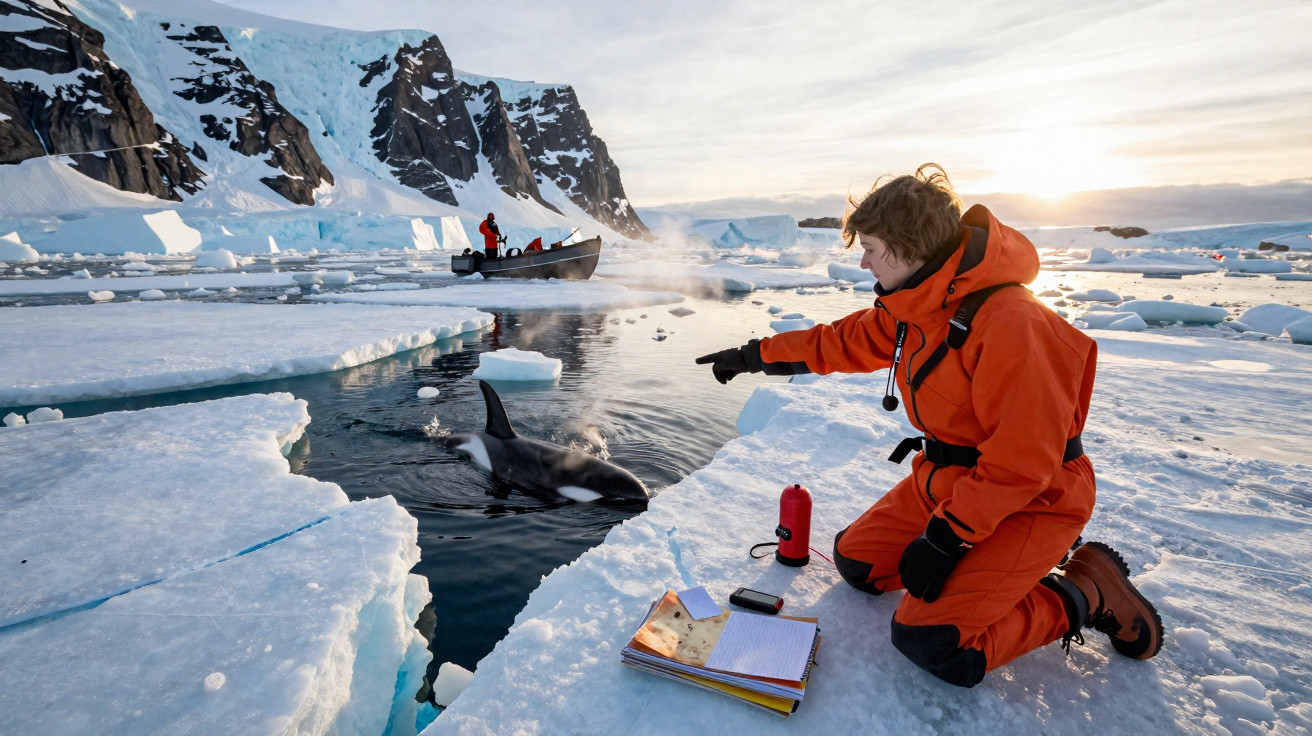
The first orca broke the surface just beyond the mottled boundary of the ice, its black-and-white body stark against the level grey sea. Several hunters in the small coastal settlement of Tasiilaq stopped dead, rifles only half-raised, as whales were not what had caught their attention. Their eyes were fixed on the towering blue-white ice ahead, which had been groaning and splitting for days. As the orca breathed out, its vapour rose like smoke in the freezing air and drifted towards an ice shelf everyone now calls by the same name: unstable.
A second dorsal fin emerged minutes later, nearer this time, moving in the unsettlingly inquisitive manner for which orcas are known.
Someone on shore took out a phone and rang the local police. The call was not about the whales, but about what the ice might do.
Nobody wants to be present when it finally gives way.
Greenland’s emergency: orcas, ice and a dangerous new normal
This winter, unusually open water has spread along Greenland’s south-east coast, cutting dark, shifting channels through the ice shelves. Those who were raised to read ice as though it were a book now concede that they no longer recognise its pages. Against this vulnerable backdrop, orcas have returned repeatedly, moving along glacier margins that were once firmly sealed by ice. Local radio broadcasts carry fresh reports almost every day: “Orcas near the fjord mouth.” “Orcas under the ice edge.” “Orcas close to the shelf.”
For Greenland’s government, the trend became impossible to dismiss. Officials declared a regional emergency last week following recurring orca sightings beside ice shelves already classed as unstable. The concern extends beyond the whales themselves; it lies in what their appearance may quietly indicate.
A particular event in Sermilik Fjord has been retold repeatedly in discussions from Nuuk to Copenhagen. Fishermen set out at first light beneath a sky still coloured deep Arctic blue, heading for an ice-shelf area where their lines had been placed for generations. By the time they reached it, a pod of orcas was already surfacing and diving at the ice edge like scouts. The hunters say a different noise reached them that morning.
It was not the whales.
Instead, it was the shelf cracking far within its structure as the orcas hunted around its base, herding seals into a fatal trap. Several hours afterwards, part of the shelf collapsed with a thunderous sound that rang through the fjord. Nobody was injured, but the boats had to retreat as the water became strewn with sharp ice blocks as large as cars.
Scientists have long understood that orcas are highly opportunistic. They track food, investigate unfamiliar passages and enter areas where ice has become thinner. Their regular presence beneath old, high ice shelves is therefore a sign that conditions have already altered. Thinner ice opens up hunting grounds that were inaccessible for much of the year in the past.
Greenlandic authorities have two main concerns. Firstly, orcas may place additional stress on ice from beneath while travelling through narrow leads, nudging floes and disrupting seals resting near cracks. Secondly, seeing them there can draw fishermen and interested residents nearer to the hazardous ice edge, whether in search of a stronger catch or a closer view. It’s the perfect recipe for someone to be in the wrong place when a massive block finally breaks away.
How Greenland is responding on the ground
Although an emergency declaration can appear distant and theoretical, it has become a highly practical set of everyday rules on Greenland’s east coast. Patrol vessels have been reassigned to watch recognised unstable shelves and recorded orca hotspots. When sightings occur close to fragile ice, authorities send text alerts to village leaders, who share the warning by the quickest available means: group chats, VHF radio and calls across harbours where people still mend nets by hand.
The advice is straightforward: keep vessels a considerable distance from high ice faces; do not stand or travel on sea ice near reported orca pods; and choose safer landing places, even where this makes journeys longer. For sea-dependent communities, these instructions are not merely safety guidance. They change the daily pattern of work.
In Kuummiut, Jakob, a 54-year-old fisherman, says the most significant shift has been mental. Previously, he assessed ice solely by its colour and the sounds it made. Now he also pays attention to reports of orcas. When a dorsal fin is seen near “his” ice shelf, he remains at home, regardless of how much his family wants a fresh catch.
He recalls when an orca sighting was rare, more often an occasional tale shared over coffee. This season, however, his teenage son recorded them on his phone three times in one week as they circled a narrow channel beside a glacier front. The clips attracted thousands of TikTok views, but they also sent a quiet shiver through the settlement. As residents watched smaller pieces of ice collapse in slow motion behind the animals, many saw a boundary they had never wished to cross. The orcas had reached a place where the ice was no longer reliable.
Away from public view, glaciologists are studying satellite images and comparing changes across weeks rather than years. Orca reports have become moving markers on their digital maps, identifying vulnerable stretches of Greenland’s coastline. Where several pods gather at the same ice front within a short period, researchers search for concealed fractures and deep erosion from warmer water.
Emergency status releases funding and powers for a rapid response, including temporary exclusion areas, additional patrol fuel and even helicopters when moving ice cuts off a settlement. The response concerns more than immediate danger. It is also a live-fire exercise for an Arctic future in which unpredictable ice, new marine predators and human settlements will meet more frequently. Let’s be honest: nobody really has a playbook for this yet.
What this strange alliance of whales and warming means for the rest of us
Viewed from afar, orcas can seem like majestic visitors and the ice like a remote postcard scene. In Greenland itself, the pairing increasingly resembles a warning system that the wider world has not yet learned to interpret. One quiet and practical approach now gaining ground among local researchers is remarkably simple: regard every unusual gathering of orcas as a possible warning sign of ice instability.
They record GPS locations, contact nearby settlements and compare the dates against regional temperature and sea-current data. Where the same pattern occurs again, the site is marked as high-risk for calving or sudden break-up. This is a grassroots form of climate adaptation, shaped not by major international summits but by fishermen’s instincts and scientists prepared to hear them.
The human dimension can easily be overlooked. Altering routes means reduced income, while avoiding a productive ice shelf can result in a difficult month for families dependent on seals or fish. When officials instruct residents to avoid areas because of orcas and unstable ice, they are also indirectly asking them to alter their culture at speed.
We’ve all been there, that moment when you realize the “old way” you trusted no longer quite works, and no one has given you a comfortable new one yet. For Greenland’s coastal residents, that realisation unfolds amid splitting glaciers and sudden booming icefalls that resemble far-off blasts. The emergency designation applies not only to the ice, but to a way of life being compelled to adapt quickly.
“As a child, I was never afraid of the ice,” says 32-year-old hunter and guide Ane Kirstine from East Greenland. “You learned its moods. Now the orcas show up where my grandparents said they should never be. That tells me the ice has moods we don’t know anymore.”
Stay curious about small signs
Even when living far from Greenland, notice how animal ranges are changing in your own area: unfamiliar winter birds, insects appearing at unusual times of year or marine mammals moving closer to shore. Such changes are often among the earliest signs of shifts that people are still discussing.Recognise climate stories as safety stories
Greenland’s emergency is not simply a remote and abstract climate headline. It is a public-safety measure prompted by particular threats: boats approaching ice walls too closely, hunters on thinning shelves and children playing where the sea has quietly become warmer.Connect the dots beyond the spectacle
Videos of orcas hunting near glaciers can be mesmerising. Their real importance emerges when we ask: Why are they here now? What does their presence reveal about the ocean, the ice and those who share this environment every day?
A fragile edge that concerns more than one country
At the foot of a Greenlandic fjord, the scale of 60 metres of vertical ice makes a person feel very small. There is another sensation too: the impression that the dividing line between solid and liquid is no longer fixed. Orcas gliding along this boundary create a form of moving headline, traced in black-and-white curves over a melting blue wall.
For those who live there, an emergency declaration does not resolve much on its own. It creates time. It tells fishermen and hunters that their observations about a changing sea are being taken seriously. It also presses distant ministries and overseas capitals to acknowledge that the Arctic’s “later” has already arrived.
Most of the rest of us encounter these events only as brief images on phone screens: dramatic calving, a sleek dorsal fin cutting steel-grey water or a climate scientist’s quotation. Yet repeated orca sightings near unstable shelves belong to a broader pattern. They show how swiftly animals adjust to warmer conditions, how slowly infrastructure catches up and how communities are left between the two.
Some people will regard this as an oddity. Others may recognise something uneasily familiar: seasonal changes, emerging hazards and old rules coming apart. Greenland’s ice is changing loudly. The question over those cold, open waters is whether we are ready to hear what the whales are quietly communicating.
| Key point | Detail | Value for the reader |
|---|---|---|
| Orca sightings as warning signs | Repeated pods close to unstable ice shelves point to thinner ice, warmer water and a greater risk of calving | Helps you view wildlife headlines as early signs of climate stress rather than isolated curiosities |
| Local emergency measures | Greenland has redirected patrols, sent text alerts and advised boats to avoid particular ice fronts | Shows what climate adaptation looks like in practice and how rapidly rules can change in dangerous areas |
| Human impact and adaptation | Fishermen and hunters are taking different routes, losing income and learning anew how to “read” the ice | Provides a human perspective on climate change beyond charts and helps connect with the reality of Arctic communities |
FAQ:
Why did Greenland declare an emergency over orca sightings?
Repeated sightings coincided with ice shelves already known to be unstable, increasing the threat of abrupt collapse, hazardous falling ice near boats and accidents involving people on or close to thinning sea ice.Are the orcas directly causing the ice to break?
They are not the underlying cause - warmer water and air are. Orcas can add pressure by travelling under and beside weakened ice, as well as driving seals and boats nearer fragile edges where break-ups are more likely to prove fatal.Is this linked to global climate change?
Yes. Warmer oceans and milder winters thin sea ice and erode glaciers from below, creating new paths for orcas into fjords and beneath shelves that were sealed off for much of the year.How are local communities affected day to day?
Residents are changing fishing and hunting routes, staying away from familiar ice shelves, monitoring weather and wildlife more carefully, and facing lost income when prime areas are judged too dangerous.What can readers outside Greenland take from this?
Consider orca sightings and shifting ice as an early-warning system from which everyone can learn. It is a reminder to notice subtle changes to wildlife, seasons and local safety guidance where you live - these often come before large, headline-making disasters.



Comments
No comments yet. Be the first to comment!
Leave a Comment