
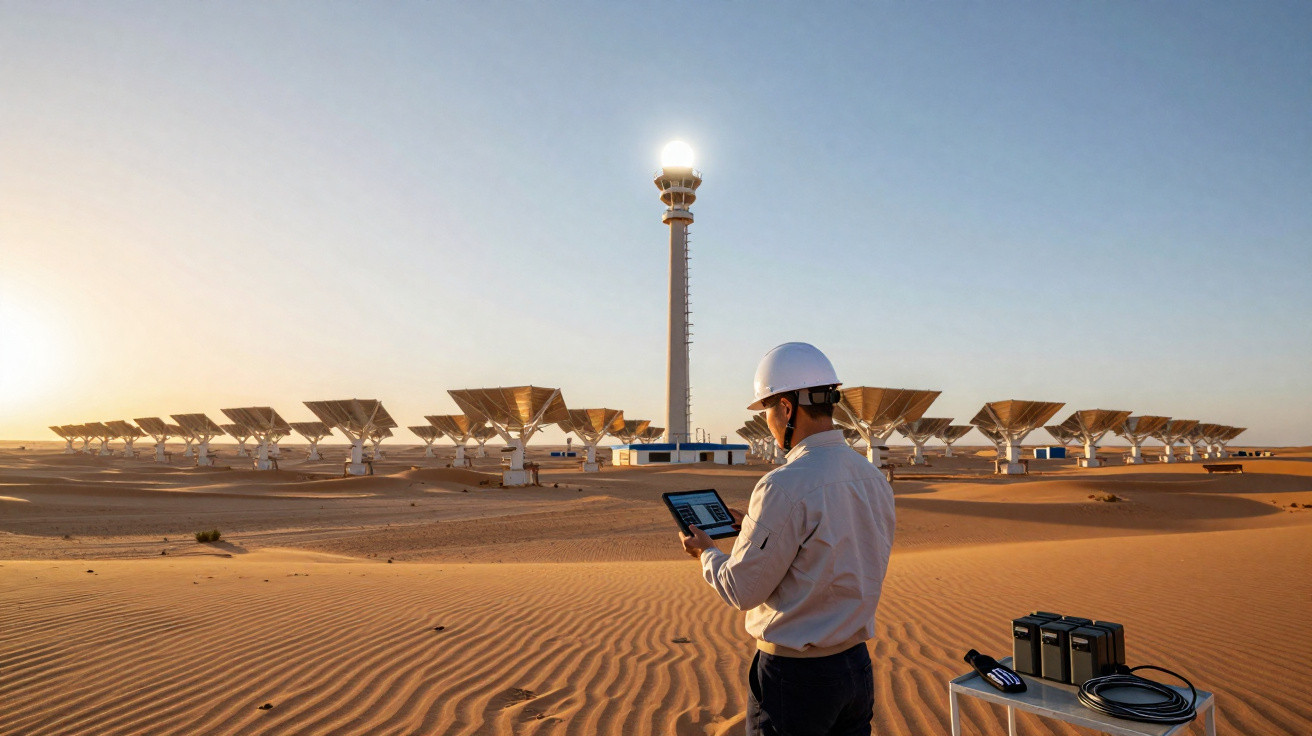
Amid vast stretches of sand and extreme heat, a quiet project is beginning to reshape the global energy map.
Far from urban centres, in a desert area of Abu Dhabi, an extraordinary array of solar panels and vast batteries is being built to create something close to an “artificial sun”, capable of keeping entire cities powered day and night.
A sun that never sets in the desert
Construction has begun in the United Arab Emirates on Khazna Solar PV, billed as the largest solar power plant on the planet. The complex covers around 90 km² in the Abu Dhabi desert, on land that is almost uninhabitable but ideal for capturing intense solar radiation throughout the year.
The consortium behind the scheme brings together Masdar, the country’s renewable-energy giant, France’s Engie and the Emirates Water and Electricity Company (EWEC). Together, they are backing a model that goes beyond the conventional grid-connected solar plant.
Khazna Solar PV was designed to deliver 1.5 gigawatts of clean electricity, 24 hours a day, 7 days a week, with uninterrupted supply.
The aim is ambitious: to remove the well-known intermittency of solar power by providing a steady flow of electricity without relying, in real time, on sunshine or clear skies. Operations are scheduled to begin in 2027.
Three million panels creating a blanket of light
To achieve this output, the project calls for the installation of roughly 3 million photovoltaic panels, creating a genuine “sea” of silicon in the desert. In satellite images, the installation is expected to stand out as a dark rectangle against the sand’s beige landscape.
These panels will capture energy during daylight hours, when production peaks well beyond immediate demand. Rather than simply feeding all of that power into the grid and dealing with fluctuations, the plant has been designed from the outset as an integrated generation-and-storage system.
- Project area: ~90 km²
- Planned capacity: 1.5 GW
- Approximate number of panels: 3 million
- Start of operations: 2027
- Technological frontier: generation + storage for continuous supply
According to consortium estimates, the electricity produced will be enough to supply around 160,000 homes in the Emirates. Environmentally, the plant is expected to prevent the release of more than 2.4 million tonnes of CO₂ each year.
The projected climate impact is equivalent to taking approximately 470,000 combustion-engine cars off the roads every year.
Advanced technology to capture every ray of sunlight
The developers are not merely increasing the number of panels. Their intention is to make every square metre of desert productive. To achieve this, every photovoltaic module will use solar-tracking technology.
Instead of remaining fixed in place, the panels will move throughout the day. Motors and control systems will automatically alter their tilt angle to follow the sun’s path across the sky. This movement delivers significant efficiency gains, particularly across large open areas.
The project also promises extensive use of advanced digital solutions. Sensors distributed across the site will monitor temperature, radiation levels, the performance of each panel row and even dust build-up, which is a critical issue in desert regions. Data-analysis algorithms will help forecast faults, optimise cleaning and schedule maintenance with less impact on output.
The role of storage systems
One crucial part of the equation remains: where to keep so much energy so it is available at night. Khazna Solar PV has been designed with one of the largest storage systems ever planned for a single power plant, combining utility-scale batteries and potentially other complementary solutions, such as thermal storage or green hydrogen storage, depending on the final design.
| Period | Main source | Role of storage |
|---|---|---|
| Day | Direct generation from panels | Store surplus for the night and peak-demand periods |
| Night | Batteries and reserve systems | Gradual release to maintain a steady flow |
With this combination, the plant moves closer to something governments and companies have pursued for years: turning naturally intermittent solar energy into a dispatchable source, similar to hydroelectric or thermal generation, but without burning fossil fuels.
Why this “artificial sun” matters to the rest of the world
Although it is located in Abu Dhabi, the project has global showcase value. Countries with high levels of sunshine, including Brazil, Chile, Australia and several African nations, are watching this type of scheme closely. The model of hybrid mega-plants, combining renewable generation with large-scale storage, is likely to become a standard feature of the energy transition.
For the Emirates, the plant also carries symbolic value. One of the world’s largest oil producers is placing a solar megaproject at the heart of its own electricity mix. This directly aligns with decarbonisation targets and international pressure to reduce the use of fossil fuels.
The message is clear: even oil powers are investing heavily in more stable and predictable solar energy.
What this signals for cities and consumers
If Khazna Solar PV delivers on its promise, it could make room for major urban regions to rely predominantly on solar systems without fearing blackouts when skies darken or night falls.
In practice, this could mean:
- A gradual reduction in the share of gas- and coal-fired power plants.
- Long-term contracts for 100% renewable electricity, including for industry.
- More stable prices, less exposed to fossil-fuel fluctuations.
- Greater scope for electric cars charged using low-carbon energy.
Terms worth understanding
Two concepts are particularly important when discussing projects of this kind.
Electricity mix: this is the combination of sources that make up the generating mix of a country or region. Solar, wind, hydroelectric, thermal and nuclear power all form part of it. When solar energy’s share is said to be increasing, it means that the proportion contributed by solar panels to total annual generation is growing.
Intermittency: this is the natural variation in output from renewable sources such as solar and wind power. When a cloud passes overhead, generation falls. When the wind strengthens, it rises. Without storage or supporting sources, this variation makes it harder to keep the electricity grid stable.
Scenarios, risks and opportunities
Projects on this scale bring technical and environmental challenges. Large-scale installation in desert areas requires care for local biodiversity, wildlife adapted to arid conditions and water use for cleaning modules, as dust can significantly reduce panel efficiency.
There is also the issue of component lifespan. Panels and batteries need replacing after a few decades. This requires planning for recycling chains and the reuse of materials such as silicon, aluminium and lithium, so that “clean” energy does not leave behind a trail of poorly managed waste.
On the other hand, as new solar mega-plants with storage emerge in different regions, costs are expected to fall and expertise to spread. This could make it easier, for instance, for medium-sized cities to sign energy contracts with hybrid plants that guarantee 24/7 renewable supply, something that still seems far removed from the reality of many consumers today.
Ultimately, one possible scenario for the coming decades is a combination of large desert “artificial suns”, utility-scale wind farms and distributed generation on urban rooftops, creating a far more diverse and resilient electricity system. Abu Dhabi’s experiment, with its sea of 3 million panels, serves as an open-air laboratory for this new stage of the global energy transition.






Comments
No comments yet. Be the first to comment!
Leave a Comment