
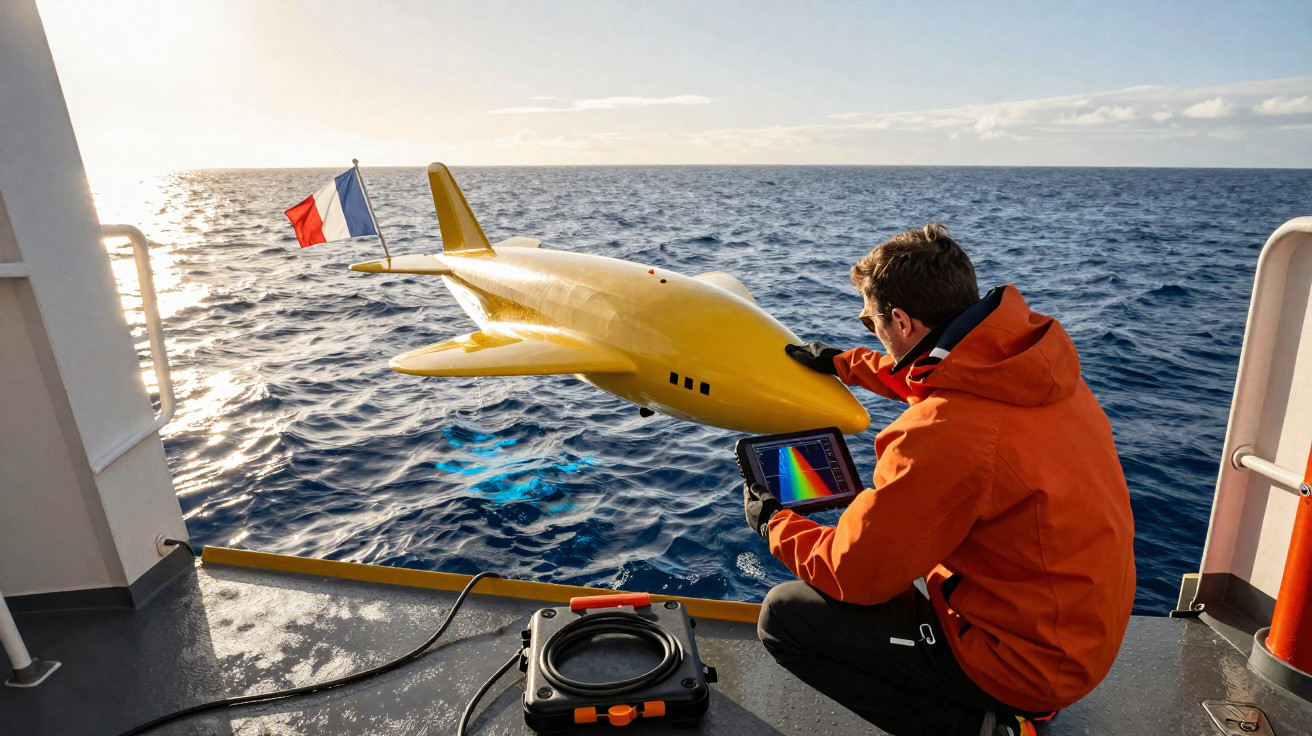
The research vessel rocks gently in a grey Atlantic swell somewhere off Brest.
On the aft deck, engineers wearing orange helmets gather around an unusual yellow torpedo resting in its cradle. There is no propeller, no noise and no spectacle - only sleek composite lines, several antennae and a logo that conveys more than any press briefing: France is heading deep.
A crane raises the glider and, for a moment, it dangles above the sea like a suspended question mark. It then touches the water, leans over and vanishes in a soft, almost courteous splash. There is no dramatic countdown or grand address. Instead, a compact machine begins its descent towards 3,500 metres, into a realm untouched by light.
Someone on deck says quietly: “If it works, we’ll see things nobody has seen before.”
The reply is silence. For now, the ocean holds on to its secrets.
France discreetly equips itself with a new deep-sea eye
At first sight, the glider France is acquiring appears unremarkable. Roughly the length of a small kayak, it neither roars nor sends spray skywards like a film submarine. It simply glides - slowly and steadily - descending to 3,500 metres before climbing again in repeated, broad arcs.
Rather than relying on a propeller, it travels by altering its buoyancy, much like a mechanical fish regulating its lungs. When it becomes denser than water, it descends; when it is made slightly lighter, it ascends. Its wings convert this vertical motion into forward movement: underwater soaring far below the storms that churn the surface.
Although it may resemble a toy, the device is in fact a strategic asset that sits between a scientific instrument and a discreet sentry.
In 2018, a comparable glider spent months drifting across the Southern Ocean and transmitted accurate temperature and salinity readings. Researchers subsequently used those measurements to improve climate models and examine how the deep ocean absorbs heat. It required no crew and no fuel: the robot navigated darkness by harnessing pressure and gravity.
France’s new 3,500-metre glider takes this approach considerably further. At that depth, pressure reaches 350 bars - comparable to having a small car pressing down on every square centimetre. Conventional research vessels may sail overhead, yet they can only skim the surface of what is happening below.
This is the machine’s role: sustained endurance, broad coverage and continuous data transmission. For weeks or months, it can follow unseen water-mass structures, chart soundscapes and detect faint chemical traces that may reveal life or pollution.
We often imagine “exploration” as aiming a camera at somewhere unfamiliar. That definition has changed. Exploration can now involve hearing minute temperature changes, measuring tiny oxygen variations and identifying patterns visible only to algorithms. France’s glider belongs to this new language of discovery.
At 3,500 metres, sunlight has vanished and colours no longer exist as we experience them. Temperatures remain just above freezing. The water is dense, almost syrup-like, but life persists there - resilient and adapted. This is the zone where continental slopes give way to abyssal plains, where submarine canyons form hidden routes and mineral-rich seeps sustain surprising ecosystems.
The glider is not a miniature submarine for visitors. It is a silent messenger crossing these environments with a sensor-packed payload. France can alter that payload whenever needed: chemical detectors today, acoustic equipment tomorrow, and perhaps micro-cameras or genetic-sampling instruments later.
Each descent adds a strand to a far larger account involving climate, resources, national sovereignty and perhaps even new pharmaceutical prospects concealed in strange organisms that have never encountered sunlight.
How France’s diving robot changes science, strategy and daily decisions
A 3,500-metre glider matters for a straightforward reason: decisions about climate begin in the ocean long before they are debated on land. The sea stores most of the heat retained by greenhouse gases. Without reliable measurements at depth, our understanding is close to flying blind.
A glider can record temperature and salinity profiles across vast areas for extended periods with precise consistency. Dive after dive, it produces vertical data “curtains”, like a scanner gradually exposing a body’s internal structure. Scientists compare those sections with satellite imagery and readings gathered by ships.
The outcome is a three-dimensional, time-lapse picture of what the ocean is truly doing, rather than an assumption based solely on its surface.
France also has tangible interests beneath the waves: cables, offshore wind farms, key naval routes and extensive exclusive economic zones stretching from the Atlantic to the Pacific. A glider able to work quietly, at great depth and over lengthy periods is more than a scientific gadget. It is a means of maintaining a presence.
There is no heroic soundtrack here either. The underwater robot can instead monitor a chosen area, detect a gas leak, measure turbulence around a cable or listen for low-frequency noise in a contested maritime zone. In a world where the seabed generates as much attention as space, such presence matters.
We do not often connect everyday actions - eating seafood, streaming films or flying - with machines like these. Yet glider data informs fishing rules, the design of undersea infrastructure and long-term risk assessments for coastal towns and cities.
Gliders also transform how teams operate. Traditional oceanographic missions were brief, intensive and costly: a large vessel, a large crew and a few weeks at sea before returning to port. A single ship can now deploy several gliders and depart, while the robots continue working after the people involved are home and receiving data in real time.
This requires researchers, engineers and policymakers alike to work in a follow-up mindset rather than treating a mission as a single opportunity. They can modify operations as they unfold, redirecting a glider when an unusual current emerges or investigating an unexpected sound anomaly detected at depth.
Let’s be honest: nobody reads 400-page mission reports from beginning to end every day. Yet when anomalies emerge from the data and affect something concrete - a threat to a cable or a possible current pattern that could alter winter storms - decisions can begin changing quietly behind the scenes.
France’s purchase is part of a broader trend. The United States, China, Australia and several European neighbours are developing fleets of gliders and deep-sea robots. The contest is not merely about who “owns” the seabed, but who understands it most effectively. In this slow-moving race, endurance and detailed data often count for more than spectacular one-off expeditions accompanied by television crews.
What this deep-sea advance means for you, me and our view of oceans
To understand what the new glider really alters, picture a weather forecast based on only two or three ground stations. That is broadly the position we have been in with the deep ocean: a few moorings, occasional ship-based surveys and scattered readings within a moving, living mass.
As glider numbers grow, we begin to approach the equivalent of a proper deep-water meteorological network. Storms, heatwaves and droughts leave an underwater signature before they become evident in the sky. With its 3,500-metre operating range, France can examine these early indications far more effectively.
That will not ensure fewer disasters, but it does improve the chances of earlier alerts, more intelligent adaptation and fewer severe surprises.
It would be a mistake to regard the glider as a silver bullet that will “solve” the ocean. It cannot. There is a risk of scientific complacency: believing that a handful of robots and colourful charts mean we already understand enough. In reality, the reverse is true. The more information gliders return, the more questions multiply.
Why does a deep current slope slightly in one location but not another? How do deep soundscapes alter as shipping routes change? Which organisms flourish on chemical gradients that humans could never sense? Each answer creates three further questions.
For non-specialists, the important point is that this form of exploration is not a glamorous sprint. It is a marathon of minor adjustments, small findings and occasional major breakthroughs. The glider is a method rather than a miracle.
There is a cultural dimension as well. For decades, the ocean was presented either as a postcard or as a danger: tourism at the surface and storms in the news. Deep-sea robots such as this glider provide a third story, portraying the ocean as a complex, data-rich partner in our future.
At a very human level, that can reshape discussions. A port city may consider using glider readings to prepare coastal defences. A fisher may track deep-temperature anomalies that influence fish migration. A teacher may show pupils more than a globe, displaying real-time profiles from a machine diving beneath their feet.
“Exploration used to mean sending a few heroes to plant a flag,” says a French oceanographer who worked on the project. “Now it means sending dozens of quiet machines, every day, to listen to a planet we thought we knew.”
On a more emotional level, this technology appeals to something straightforward: curiosity. On a busy, noisy planet, the deep ocean remains among the last places that nobody has yet scrolled through. On a Sunday evening, exhausted after a long week, someone ashore might watch a small laptop dashboard and follow a yellow icon descending and ascending in slow waves.
- They watch a blue temperature line fall as the glider descends.
- They spot a slight irregularity at 2,800 metres and wonder what lives there.
- They understand that this is not merely “science”, but a way of quietly renegotiating our relationship with the ocean.
A new underwater chapter written through silent dives and patient work
France’s deep-diving glider will not generate headlines every day. Most of its work will happen out of sight: methodical, persistent and almost stubborn. Descend, measure, rise, send data - then descend once more. It is a daily cycle at the edge of the unknown.
Even so, its presence changes the story. It offers scientists another level of observation, gives the navy a subtler sense of activity beneath its routes and helps society better understand the concealed engine of the climate. It also communicates something significant: the space race has a counterpart immediately beneath the waves.
We have all experienced a moment when the sea appears flat and almost dull, prompting our eyes to turn back to our phones. Yet 3,500 metres below that surface, the glider passes through landscapes as striking as mountain ranges, listening for whispers of heat, chemistry and life.
Whether this development produces wiser choices or simply more efficient exploitation will depend on how we use the information it returns. The machine cannot make that choice for us. It can only reveal, line by line, a world we have treated as scenery for too long.
Perhaps that is the quiet revolution: not the robot alone, but the recognition that understanding the deep ocean is no longer a luxury limited to a few high-profile expeditions. It becomes an ongoing shared responsibility, somewhere between national strategy and collective curiosity.
| Key point | Detail | Why it matters to the reader |
|---|---|---|
| A glider reaching 3,500 m | A propeller-free robot that descends and rises by changing its buoyancy | Understanding what this “new” form of ocean exploration looks like in practical terms |
| A scientific and strategic tool | Deep-climate measurement, cable monitoring and a discreet presence at sea | Seeing how a specialist technology affects security, weather and the economy |
| A changing ocean narrative | Moving from occasional expeditions to permanent, silent and distributed monitoring | Imagining a more detailed and continuous relationship with the marine world |
FAQ:
- What exactly is an ocean glider? An ocean glider is an autonomous underwater robot that moves by changing its buoyancy instead of using a propeller, diving and rising in slow arcs while collecting data with onboard sensors.
- Why is diving to 3,500 metres such a big deal? At 3,500 metres, pressure is extreme and traditional instruments struggle; reaching that depth opens access to vast, poorly known zones where climate processes, ecosystems and resources interact.
- What kind of data will France’s glider collect? Typically it measures temperature, salinity, pressure, sometimes oxygen, sound or chemical traces, and future missions can add new sensors depending on scientific or strategic needs.
- Is this glider a military tool or a research tool? It is primarily a research platform, but like many ocean technologies it has dual-use potential, from environmental monitoring to discreet surveillance of undersea infrastructure.
- Will this change anything in everyday life? Indirectly, yes: better deep-ocean data feeds into climate forecasts, coastal protection plans, marine resource management and even the reliability of cables that carry our internet traffic.



Comments
No comments yet. Be the first to comment!
Leave a Comment