
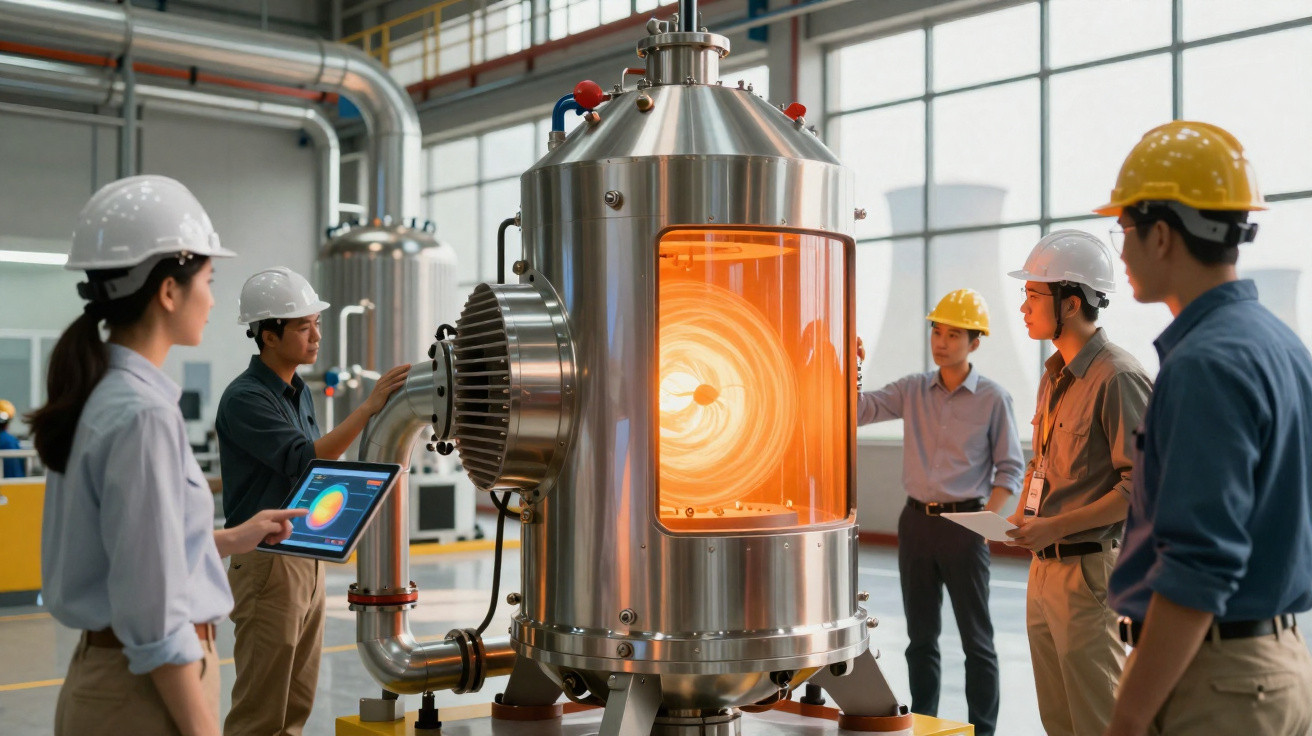
Their goal is not to construct another vast reactor supplying the national grid, but a compact unit conceived primarily as a clean industrial boiler. The proposal has now reached France’s nuclear safety regulator.
France enters the era of mini nuclear reactors
France has long been associated with large nuclear power stations that provide low-cost electricity to households and industry. However, that approach is under strain from ageing reactors, delayed projects and competition from renewable energy.
A new wave of businesses is therefore promoting another model: small modular reactors (SMRs) designed for industrial facilities that still burn gas or coal simply to generate heat. Two French start-ups have now formally applied to construct such reactors in France.
France’s nuclear watchdog has already received two creation permit requests for mini-reactors, signalling a turning point for the sector.
Jimmy, an early developer of SMRs focused on heat, submitted its application at the beginning of 2024. This week, Stellaria, a newer but highly technical company, lodged its own dossier for a radically different molten-salt design.
Stellaria: small team, substantial support
Stellaria was created in 2022 from the French Alternative Energies and Atomic Energy Commission (CEA), one of Europe’s most significant nuclear research organisations. The start-up is based in the Paris-Saclay cluster, the technology hub south of Paris.
Its central team has intentionally remained lean, bringing together nuclear physicists, fuel-cycle specialists and engineers who had previously worked on advanced reactor designs that never moved beyond research. Their access to CEA experimental facilities offers an unusual advantage.
Those platforms embody decades of research into so-called Generation IV reactors, including designs cooled by molten salt rather than water. Concepts once confined to scientific papers and laboratory notebooks are now directly informing Stellaria’s first product.
Instead of chasing another giant EPR-type reactor, Stellaria wants a compact, factory-built machine focused on industrial heat.
The proposition is straightforward, yet demanding: fit sophisticated nuclear physics into a unit sufficiently small and resilient for a chemical plant, refinery or glassworks to regard it as another essential item of equipment.
Stellarium: a molten-salt mini-reactor for heat
A liquid core unlike conventional nuclear designs
Stellaria’s lead project, Stellarium, is a small fast-neutron reactor that uses molten salts both to cool the system and carry the fuel. It therefore belongs to the Generation IV class of reactor designs.
This immediately distinguishes it from France’s present fleet of pressurised water reactors. In a conventional station, uranium fuel is formed into solid pellets held in metal rods, while water at extremely high pressure cools the core and carries heat to turbines. That pressure adds both complexity and risk.
With Stellarium, fuel is dissolved directly into a molten-salt bath. This same liquid flows through the core and the heat exchangers. In literal terms, the reactor’s core is liquid.
- Heat is distributed more uniformly across the core, limiting hot spots.
- High-pressure water circuits and steam explosions are taken out of the equation.
- A conventional “meltdown” scenario no longer has the same meaning because the fuel is already liquid.
Fast neutrons may offer a further advantage: in theory, they can make more efficient use of nuclear resources and may even consume long-lived waste from other reactors. This prospect remains distant and technically challenging, but it helps explain regulators’ close interest in such designs.
Safety based on physics rather than control systems alone
Stellaria places considerable emphasis on what it describes as intrinsic safety. Rather than depending chiefly on pumps, valves and sophisticated electronics, the design uses fundamental physical effects that oppose increases in temperature.
When the molten salt becomes hotter, changes in the fuel’s density and geometry naturally slow the nuclear reaction. In severe conditions, some concepts also incorporate a freeze plug: a solidified section of salt that melts if overheating occurs, allowing fuel to drain under gravity into subcritical tanks.
The company argues that if the reactor starts to run too hot, the physics of the system itself pushes it back toward a calmer state.
The selected salts are non-flammable and chemically stable, eliminating the risk of hydrogen explosions associated with certain previous nuclear accidents. The absence of a high-pressure water circuit also means that far less mechanical energy is stored on site.
Forty megawatts of heat: designed for factories rather than national grids
Stellarium is intended to provide roughly 40 megawatts of thermal power. This is modest beside a grid-scale reactor producing more than 1,000 megawatts, but it falls within the ideal range for a typical gas- or coal-fired industrial boiler.
This output could provide process steam, high-temperature heat, or a combination of the two, to sites including:
- chemical plants
- refineries
- cement works
- glass manufacturing sites
- large food-processing factories
The concept is intended to provide continuous and stable output from a limited footprint. Stellaria also plans to pre-assemble much of the reactor system in a factory, transport it to the location, and complete it there. Compared with bespoke mega-projects, this could shorten construction schedules and make costs more predictable.
A demonstrator planned for around 2030
Stellaria’s roadmap hinges on one key stage: the construction of a full-scale demonstrator around 2030. This first installation would do more than establish that the technology functions; it would become a real-world test case for France’s nuclear regulator and local authorities.
Industrial clients are unlikely to enter long-term agreements before at least one operational unit has been seen in practice. For investors, a working demonstration reactor would lower the perceived risk and could help secure larger rounds of funding.
In nuclear, a working prototype often weighs more than a thousand slide decks in the eyes of regulators and financiers.
By submitting its regulatory dossier at an early stage, Stellaria is also seeking to influence the development of future European SMR standards, including requirements for siting, emergency planning and waste management.
The regulatory step from start-up to nuclear operator
On 22 January, Stellaria filed its “application for authorisation to create” with the Nuclear Safety Authority (ASN). For any reactor project, this is the entry point to France’s strictly regulated nuclear sector.
The submission must set out several matters in exhaustive detail: the resilience of containment barriers, reactor performance in accident conditions, long-term fuel management and the eventual decommissioning of the site decades later.
For a start-up, this marks an immense cultural change. The business shifts from rapid design iterations and investor presentations into a legal environment historically dominated by state-owned groups and major utilities.
Jimmy, which submitted its application before Stellaria, is subject to the same examination. Their involvement demonstrates that France’s nuclear landscape is no longer limited to EDF and major equipment manufacturers. Smaller firms are now standing at the same regulatory threshold.
A French race for industrial heat, not electricity alone
Jimmy and Stellaria are both targeting an area that has attracted far less political focus than household electricity: industrial heat. Factories continue to consume huge quantities of fossil fuels merely to produce hot gases, steam and process heat.
Cutting emissions from industrial heat could move the needle faster than adding yet another source of low-carbon electricity.
France’s expanding SMR sector is wagering that compact nuclear installations can fit into existing industrial areas and replace fossil-fuel boilers. Should that prove viable, the country could cut emissions without having to wait for extensive upgrades to national electricity grids.
The obstacles, however, are substantial. Operators will weigh any nuclear boiler against low-cost gas, particularly while carbon prices remain volatile. Maintenance arrangements will need to be understandable and affordable. Local communities will question why a nuclear site should be located beside their town, even if it is far smaller than a conventional power station.
Global competition: France enters a crowded SMR field
Who else is developing small reactors?
France is by no means alone. Across the world, from Canada to China, companies and public bodies are competing to turn SMRs into commercial technologies. Stellarium will face not only French competitors, but a broad catalogue of overseas reactor designs.
| Project | Country | Technology | Approx. thermal power | Main focus |
|---|---|---|---|---|
| Stellarium (Stellaria) | France | Molten salt, fast neutrons | ≈ 40 MW | Industrial heat |
| IMSR (Terrestrial Energy) | Canada / US | Molten salt, liquid fuel | ≈ 400 MW | Power + heat |
| KP-FHR (Kairos Power) | US | Molten salt, solid fuel | ≈ 320 MW | Power, hydrogen |
| Xe-100 (X-energy) | US | High-temperature gas | ≈ 200 MW | Power + high-temp heat |
| SSR-W (Moltex) | UK / Canada | Molten salt, fast | ≈ 300 MW | Power |
| Aurora (Oklo) | US | Fast reactor, metal coolant | < 50 MWe | Off-grid electricity |
| HTGR (CNNC) | China | High-temperature gas | > 200 MW | Power + industry |
| Linglong One | China | Pressurised water SMR | ≈ 385 MW | Power + heat |
Stellarium’s distinguishing features are its comparatively low output and its clear emphasis on heat as the principal product, rather than electricity. This specialism could allow it to fit into industrial zones where grid capacity is already adequate but decarbonised heat is unavailable.
Risks, benefits and the meaning of “molten salt”
The term “molten salt reactor” may appear unfamiliar. It describes a mixture of salts, often fluorides, heated until it becomes liquid. The material behaves somewhat like a dense, extremely hot liquid metal: it transfers heat effectively, remains stable at elevated temperatures and does not readily boil.
Once nuclear fuel is added, these salts become highly radioactive. Careful handling, shielded pipework and robust containment structures are still essential. A leak would pose a serious clean-up problem, even though the liquid itself neither burns nor explodes.
On the positive side, the higher operating temperatures compared with water-cooled reactors permit more effective heat transfer to industrial applications. This makes such reactors appealing for hydrogen production through high-temperature electrolysis, synthetic-fuel production and even district heating in colder regions.
One plausible French scenario, if Stellarium and comparable projects succeed, would involve a group of chemical plants in a coastal area sharing two or three mini-reactors through a dedicated heat network. The reactors would operate steadily for years, while factories connected or disconnected individual processes as demand changed.
Such shared infrastructure would create governance issues. Who would own the reactors? Who would assume nuclear liability? How would costs be divided between users? These questions concern law and finance as much as engineering, and they will determine whether mini-reactors remain prototypes or become a genuine industrial tool.






Comments
No comments yet. Be the first to comment!
Leave a Comment