
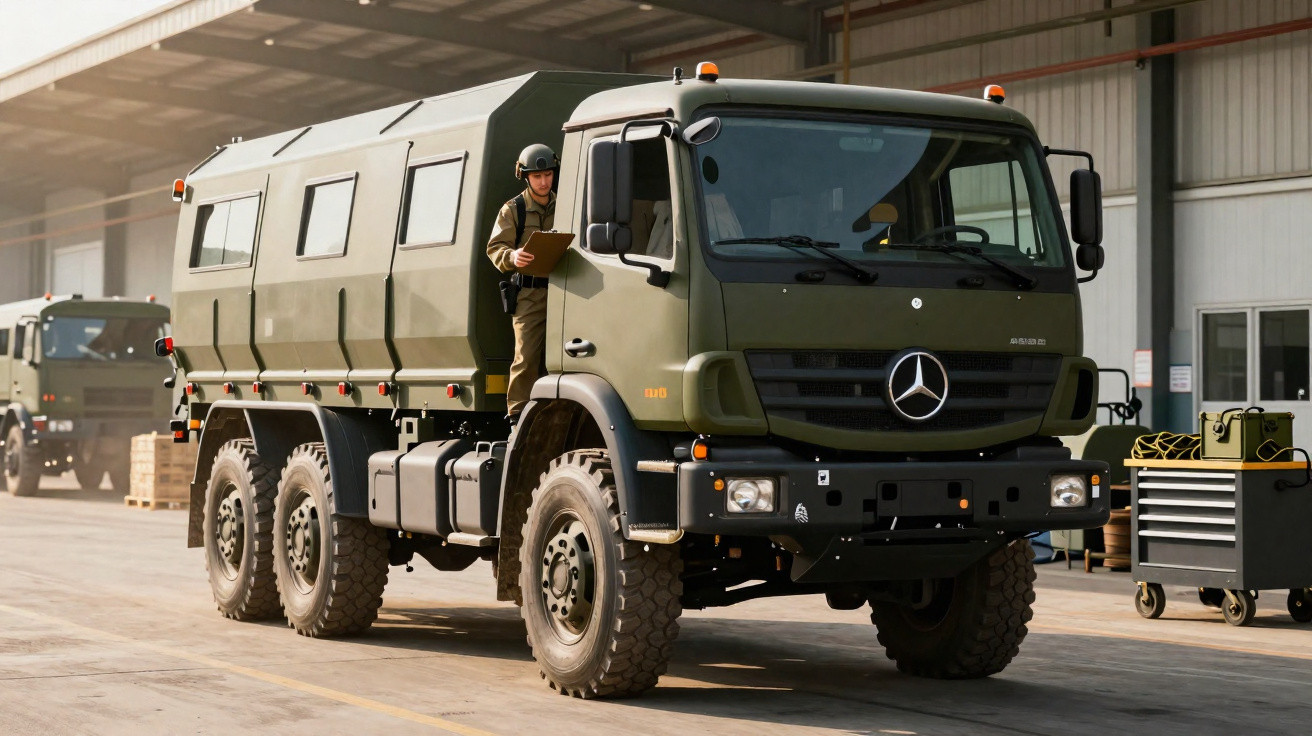
The French government has approved a major long-term procurement programme for thousands of logistics vehicles, awarding the contract to a partnership formed by John Cockerill’s Arquus and Daimler Truck. The purchase will renew an ageing fleet and demonstrates the importance Paris now places on supply chains in any future high-intensity war.
France agrees decade-long contract for 7,000 military trucks
On 16 January 2026, John Cockerill confirmed that its French subsidiary, Arquus, and Daimler Truck had won a contract to provide the French Army with 7,000 next-generation Zetros military trucks.
France’s PL6T programme, worth around €2 billion, will replace thousands of aging medium trucks with a single, modern 6×6 platform over more than a decade.
The agreement forms part of the PL6T programme, an abbreviation of “Porteurs Logistiques 6 Tonnes” – logistics carriers with a six-tonne payload. The new vehicles will gradually take over from the 4–6 tonne lorries that have served as the army’s mainstay for decades, both in France and in overseas territories and training areas.
Deliveries will continue far into the 2030s, covering the vehicles, their equipment, specialist versions and long-term maintenance provision. The programme is closely linked to the French Army’s transformation initiative, “Toward a Combat‑Ready Army”, which treats resilient logistics as a fundamental need rather than a secondary consideration.
How the PL6T trucks will be configured
The selected vehicle is the “Zetros by Arquus”, a military adaptation of Daimler’s Mercedes‑Benz Zetros 6×6 off-road truck. Daimler will provide the underlying vehicle, with Arquus responsible for military conversion and integration work in France.
The PL6T fleet will use a standard three‑axle 6×6 chassis for all variants, simplifying driver training, spare parts, and maintenance.
Its principal technical features are:
- Permanent 6×6 drive for difficult off-road environments
- A cab positioned behind the front axle, an arrangement long preferred by French land forces
- The availability of protected cabs while retaining a six-tonne payload
- An automatic transmission with a torque converter to make driving easier
- A diesel engine designed for harsh conditions and low-quality fuel
The trucks are expected to use the Mercedes‑Benz OM 460 diesel engine in Euro 3 specification. This standard is intended less for emissions performance than for durability and tolerance of different fuels, allowing the engine to operate in areas where only poor-quality fuel can be obtained.
Design decisions informed by operational conditions
Placing the cab behind the axle keeps the vehicle’s overall height comparatively low. This is valuable in dense European woodland, beneath bridges, through tunnels and in built-up areas. It also makes transport by rail and aircraft loading easier.
France additionally seeks the possibility of fitting armoured cabs to at least part of the fleet. The low-profile design and robust chassis should allow protection against shrapnel, small-arms fire and roadside bombs to be added without compromising the six-tonne payload central to the PL6T concept.
Several variants using one shared chassis
The 7,000-vehicle purchase will include an entire range of versions based on a common platform. It is intended to meet as many logistics requirements as possible while avoiding an increase in vehicle categories and training routes.
The planned variants comprise:
- Troop carriers with bench seats and canvas or hard covers
- General cargo vehicles for ammunition, food and engineering supplies
- Shelter carriers for communications or command modules
- Crane-fitted lorries for field logistics and recovery duties
- Winch-equipped vehicles supporting recovery and off-road operations
All PL6T variants share the same engine, drivetrain, and basic chassis, allowing the army to support a complex fleet with a simplified toolbox.
Arquus will provide in-service support for the full PL6T fleet. Daimler Truck will deliver spare parts and technical assistance for the underlying Zetros platform, using its global logistics network and lengthy production history.
Franco-German industrial division and French employment
Industrial responsibilities will be divided between France and Germany.
| Country | Company | Main role in PL6T |
|---|---|---|
| Germany | Daimler Truck (Wörth am Rhein) | Production of base chassis |
| France | Daimler Truck (Molsheim) | Base vehicle production and support |
| France | Arquus (Limoges, Garchizy, Saint‑Nazaire) | Militarisation, protected cabs, integration, fleet support |
John Cockerill Defense acquired Arquus from Volvo Group in July 2024 for around €300 million. Arquus already supports roughly 25,000 vehicles used by the French Army, with about 20,000 receiving direct company support, giving it a substantial foundation for overseeing the new truck fleet.
Daimler Truck France, meanwhile, operates more than 150 sales and service sites nationwide and directly and indirectly employs approximately 5,500 people. Its Molsheim factory in Alsace belongs to this network and is configured to support serial production over an extended period.
Worldwide record of the Zetros platform
The Zetros range is an established product rather than a new design. Daimler has built more than 15,000 vehicles globally since 2008, and armed forces in Canada, Lithuania and Ukraine are among those already using versions of the truck in challenging conditions.
The long production history of Zetros underpins Daimler’s claim that it can sustain delivery rates of several hundred trucks per month when required.
For France, this international presence reduces risk because spare parts, training documentation and battlefield experience are already available instead of having to be developed from the beginning for a bespoke national vehicle.
Why logistics vehicles are central to French defence planning
The PL6T programme reflects a wider change in how future conflict is viewed. French planners now openly discuss preparedness for high-intensity operations, including situations in which supply routes are contested, infrastructure has been damaged and forces must continue moving under sustained threat.
Many legacy lorries are more than 30 years old, making them progressively harder to maintain and ill-suited to these circumstances. They offer limited protection, have varying payload capacities and face spare-parts shortages. The PL6T fleet is intended to deliver a standardised, protected and maintainable replacement.
Logistics may receive little public attention, but it directly determines combat capability. A modern armoured brigade can consume hundreds of tonnes of fuel, ammunition and supplies within days. Without dependable lorries, artillery batteries cease firing, infantry units lack food and water, and medical formations exhaust essential equipment.
Situations in which PL6T trucks could prove decisive
Take a rapid reinforcement operation on NATO’s eastern flank. French forces travelling to Eastern Europe by rail and road will require vehicles capable of covering long motorway distances before leaving surfaced routes to operate alongside tanks and infantry fighting vehicles. Once deployed, a standard 6×6 platform makes convoy organisation, spare-parts supply and driver allocation more straightforward.
During overseas operations, including those in the Sahel or Indo-Pacific territories, road surfaces and fuel quality can be uncertain. An engine built to handle low-grade fuel lowers the likelihood of breakdowns, while crane- and winch-equipped versions can help convoys continue operating when local infrastructure breaks down.
Key terms and practical implications
For readers who are less familiar with military logistics, several PL6T programme terms warrant explanation:
- 6×6 configuration: The vehicle has three axles, with power sent to all six wheels. This arrangement improves traction away from roads and on loose or soft terrain.
- Militarisation: Civilian-style lorries are modified for military service through measures including strengthened frames, blackout lighting, radio integration, weapon mounts and protected cabs.
- Lifecycle support: Rather than procuring vehicles alone, the army pays for maintenance, spare parts, software updates and upgrades throughout the trucks’ operating lives.
A practical result of this model is greater certainty over costs. Combining acquisition and support within a long-term arrangement gives the French Ministry of Armed Forces improved visibility of operating expenditure across 10–15 years. In parallel, the industrial partners can support investment in manufacturing capacity and training because the workload will not disappear after a brief delivery run.
Risks nevertheless remain. Relying on one truck family streamlines logistics but also creates dependence on a single supply chain. A major interruption at vital factories, or political friction affecting Franco-German cooperation, could restrict availability. Conversely, the broad civilian and military use of Daimler trucks, together with the geographical distribution of its factories and service centres, generally lessens that exposure compared with a specialist defence-only design.






Comments
No comments yet. Be the first to comment!
Leave a Comment