
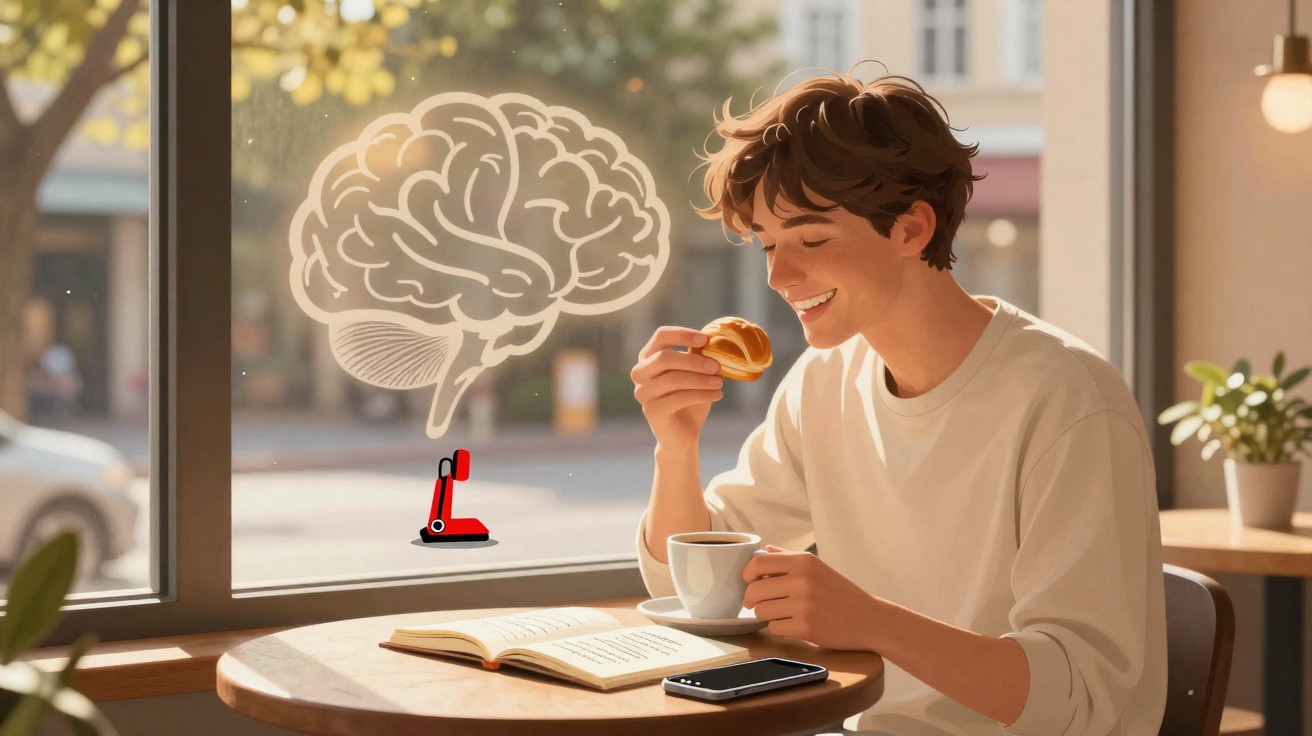
Your life appears perfectly all right on paper. The rent is covered, your notifications are manageable, and perhaps you have a good holiday planned. You get up, scroll for a while and have your coffee. Nothing is on fire, nobody is shouting, and the world feels… manageable.
Still, there is a muted buzz in your chest: a low, unplaceable sense of “meh”.
You may find yourself asking, “Why don’t I feel happier? What’s wrong with me?” Before long, you brush the thought aside and carry on with the day.
Yet the question never truly disappears.
It simply stays there, observing you.
When your brain quietly pulls the handbrake on joy
Some days are like driving with the handbrake still engaged. On the surface, you are getting on with things: meetings, errands, messages and dinners. Internally, though, there is friction - a reluctance to let yourself genuinely feel good.
Someone compliments you, and you dismiss it straight away. You achieve something small at work, then immediately focus on the next issue. It is a peaceful Sunday afternoon, and your mind abruptly says, “Enjoy this while it lasts, something bad is coming.”
Your brain is not trying to be cruel for its own amusement. It is attempting to keep you safe.
But that safety mechanism can feel imprisoning.
Imagine this. It is Friday evening and you are on the sofa, watching a programme you have been looking forward to all week. There is food, warmth, Wi-Fi and perhaps somebody you care about beside you. It is exactly the sort of scene advertisers adore.
Then, without warning, you feel hollow. You pick up your phone, open three apps one after another, and none of them satisfies you. Your thoughts turn to work emails, an awkward remark from last week, your parents getting older, the economy and the planet. You are not in a crisis, but you are not fully present either.
You tell yourself, “I should be grateful.”
Then you feel guilty because you are not.
The explanation is painfully straightforward: your brain is designed for survival rather than happiness. For thousands of years, people who repeatedly looked out for danger were more likely to survive than those who were busy watching sunsets. As a result, our minds developed “negativity bias” - the tendency to give potential threats more importance than pleasant experiences.
Even if your life is fairly settled, this ancient system does not simply power down. It continues searching for possible rejection, loss, failure and embarrassment. Happiness can seem oddly dangerous, as though you are standing with your back to the door.
Your brain therefore braces itself in advance.
Just in case.
Training a suspicious brain to trust small moments of joy
One practical approach is to show your brain that modest moments of happiness are safe. This does not require major life changes, only tiny, ordinary and nearly imperceptible experiments.
Once or twice each day, spend 20 seconds properly noticing something pleasant. It could be the heat of your mug, the way your shoulders relax when you lie down, or a brief laugh in a group chat. Rather than moving straight on, pause and silently remind yourself: “This is allowed.”
At first, it can seem absurd.
Your brain is not accustomed to being spoken to with kindness.
Most people either pursue happiness as though it were a project or avoid it as if it were a snare. They create enormous targets: “When I move, when I earn more, when I find someone, then I’ll feel better.” Alternatively, they make no attempt at all, because joy feels delicate, short-lived and almost untrustworthy.
That leaves them in an in-between state: neither unhappy nor properly alive. Half-scrolling, half-working and half-present. In reality, nobody manages this every day. Yet trying it two or three times weekly may begin to disrupt your internal alarm system in a helpful way.
Gradually, your brain starts to understand that feeling all right for a few seconds
does not inevitably end in disaster.
Our brains learned to survive storms. Nobody taught them how to relax once the sky is clear.
- Each day, spot one small positive thing and hold it in your mind for a few breaths.
- When your brain says “this won’t last”, gently respond, “maybe, but I can still enjoy this part.”
- Do not turn happiness into a measure of performance. Feeling flat does not mean you are failing at life.
- Be honest with one person about this resistance, even once. Shared shame begins to dissolve.
- Remember that emotional numbness is also a form of protection, not a personality flaw.
Living with a cautious brain without letting it run your life
It can be unexpectedly relieving to realise that resisting happiness is not a personal defect. It is an old operating system: still installed, still working, but doing its job rather too enthusiastically. Seeing it this way lets you stop battling yourself and begin negotiating instead.
You might say: “Okay, brain, I know you want to keep me safe. You can keep scanning for danger, but I’m also going to let myself feel this cup of coffee, this song, this quiet minute.” This is not denial. It is a way of bringing more texture into your day.
The world remains complicated, and your problems do not vanish by magic.
You simply stop delaying every small piece of joy until an imagined future that never comes.
| Key point | Detail | Value for the reader |
|---|---|---|
| Survival wiring beats happiness wiring | The brain prioritises detecting threats and negativity bias, including during calm periods | Reduces self-blame: feeling “not happy enough” is a pattern, not a failure |
| Happiness can feel unsafe | Previous disappointments can teach the brain to connect joy with loss or vulnerability | Helps readers understand why they brace for impact when things are going well |
| Small experiments shift the system | Brief, repeated experiences of safe enjoyment retrain emotional responses | Offers practical, manageable ways to gently broaden their capacity for joy |
FAQ:
Why do I feel empty even when my life is objectively good?
Because your emotional system responds not only to present circumstances, but also to old fears, habits and unprocessed stress. Out of habit, your brain may still be looking for danger, which means it minimises the safety and comfort that are genuinely there.Does this mean I’m depressed?
Not necessarily. Feeling flat or resistant can be part of depression, but it may also result from burnout, ongoing stress or long-term emotional self-protection. If the emptiness feels intense, persistent, or affects your sleep, appetite and motivation, speaking to a professional is a sensible step.Can I “fix” my brain so it stops resisting happiness?
You are unlikely to flick a switch and become effortlessly joyful. However, you can develop a greater capacity for small, safe moments of contentment, allowing your brain to gradually stop viewing them as threatening. That is genuine change, even when it is not dramatic.Isn’t focusing on happiness selfish with everything going on in the world?
Caring about the world and looking after your own nervous system are not opposing priorities. People who have access to steady, grounded moments of well-being usually have more energy, patience, and clarity to act on what matters to them. It is not selfish; it is sustainable.What if I try these small steps and feel nothing?
Numbness is information, not evidence that you are broken. Sometimes your system is so used to shutting down that it needs time and repetition before it can begin to soften. If nothing changes after several weeks, discussing this with a therapist or counsellor may speed up the process and provide tools tailored to you.






Comments
No comments yet. Be the first to comment!
Leave a Comment