
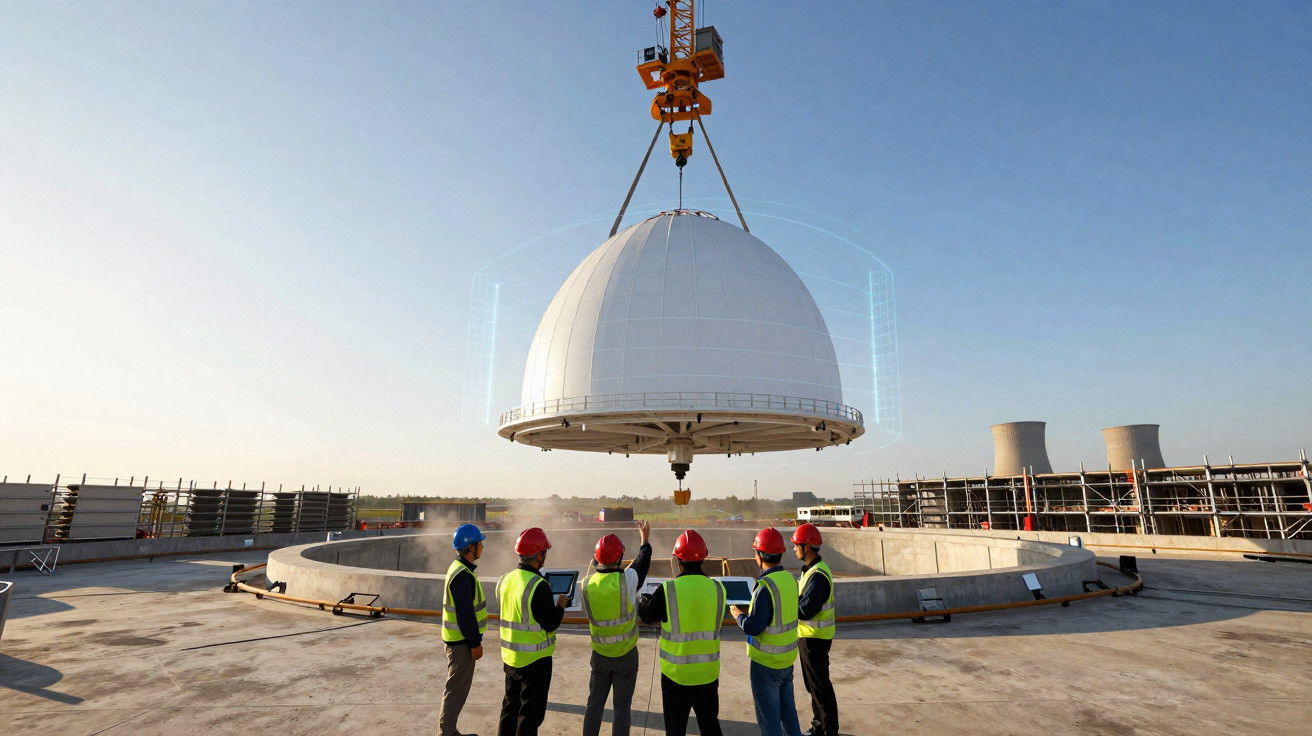
At the heart of a vast construction site, a steel dome descends slowly from above. Its movement is controlled to the millimetre, monitored by cameras and watched by engineers holding their breath.
A logistical and technical feat has been achieved at a Chinese nuclear power plant project: a 261-tonne reactor dome was placed on the building in under an hour and a half. This operation would ordinarily take considerably longer and involves substantial risks. It demonstrates just how extensively China has industrialised and digitised construction processes in the energy sector.
Precision work involving 261 tonnes of steel
The installed dome forms part of a new Chinese nuclear power plant unit using modern reactor technology. It serves as the upper protective layer above the reactor building and, in effect, completes the structural construction phase of the reactor core. Domes of this kind must withstand earthquakes, hurricane-force gusts and potential internal pressure waves.
261 tonnes of steel, 94 minutes of installation time – the reactor dome lift sets a new benchmark for industrial construction-site logistics.
A heavy-lift crane was used for this striking operation, slowly swinging the prefabricated dome over the building. Engineers relied on several measuring systems: GPS-based positioning, laser scanners and camera feeds were brought together in a control room. This allowed every crane movement to be adjusted in real time.
Why 94 minutes is so remarkable
Such an installation normally takes several hours and can sometimes occupy an entire working day. It is also frequently interrupted by wind, poor visibility or minor misalignments requiring correction. Every minute that a 261-tonne structure hangs freely from the hook costs money and puts pressure on the teams involved.
For this reason, the Chinese project managers planned the entire procedure in meticulous detail. Digital twins – virtual 3D models of the power station – were used as a testing environment. The crane’s path, the dome’s rotation, and even assumed temperature and wind conditions were simulated in advance. On site, the lift then unfolded like a carefully rehearsed stage performance.
- Pre-assembly of the dome close to ground level
- Laser-scanner surveying of the reactor building
- Trial runs of crane movements without a load
- Real-time drone monitoring throughout the lift
- Millimetre-precise alignment before final lowering
A symbol of China’s energy and industrial ambitions
China has been expanding its nuclear capacity at a rapid pace for years. The use of large prefabricated elements, including reactor domes, fits into this strategy. The government is pursuing shorter build times, greater standardisation and tighter quality control in order to keep projects within schedule and budget.
Those who install reactor domes in record time do not merely shorten construction schedules – they also gain industrial and technological advantages in global competition.
In international markets, China already supplies reactor technology and construction services to several countries in Asia, and increasingly to Africa and the Middle East. An event of this kind therefore serves not only domestic energy supply, but also showcases exportable capabilities: heavy-lift logistics, modular construction and digitally managed construction sites.
Serial production rather than a one-off project
While many Western nuclear power plant projects remain highly site-specific and individually designed, China places greater emphasis on platform-based and serial approaches. Domes, reactor buildings and auxiliary systems follow standard designs that can be repeated across numerous locations. This creates learning effects that further increase speed.
| Aspect | Traditional nuclear power plant construction | Chinese approach |
|---|---|---|
| Construction method | Many components manufactured on site | High proportion of prefabrication and modules |
| Planning | Project-led, often with a bespoke design | Standardised reactor types and layouts |
| Installation of large parts | Long lifts with several interruptions | Fully simulated rapid lifts using real-time data |
| Construction period | Multiple risks of delay | Tightly scheduled construction phases |
Safety and risk: millimetre work above a reactor building
This record pace inevitably raises safety questions. A 261-tonne dome swinging above a reactor building represents a major hazard. Even slight gusts can make the huge steel structure sway. Temperature differences must also be considered, as they can cause steel to expand or contract slightly.
Project management addresses these risks through a package of measures. The lift is carried out only within narrow weather windows, with controlled wind speeds and good visibility. Multiple measuring points on the dome and building report deviations, in some cases to within a tenth of a millimetre, to the control room. The crane’s braking operations are performed in stages to prevent abrupt movements.
The real skill lies less in the crane’s sheer lifting power than in the sensitive control of the final few centimetres.
A clearly defined emergency protocol is in place: if a wind or tilt threshold is exceeded, the crane operator must retain the ability to manoeuvre rather than rigidly forcing the lift to completion. Safety authorities and the operator jointly establish these intervention thresholds before the project begins.
What a reactor dome must deliver
The dome is more than a “lid”. It combines several safety functions:
- Protection against external impacts, such as aircraft crashes or falling debris
- Containment of internal overpressure in the event of a fault
- Structural support for ventilation and filtration systems
- Radiation shielding in combination with thick concrete walls
This is why particularly stringent requirements apply to materials, welds and airtightness. Every weld is documented, inspected and, where necessary, reworked. Further tests follow installation: overpressure leak tests, ultrasonic inspections and visual checks using scaffolding and drones.
Digitisation is changing large construction sites
The record installation also illustrates how strongly digital tools are shaping everyday construction work. Building Information Modelling (BIM) represents the power station as an interconnected data set. Every alteration to the dome or reactor building is incorporated into this model. Potential conflicts, for example involving crane routes or scaffolding, can therefore be identified virtually before they arise on site.
Drones provide additional viewpoints. They fly around the dome during the lift, record clearances and can, where necessary, issue warnings faster than an engineer in the control room. Sensors on the crane hook and dome measure vibrations, providing teams with specific figures rather than relying solely on subjective assessments.
The construction site becomes a partly automated system – people intervene when algorithms flag anomalies.
What is meant by a “digital twin”
The term is appearing ever more frequently on major construction sites. A digital twin is a virtual representation of a real object – in this case, the nuclear power plant. It consists not only of 3D geometry, but also of data: material properties, maintenance intervals, planned alterations and operating sensor data.
During the dome lift, the digital twin makes a range of “what-if” scenarios possible: what happens if crosswinds become stronger? How does the crane respond if temperatures rise sharply during the lift? Such simulations are run thousands of times long before the actual dome even leaves the ground.
What local residents can take from this
For people living near new nuclear power plants, three questions matter most: how safe is the facility, how reliable is the electricity supply, and what part does the project play in regional development? The rapid dome lift offers indirect indications in these areas. Shorter construction periods reduce the time window for accidents on site. Standardised processes lower the risk of planning errors. And buildings completed earlier make access easier for independent inspectors.
On the other hand, nuclear power remains socially controversial. Longer operating periods raise questions about the final disposal of radioactive waste and the long-term allocation of costs. The technical brilliance of a dome lift does not answer these issues; it merely demonstrates how highly industrialised the construction of modern reactors has become.
Possible future scenarios in power plant construction
If lifts of this kind become established, future nuclear power plants and other major facilities, such as LNG terminals or large energy-storage projects, could be built in a similarly modular way. Components would then be prefabricated even more extensively in factories, delivered to the site and assembled through precise heavy-lift operations.
This will require specialist teams, new professional roles and training routes: crane operators with digital expertise, engineers who understand both simulations and practical construction-site work, and safety specialists who can interpret data streams as readily as building plans. The 94 minutes in which the 261-tonne dome was put into place therefore offer a glimpse of the day-to-day reality of future major projects.




Comments
No comments yet. Be the first to comment!
Leave a Comment