
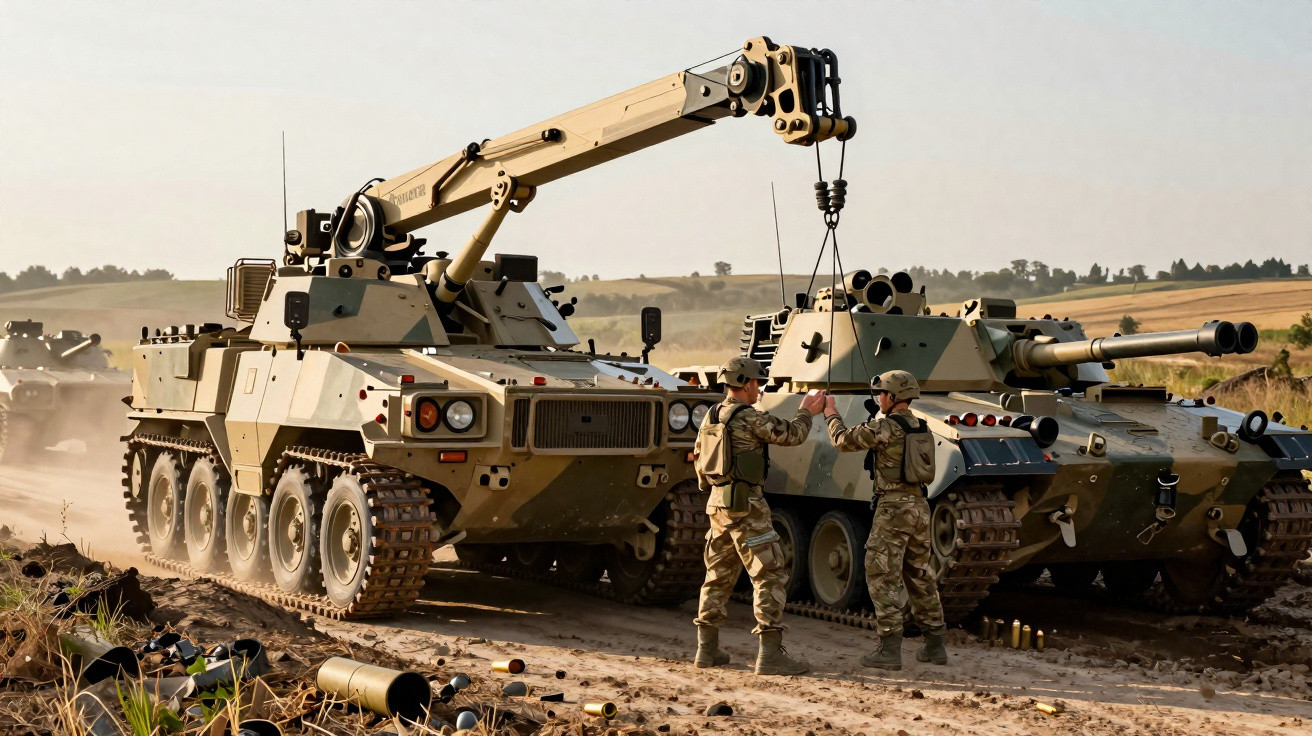
France has discreetly concluded a significant contract for a new generation of heavy recovery vehicles, intended to keep its newest armoured fleet operational under fire and support the SCORPION modernisation programme transforming the French Army.
France commits to heavy recovery for high-intensity warfare
On 22 January 2026, the Délégation générale de l’armement (DGA), France’s defence procurement agency, awarded Soframe, an Alsace-based specialist company in eastern France, a strategic framework agreement.
The deal concerns a new family of Engins Lourds de Dépannage (ELD): heavy recovery vehicles capable of towing, lifting and recovering the latest armoured platforms deployed through the SCORPION programme.
The first 20 vehicles are due in 2027, with an option that could raise the fleet to 100 heavy recovery giants.
The first order covers 20 ELDs, including five that must arrive before the end of the first half of 2027. Paris can subsequently exercise an option for as many as 80 further vehicles, allowing the French Army to expand the fleet rapidly should operations or the political situation demand it.
It may not be a high-profile acquisition, but it is an informative one. French planners anticipate land warfare becoming quicker, more severe and more attritional. In those circumstances, an armoured vehicle that cannot be recovered, repaired and returned to combat is effectively a single-use asset.
Why SCORPION requires dedicated “armoured tow trucks”
For roughly ten years, French heavy recovery capabilities have depended primarily on two systems: Renault Kerax 420 trucks and the Porteur Polyvalent Lourd de Dépannage (PPLD), which entered service from 2014.
The PPLD is far from a light vehicle. It has a 12-tonne crane, an 18-tonne primary winch, a secondary winch and a protected cab armed with a 7.62 mm machine gun for self-defence. Approximately 50 are now in French service.
However, the armoured vehicles requiring their support have evolved. The new Griffon, Serval and Jaguar, together with modernised Leclerc XLR tanks, are heavier, more sophisticated and filled with electronics. They are intended to operate in highly contested areas, where recovery work may be conducted under direct threat.
SCORPION vehicles are built to fight as a networked team; their support fleet now has to match that new standard of intensity.
The DGA set out a straightforward ELD requirement: it must be able to extract, lift and recover every wheeled vehicle in the SCORPION family, while offering its crew substantial protection against battlefield hazards.
What the French Army required from industry
The official requirements set out several principal criteria:
- An armoured, pressurised cab providing protection against small arms, mines and improvised explosive devices.
- A heavy-duty crane and towing arrangement capable of handling the weight of modern armoured vehicles.
- The ability to operate fully on the front line, rather than solely conducting breakdown recovery in rear areas.
- A proven design that has already been manufactured and fielded within the past five years.
That final condition excluded paper proposals and experimental demonstrators. The DGA sought a system that was already functional, rather than a vehicle that might only become available in a decade.
Soframe’s victory and the Belgian link
Soframe won the competition, which was opened in spring 2025. The firm already supplies a suitable vehicle in operational service: the Protected Recovery Vehicle (PRV), used by the Belgian Army.
France’s ELD will be closely derived from the Belgian PRV. This offers obvious advantages for commonality, training and multinational missions, particularly through the Franco-Belgian CAMO cooperation programme.
By aligning its heavy recovery fleet with Belgium’s, France boosts joint readiness and simplifies logistics for combined deployments.
The PRV: an 8×8 workhorse for disabled armour
The PRV was developed as a robust vehicle able to travel across difficult ground in threatening conditions, connect to disabled armoured vehicles weighing up to 50 tonnes and pull them to safety.
Its key characteristics, which provide a strong indication of the likely French ELD configuration, are as follows:
| Role | Front-line extraction and heavy recovery of armoured vehicles |
| Configuration | 8×8 all-terrain chassis |
| Crew | 3 personnel |
| Protection | Armoured, pressurised cabin against ballistic and explosive threats |
| Recoverable vehicle weight | Up to 50 tonnes |
| Towing arm capacity | Up to 14 tonnes lifting |
| Main winch | 20 tonnes, with 80 m cable |
| Top speed | Around 90 km/h on road |
| Range | About 800 km |
| Off-road ability | Gradients up to 60%, fording depth about 70 cm |
| Dimensions | Roughly 10.4 m long and 2.5 m wide |
This combination of mobility, lifting capability and protection enables recovery crews to operate close to the battle, instead of waiting for damaged vehicles to be pulled back by less capable trucks.
The industrial company behind the agreement
Soframe has focused on tactical and protected logistics vehicles since 1978. The company belongs to the Lohr group, a largely export-oriented industrial business with six factories across three continents and around 2,000 employees.
Lohr recorded approximately €400 million in revenue in 2024, with international markets accounting for around 80% of the total. The French contract strengthens Soframe’s standing as a credible European provider of combat-support vehicles, rather than simply a niche supplier.
SCORPION: Europe’s reference programme for land combat modernisation
The ELD contract forms part of a wider transformation. Introduced in 2014, SCORPION is France’s long-term programme to modernise its land forces, with more than €9 billion allocated over about 15 years.
By 2030, France plans to deploy approximately 4,500 new vehicles and provide around 50,000 soldiers with better-protected, more connected platforms. The central SCORPION vehicle family comprises:
- Griffon armoured personnel carriers for combat transport.
- Serval light armoured vehicles for reconnaissance and patrol missions.
- Jaguar reconnaissance and combat vehicles equipped with a 40 mm cannon and anti-tank missiles.
- Leclerc XLR main battle tanks upgraded with new sensors and networking.
All of these platforms are connected through a shared digital command-and-control system designed to support “collaborative combat”: the real-time exchange of information allowing sensors, drones, artillery and ground forces to respond more rapidly than an adversary.
SCORPION is less about buying shiny new tanks and more about building a connected, fast-reacting land combat system.
France’s objective for 2027 is to deploy at least one fully equipped combat division operating under this new model. Heavy recovery systems such as the ELD are part of the unseen foundation needed to keep that division operating under continuous pressure.
How heavy recovery influences ground combat
During high-intensity operations, recovery crews can determine whether a battlegroup remains engaged or comes to a halt at the roadside. One disabled vehicle in a narrow street can obstruct an entire convoy. A tank immobilised in a ditch may remove both its crew and accompanying infantry from the fight.
With an ELD-type platform, a French commander could deploy a protected 8×8 recovery truck forwards under armour, use its 20-tonne winch to pull the disabled vehicle clear and then tow it to a safer location for field repairs.
In a Baltic or Sahel-style theatre, an ELD could operate alongside Griffons and Jaguars, travelling over rough tracks with them instead of remaining on a motorway kilometres away. This shortens response times and reduces the opportunity for an enemy to exploit damaged vehicles for propaganda or intelligence purposes.
Key terms explained for non-specialists
What is considered a “heavy” recovery vehicle?
In military terminology, “heavy recovery” usually means platforms able to deal with large armoured systems: 8×8 fighting vehicles, self-propelled artillery and, in some cases, main battle tanks. They require powerful winches, strong cranes and towing equipment capable of moving dozens of tonnes over poor roads.
By comparison, “light” recovery vehicles may deal with damaged 4×4 vehicles or light lorries. They are more widespread, but are much less capable of operating under direct threat or across the same terrain as front-line armoured forces.
The risks and advantages of deploying recovery teams forwards
Positioning ELDs near combat lines brings evident risks. While recovering stranded vehicles, crews could encounter ambushes, artillery fire or drones. Even when protected by armour and defensive weapons, they may become valuable targets.
The advantage is resilience. If a brigade knows that most damaged vehicles can be recovered quickly, it can sustain a higher operational pace and accept greater risk, because many apparent “losses” will only be temporary. The effect accumulates: more vehicles are repaired and returned to service, fewer replacements are required, and crews and mechanics gain greater experience.
For allies observing France’s decisions, the ELD contract indicates an increasing emphasis on enablers: logistics, maintenance and recovery systems that seldom appear in political speeches but often determine whether sophisticated armoured fleets can fight for days, rather than only through one sharp engagement.
Comments
No comments yet. Be the first to comment!
Leave a Comment