

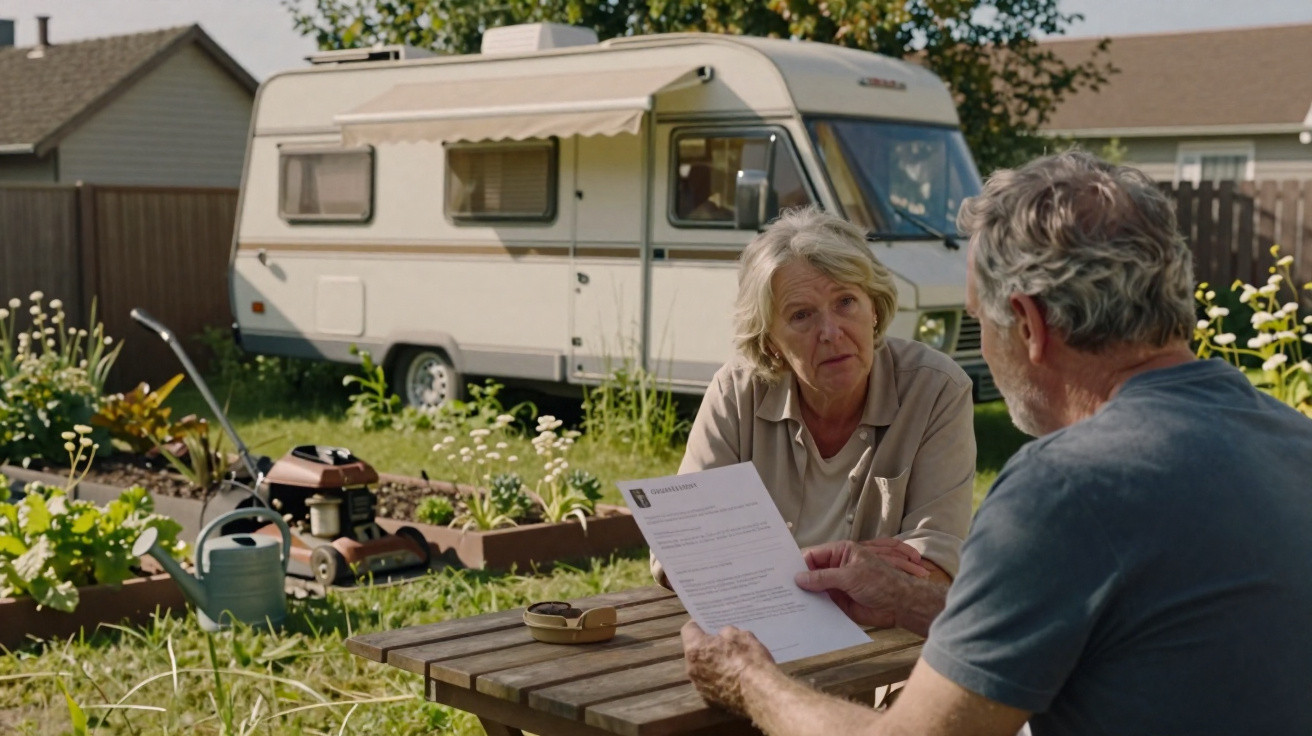
At 71, Gérard believed he had found the most unobtrusive solution: parking his motorhome behind the house, at the far end of his plot, where dense hedges block the view from the road. The vehicle does not rise above the fence, inconvenience neighbours or obstruct traffic, and he does not sleep in it all year round. Yet one morning, a letter from the town hall lands on his doormat. The issue is not where he parks it. What has caught the council’s attention is beside the motorhome: a pipe, a few fittings and a habit he adopted almost without thinking. Gérard’s story mirrors many everyday situations. It contains one detail few homeowners anticipate.
A motorhome behind a hedge does not always concern the town hall
In Gérard’s garden, the motorhome is parked on a firmed area behind the garage. At first glance, there is nothing alarming: its wheels stand on gravel, no permanent awning turns the vehicle into a small house, and a laurel hedge shields it from view. We all know that moment when we simply want to store something bulky without drawing attention to it. In many French municipalities, keeping a motorhome on private land remains possible provided it retains its status as a vehicle and does not become a permanent installation.
The retired man had even acted with some care. After hearing two comments at the bakery about “the big white lorry” visible from the road, he stopped leaving it in front of the gate. Under local planning rules, a vehicle may be permitted in a yard or garden, subject to varying restrictions set out in the local planning scheme, housing-estate regulations or protected-area rules. The vehicle itself is seldom the sole issue. Trouble begins when its use changes, sometimes little by little.
Gérard used his motorhome for trips lasting several weeks in spring and late summer. Between journeys, he plugged it into an outdoor socket to keep the battery charged, which is entirely ordinary. However, he had also developed the habit of emptying rinse water into a drainage gully near the terrace, connected to the surface-water network. It was this connection, rather than the concealed parking space, that drew the municipality’s attention. An apparently minor detail can become a genuine administrative matter when water is involved.
What really concerns the municipality: connections and discharges
The first thing to establish is where water used in the motorhome ends up. Grey water from the sink or shower, as well as black water from the toilet, must not be discharged into a ditch, roadside gutter, surface-water inspection chamber or the garden. Surface-water systems often lead directly into the natural environment, without the treatment required for domestic wastewater. The right approach is straightforward: use a service area, a suitable disposal point or, depending on the equipment and local rules, an authorised connection to the wastewater network.
Another common mistake is assuming a vehicle is “just parked” when it gradually acquires the fittings of an extension to the home. A temporary extension lead for maintenance does not mean the same thing as a permanent electrical connection, an attached terrace, a firmly secured awning or levelling blocks left in place throughout the year. Let us be honest: nobody necessarily sets out to do this every day, but habits quickly take hold when a motorhome becomes a spare bedroom or somewhere to entertain visitors. The town hall may then question whether it is being occupied on a lasting basis, or even whether the installation is subject to planning rules.
Before replying hastily to the letter, Gérard would be wise to arrange a meeting with the planning department and check the local regulations, without overstating the situation. Officials often want to establish the facts before taking more restrictive action, particularly when an owner is willing to put right what needs correcting.
“Parking the vehicle was not the sticking point. Above all, we wanted to check that wastewater was not entering the surface-water network,” explains a local authority officer familiar with this type of report.
- Identify the inspection chambers and pipes on the property;
- Keep evidence of emptying carried out at an approved service area;
- Check the local planning scheme, housing-estate rules and any protected-site requirements;
- Avoid creating any fixed installation around the motorhome without seeking advice first.
A simple vehicle can become a matter of neighbours and common sense
Ultimately, Gérard’s case is not only about a technical rule. It highlights the sometimes blurred line between the pleasure of owning a motorhome and the obligations that come with community life. A vehicle tidily stored behind a house may go entirely unnoticed, whereas poorly directed wastewater can leave marks, cause smells or end up in a ditch alongside which children cycle. Being visually discreet is no substitute for compliance. It is less dramatic, but far more tangible.
In some streets, friction also arises from a misunderstanding. The neighbour who alerts the town hall is not necessarily opposed to motorhomes; they may have seen water being discharged, heard a pump or been concerned about a connection. Gérard, meanwhile, saw the letter as a rebuke, almost an intrusion into his garden. That is understandable. A calm conversation can often separate appearances from the real issue, without turning a holiday vehicle into a neighbourhood dispute. Dialogue prevents many unnecessary tensions.
Every municipality has its own particular circumstances: a coastal area, a housing development with its own rules, agricultural land, a listed area or an individual sewage system. Gérard’s case should therefore not be taken as an identical rule across France. Instead, it is a useful reminder to check before connecting, adapting or emptying anything near a motorhome. Owners who spend a few minutes checking their installations often travel with greater peace of mind, while municipalities also benefit from a less strained relationship with residents.
| Key point | Detail | Benefit for the reader |
|---|---|---|
| Parking on private land | It may be permitted if the motorhome remains a vehicle and local rules allow it. | Avoid confusing ordinary home storage with a permanent installation. |
| Wastewater | Discharging into a surface-water chamber, ditch or the ground can cause problems. | Identify the proper emptying point and prevent an official warning. |
| Dialogue with the municipality | The planning department can clarify local planning scheme rules and suitable solutions. | Put a situation right before it becomes a source of conflict. |





Comments
No comments yet. Be the first to comment!
Leave a Comment