
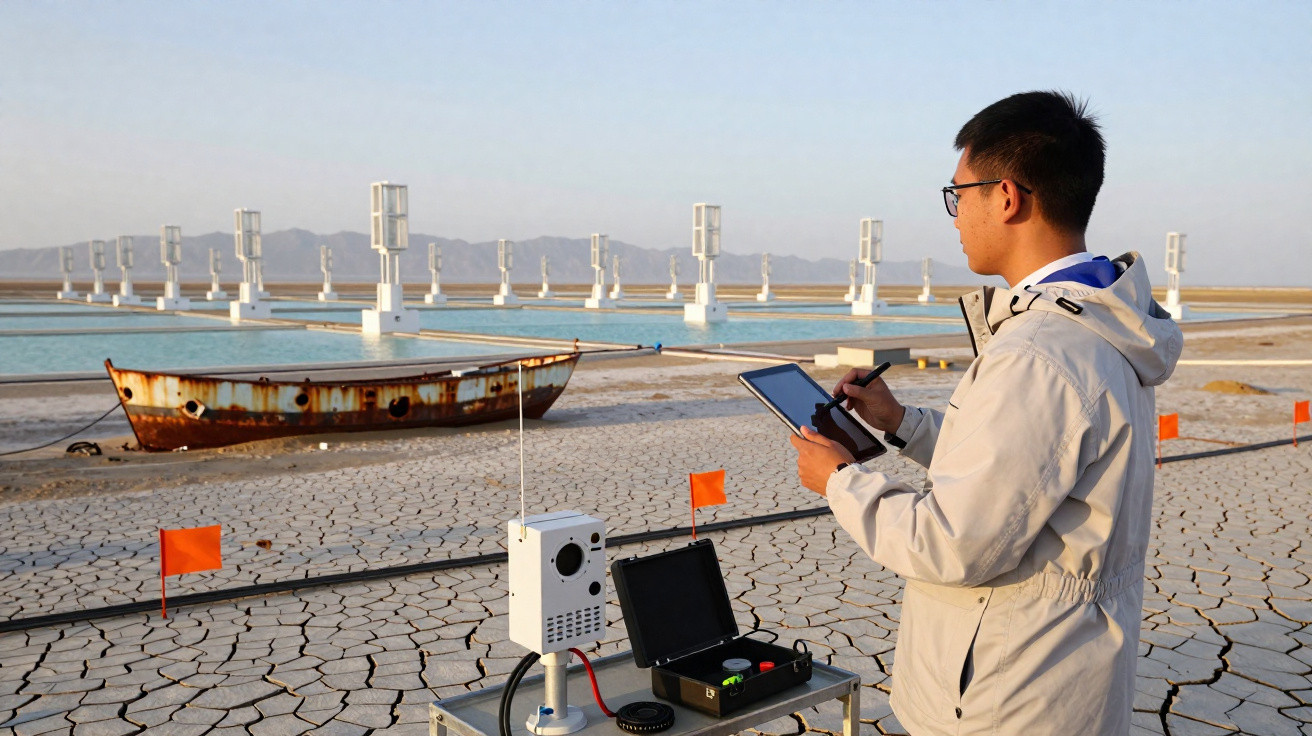
On old maps, the Aral Sea appears as a vast blue expanse between Kazakhstan and Uzbekistan. Today, in some places, you must drive for hours across cracked ground to reach what was once its shoreline. Rusting boat hulls lie among the sand, as though the sea vanished without warning. Since the 1960s, diverting the Amu Darya and Syr Darya rivers to irrigate enormous cotton plantations has turned this landscape into a global symbol of ecological disaster. Yet a striking proposal is circulating in laboratories: return water to part of the basin, not to revive its ports or fisheries, but to help capture carbon dioxide. A sea as a climate machine. The notion may sound absurd, but it deserves closer attention.
The vanished Aral Sea could become a vast laboratory
Wind still carries salty dust from the former bed of the Aral Sea, now known as the Aralkum. These particles are far from harmless: they spread salt, pesticide residues and toxic substances as far as nearby villages. In response to this open wound, some scientists are considering a reflooded basin designed from the outset as a CO2 capture tool. The aim would not be to reproduce precisely the legendary sea of the 1950s, nor to promise that fishermen would return to every abandoned harbour. Instead, the proposal is to create a system in which water, minerals and carbon could interact across an exceptionally large area.
Before it dried up, the Aral Sea covered almost 68,000 square kilometres, an area comparable with Ireland. Its volume shrank at a startling rate from the 1960s onwards, when water from Central Asia’s two major rivers was extensively redirected towards irrigated farming. The northern section in Kazakhstan has nevertheless seen some recovery thanks to the Kok-Aral Dam, completed in 2005: water levels rose there and several fish species returned. That local success offers grounds for hope. The far larger southern section, however, remains an almost unreal landscape.
The concept explored by some researchers relies on a recognised process: chemical weathering of rocks. When exposed to water and CO2, minerals rich in calcium or magnesium can create more stable compounds, including bicarbonates and carbonates. On a very large scale, an artificially supplied basin could act as a natural reactor: slow, but immense. The sea would not absorb carbon like a magical sponge. Rather, it would provide the conditions needed to lock it away for the long term in water, sediments or minerals.
Adding water is not enough: the project would need to avoid past mistakes
The first practical step is to examine the figures before focusing on spectacular imagery. Filling such a vast depression would require huge quantities of water in a region already affected by drought and tensions over irrigation. The most serious scenarios therefore do not necessarily involve restoring the entire historic sea. They instead consider targeted areas, pilot basins, carefully managed inflows and continuous monitoring of salinity. River water remains essential to residents, farmers and ecosystems. Diverting it again without safeguards would simply shift the problem elsewhere.
A common mistake would be to assume that a major technological plan can erase previous decisions. We all know the urge to find a quick fix for a problem that has taken decades to develop. Here, that temptation would be dangerous. The Aral basin needs measures that combine reduced agricultural abstraction, modernised canals, less water-intensive crops and protection for people exposed to dust storms. Let us be honest: hardly anyone manages all of this every day, especially while the local economy still depends on intensive cultivation. Scientists cannot work alone behind maps and equations.
A credible approach would involve gradual, measurable and reversible trials. Different types of rock would need to be compared, the true amount of CO2 stored would have to be verified, groundwater monitored, and results published even when they prove disappointing. Caution is not an obstacle: it is the only way to distinguish a useful climate promise from a futuristic backdrop.
“The challenge is not to recreate the past exactly, but to make this territory less vulnerable while testing a verifiable climate solution.”
- Measure the CO2 genuinely stored, rather than merely the volume of water added.
- Give priority to preserving water for residents and existing ecosystems.
- Assess risks associated with salt, sediments and legacy pollution.
- Involve local communities in decisions made about their territory.
A climate ambition that raises a highly practical question
The prospect of a partly refilled Aral Sea designed to trap carbon says something about our era: we are seeking solutions on the scale of climate disruption while living with the scars left by the major projects of the last century. An artificially revived sea could never replace cutting emissions at their source. It must not become an excuse for continuing to burn coal, oil or gas as before. Yet it could point towards another path: repairing damaged territories by giving them a new role, without erasing their history or the people who live there.
Perhaps the most unsettling aspect is the contrast. Where boats were left stranded in the middle of the desert, researchers now envisage a place that could retain some of the carbon released by the modern world. The Aral Sea is no longer only a symbol of disappearance. It could become a full-scale test for a science that must demonstrate every tonne captured, every litre saved and every benefit delivered to local people. Between utopia and necessity, this issue deserves debate far beyond the laboratory.
| Key point | Detail | Value for the reader |
|---|---|---|
| A sea dried up since the 1960s | The diversion of the Amu Darya and Syr Darya for irrigation caused the collapse of the Aral Sea. | Understand why this region has become one of the most striking examples of environmental catastrophe. |
| CO2 as a new objective | Reflooded basins could encourage reactions between water, carbon and certain minerals. | Distinguish conventional ecological restoration from a carbon-storage project based on natural chemistry. |
| A solution with conditions | The project would require local trials, reliable measurements and strict protection of water resources. | Maintain a clear-eyed view of dramatic claims about climate technologies. |





Comments
No comments yet. Be the first to comment!
Leave a Comment