
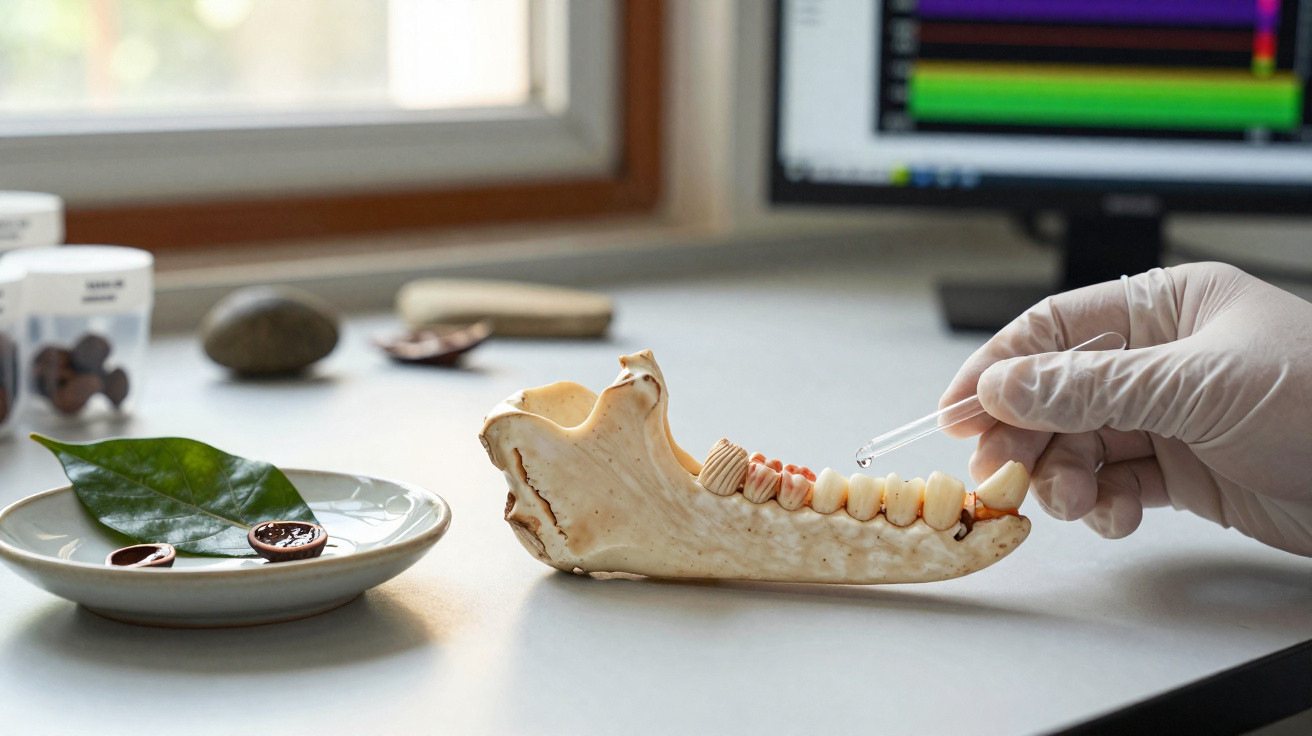
On the Indonesian island of Sulawesi, exceptionally ancient human remains are reshaping the established history of substances that affect the brain.
Archaeologists examined two hunter-gatherer skeletons whose teeth display unusual and striking wear. Chemical tests carried out within the dental tissue itself show that these individuals regularly consumed areca seeds. The custom may date back as far as 25,000 years, long before the first farming societies.
Dental grooves reveal an everyday custom
Researchers investigated the remains of two prehistoric inhabitants of Sulawesi. The first person lived roughly 25,000 to 16,000 years ago. The second was far more recent, dating from between 7,600 and 6,300 years ago.
Specialists found deep, rounded grooves in their teeth. These marks cannot be explained either by a typical hunter-gatherer diet or by ordinary age-related deterioration. Instead, they appear to have resulted from repeated contact with hard objects held in the mouth for extended periods.
“The marks observed on the molars and incisors are consistent with the repeated sucking of whole areca seeds, a practice capable of altering brain activity.”
Areca seed is commonly known as betel nut, although it actually comes from a palm. It has long been consumed across a broad region stretching from India to the Pacific. Even today, hundreds of millions of people chew it, often combined with lime and assorted leaves or spices.
A psychoactive substance long before agriculture
Until now, many scientists linked the rise of psychoactive substances with the beginnings of agriculture. Under this view, settled populations began producing fermented drinks and establishing regular plant use after they started cultivating land.
The earliest known evidence of barley beer, for example, dates to around 13,000 years ago in the Near East. The clues uncovered in Sulawesi are considerably older. They push back by several millennia the documented history of habitual stimulant consumption.
Areca seed contains arecoline, among other compounds: a molecule that can act on the nervous system. It may produce stimulation, greater alertness and mild euphoria. Its effects are generally less intense when the seed is simply sucked rather than prepared using modern methods.
Saliva alone can release some arecoline
Modern preparations often include slaked lime, which can be made by burning shells and then grinding them into powder. This ingredient changes the chemistry of the mouth and helps arecoline enter the bloodstream.
For a long time, this fact complicated the reading of ancient evidence. Could whole seeds genuinely affect the body without lime? Experiments using artificial saliva provide a positive answer.
- Areca seeds were placed in a solution designed to replicate human saliva.
- The resulting liquid was then tested on human receptors grown in a laboratory.
- The findings show that arecoline is released even without thorough chewing or the addition of lime.
- The released quantity may be enough to trigger a physiological response.
In other words, keeping an areca seed in the mouth for a long time could already have had an effect. This detail strengthens the archaeological hypothesis concerning the inhabitants of Sulawesi.
Chemical evidence found directly in teeth
The grooves are not the only indication. Scientists also looked for molecular residues in dental tissues, where they identified arecoline, the main active compound in areca seed.
This approach is particularly valuable because seeds rarely survive for tens of thousands of years in tropical soils. Bones and teeth can therefore serve as biological archives, retaining traces of certain foods, toxins or substances taken during a person’s lifetime.
“The combination of this highly distinctive dental wear and the presence of arecoline provides a strong body of evidence for regular use.”
This was therefore unlikely to have been a one-off experiment. The observed damage points to a repeated practice over many years. Areca seed consumption may thus have been among the established cultural behaviours of these hunter-gatherer groups.
A possible pain remedy that became a vicious circle
The discovery also offers a less favourable view of this habit. The people studied had poor oral health. Arecoline has mild pain-relieving properties, so it may initially have been sought to ease toothache or inflamed gums.
That relief may, however, have carried a high cost. The hard, abrasive seeds eventually wore away the enamel. In some people, the erosion was so severe that the dental pulp, the highly sensitive inner part of the tooth, became exposed.
| Intended effect | Possible long-term consequence |
|---|---|
| Temporary pain relief | Accelerated enamel wear |
| Stimulation and alertness | Deep grooves in the teeth |
| Repeated habit | Chronic dental infections and difficulty eating |
The proposed scenario is a vicious circle: a person uses the seed to soothe pain, but prolonged use worsens the damage and sustains the need to use it again. This pattern is known for many substances, even when their effects appear moderate.
A plant still consumed, but linked to risks
Areca consumption is not confined to the past. It remains widespread in several countries across Asia and the Pacific, where it may accompany social exchanges, ceremonies or daily work. In certain regions, users keep a reddish preparation in their mouths for long periods.
Current medical knowledge nevertheless calls for caution. Regular use of areca-based preparations is associated with gum damage, severe tooth deterioration and a higher risk of precancerous lesions in the mouth. Mixing it with tobacco can make these dangers even greater.
The teeth from Sulawesi show that the human relationship with substances that alter sensations did not begin with towns, crops or the first alcoholic drinks. It also has roots in the repeated practices of small groups living by hunting, fishing and gathering several tens of thousands of years ago.






Comments
No comments yet. Be the first to comment!
Leave a Comment