
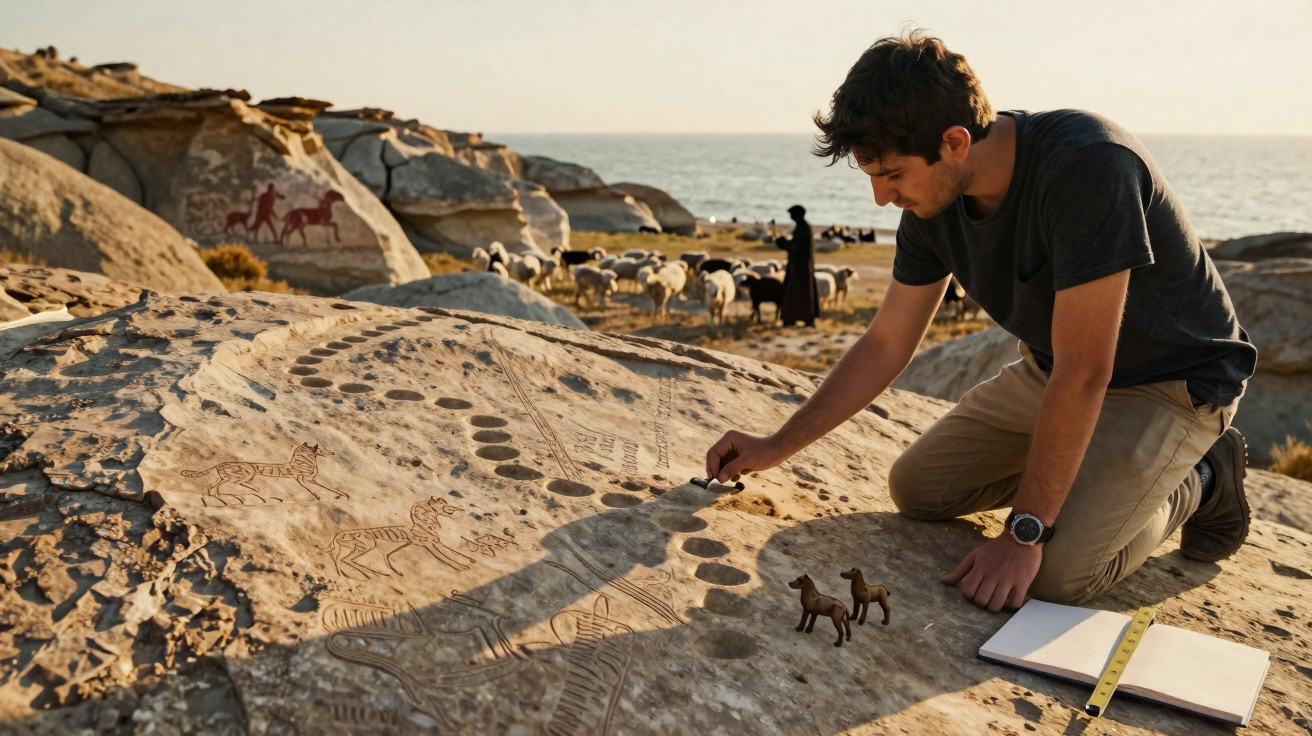
Archaeological discoveries linked to an ancient board game are shedding fresh light on the ways people connected with one another thousands of years ago.
Hounds and Jackals boards discovered in Azerbaijan
Archaeologists working at several locations on Azerbaijan’s Abşeron Peninsula and within the Gobustan Reserve have identified six patterns cut into rock surfaces. Dated to about 2000 BCE, each has the distinctive layout associated with the ancient board game Hounds and Jackals. They are roughly contemporary with the previously oldest known example of the game, recovered from the tomb of an official in ancient Egypt.
According to archaeologists Walter Crist of Leiden University in the Netherlands and Rahman Abdullayev of the Minnesota Historical Society, the sites call the assumed birthplace of the game into question. Also called Fifty-Eight Holes, it may have originated in south-western Asia rather than Egypt, as specialists had previously believed.
Regardless of where it began, the find underlines an important quality of board games: they can create social links across both geographical distance and class divisions. The Azerbaijani artefacts were probably used by cattle herders.
"At certain times in antiquity, particular games were regionally popular, suggesting that they helped to connect cultures that regularly interacted with one another," Crist and Abdullayev write in their paper.
"The game of Fifty-Eight Holes probably served this purpose in the second millennium BCE in Egypt and south-western Asia, because it was the only game that was played throughout the region."
A long history of games and social connections
Board games have existed for thousands of years and seem to have been widely played. At some stage, somebody must have been the first person to scratch a design into the ground and play something with other people. Although we cannot know what that something was, an incomplete history can be reconstructed from the remains games have left behind, including dice, playing pieces and boards themselves.
Hounds and Jackals - named after a version whose pieces were shaped with hound and jackal heads - belongs to the category known as a race game. In such games, two players move pieces along a route, each trying to be the first to reach the finish, much like Snakes and Ladders or Ludo. The game has 58 holes arranged in a particular design, with five hounds and five jackals moved into successive holes as players make their way around the board. Presumably, the winner is the player who gets all their pieces to the end first.
So far, about 70 Hounds and Jackals boards have been uncovered, with many of them found in Egypt. Among these is the oldest securely dated example, discovered in a tomb at El-Assasif dating from sometime between 2064 and 1952 BCE. This led researchers to assume that the game began in Egypt before spreading elsewhere.
Crist and Abdullayev located six ‘board’ patterns at sites across Azerbaijan: three at Ağdaşdüzü, plus one each at Çapmalı, Yenı Türkan and Dübəndi. The designs were carved into rock, with the holes picked out from the surface. Establishing their dates is somewhat difficult, but the use of the locations and other artefacts found there provide an approximate chronology. While the Ağdaşdüzü boards date to the second millennium BCE, the other three date from between the latter half of the third millennium BCE and the first half of the second millennium BCE.
Fifty-Eight Holes across social classes
This places the Azerbaijani examples at about the same time as the El-Assasif board and perhaps even earlier. Yet even if the boards all date from a similar period, their simultaneous emergence indicates that Egypt may not, after all, have been the birthplace of Hounds and Jackals.
The Azerbaijani locations also indicate that the game was played across the social spectrum. At Çapmalı, the board was discovered in a cave used by cattle herders as a winter shelter. At Yeni Türkan and Dübəndi, by contrast, the games were found in wealthy tombs. The game’s broad geographical distribution and the varied social settings in which it has appeared suggest that Hounds and Jackals was an effective means of building relationships, creating friendships and judging whether other people were trustworthy.
"Whatever the origin of the game of Fifty-Eight Holes, it was quickly adopted and played by a wide variety of people, from the nobility of Middle Kingdom Egypt to the cattle herders of the Caucasus, and from the Old Assyrian traders in Anatolia to the workers who built Middle Kingdom pyramids," the researchers write.
"The fast spread of this game attests to the ability of games to act as social lubricants, facilitating interactions across social boundaries."
That remains as true today as it was in antiquity.
The research was published in the European Journal of Archaeology.





Comments
No comments yet. Be the first to comment!
Leave a Comment