
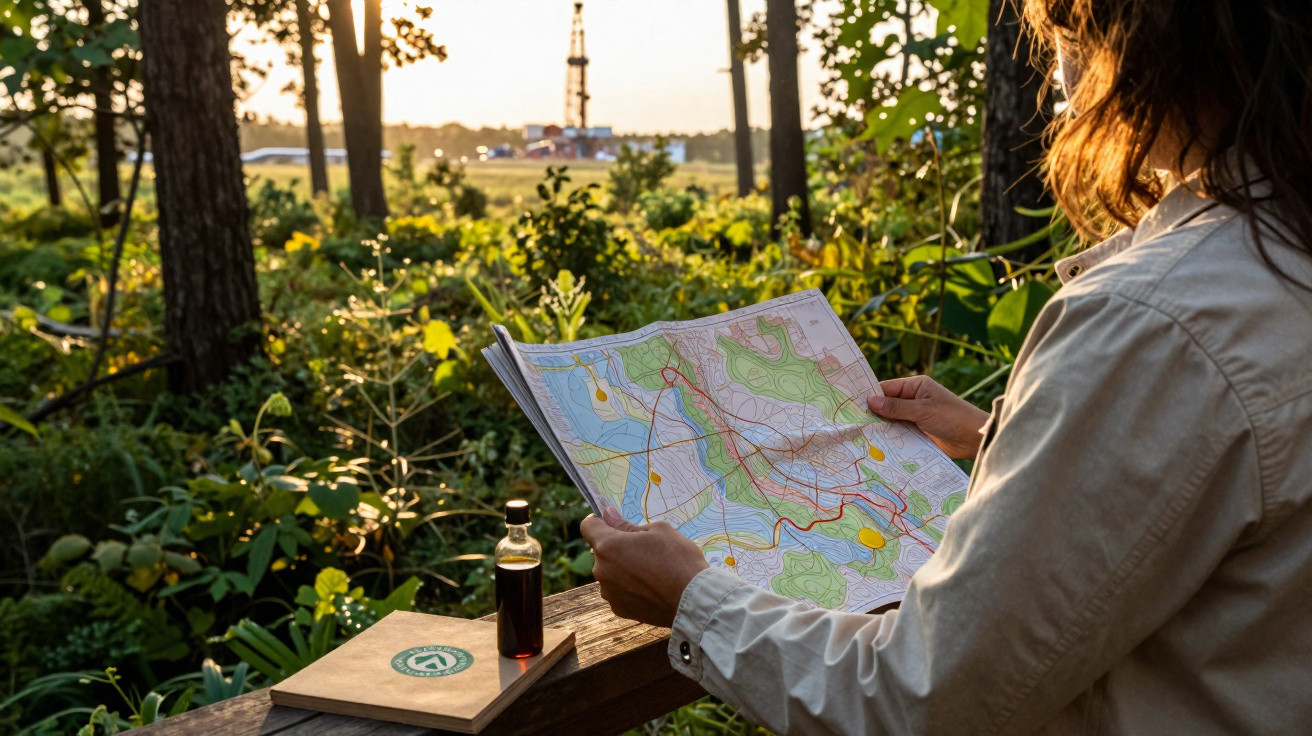
At first light, the path is still damp, and boots sink slightly into the moss. A few metres ahead, a sign states that visitors are entering a national nature reserve: no picking, no fires, no dogs off the lead and, above all, no works without permission. Yet beneath this apparent calm, geological data have brought troubling news to the surface: a hydrocarbon deposit may lie beneath the protected ground. The contrast is stark. On one side are rare birds, vulnerable wetlands and families out for a Sunday walk. On the other is the prospect of oil that has become almost mythical in France. The land says nothing, but the maps speak loudly. One question is already troubling elected representatives, local residents and experts: who might one day be allowed to reach it?
Beneath the trees, a resource that cannot be exploited like any other
The phrase “black gold field” immediately brings to mind derricks, gas flares and industrial roads. Within a national nature reserve, however, the situation is far more tightly controlled: designation is specifically intended to safeguard habitats, species and landscapes considered exceptional at national level. Even basic technical access, a drilling campaign or the installation of temporary equipment may conflict with the site’s rules.
Where a deposit has been identified beneath a protected area, the presence of oil creates no automatic right to extract it. Seismic surveys, geological assessments and prospecting archives can reveal promising structures without a single well ever being drilled. An estimate may sometimes suggest several million potential barrels, but there is a vast gap between what lies underground and actual production.
France still has limited hydrocarbon resources, particularly in the Paris Basin and the Aquitaine Basin. However, legislation is also gradually bringing hydrocarbon exploration and extraction to an end, while national nature reserves are governed by an exceptionally strict protection regime. An exceptional decree would therefore be far more than an administrative formality: it would require a politically, legally and environmentally sensitive decision of a rare kind.
Why an exceptional decree cannot simply remove the prohibitions
When an elected representative or operator raises the prospect of accessing protected underground resources, the first step should be to examine the precise legal text governing the reserve. Every site has its own designation decree, containing tailored restrictions on motorised access, works, collection, construction, alteration of watercourses or entry into certain areas. The most reliable approach is straightforward: consult the reserve manager and the relevant state authorities before drawing conclusions.
We all know the moment when striking news travels faster than the details needed to make sense of it. “Oil beneath a reserve” may appeal to some local people, especially in an area affected by factory closures or declining local employment. Let us be honest: hardly anyone reads regulatory appendices every day, even though they are the documents that set out what can, and cannot, be done.
Any proposal to gain access would have to overcome a series of highly practical barriers, far beyond an individual company’s wishes. As a former field officer who has often faced these debates puts it:
“A nature reserve is not vacant land with an attractive sign. It is a collective commitment to living nature.”
- Checking the designation decree and the applicable local rules;
- Assessing effects on habitats, water, soils and protected species;
- Consulting local authorities, the reserve manager and affected members of the public;
- Reviewing mining permissions and restrictions relating to hydrocarbons;
- Considering alternatives, including no intervention at all.
The real debate: protect an area or yield to an energy promise?
This kind of discovery revives a long-standing French dilemma: should the country seek a measure of energy independence from its underground resources, however limited, or preserve its most vulnerable places without compromise? Supporters of extraction often cite tax revenue, a small number of direct jobs and lower imports. Opponents view the landscape at a child’s height: a polluted aquifer, a newly built road or a displaced species cannot always be put right with a cheque.
Oil identified beneath a reserve is not necessarily recoverable, or even profitable. Depth, crude quality, reservoir pressure, infrastructure costs and regulatory constraints can turn a geological prospect into a case with no future. The value of a deposit is therefore not measured solely in barrels: it must also be judged in terms of risk, local conflict and time spent defending the indefensible.
There is also an almost personal aspect to the issue. For people living near a reserve, it is not merely a shaded area on a map: it is where they take a child for a walk, watch the first cranes arrive in spring and breathe more easily after an exhausting week. The prospect of a worksite entering that space, even with safeguards in place, can be enough to awaken a deep concern.
| Key point | Detail | Value for the reader |
|---|---|---|
| Identified deposit | A geological presence does not mean extraction is possible. | Avoid jumping to conclusions when faced with a dramatic announcement. |
| National nature reserve | The designation decree places strict controls on works and access. | Understand why underground resources cannot be freely exploited. |
| Exceptional decree | Any derogation would still be subject to procedures and challenges. | Appreciate the legal, ecological and local issues involved. |
FAQ:
- Can an oil deposit beneath a reserve be exploited? In theory, every case depends on the applicable law and decisions taken by the state. In practice, a national nature reserve has strong protection, while hydrocarbon extraction also clashes with French legal policy aimed at gradually ending the activity.
- What is a designation decree? It is the legal instrument that formally establishes a national nature reserve and sets its rules. It details prohibited activities, possible exceptions and the site’s conservation objectives.
- Can an exceptional decree authorise drilling? A regulatory measure does not make other environmental, mining or European rules disappear. Drilling would require extensive procedures and impact assessments, and could face legal challenges.
- Can local residents give their views? Yes. Depending on the procedure used, a public consultation or inquiry may be held. Local associations, authorities and the reserve manager also have a role in the debate.
- Why not extract the oil if energy prices rise? Because profitability does not depend only on the price per barrel. Technical costs, ecological risks, social acceptability and protection rules may make the operation unsuitable or impossible.






Comments
No comments yet. Be the first to comment!
Leave a Comment