
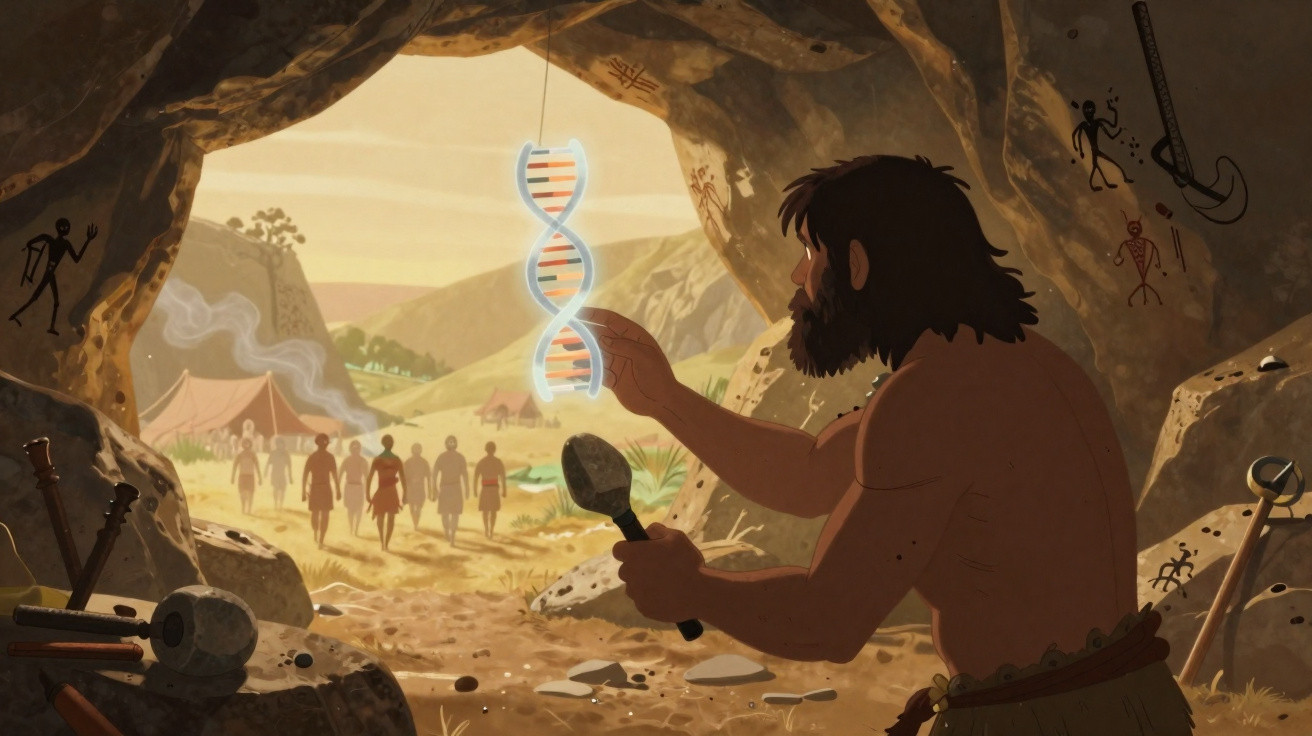
Modern humans are notably sociable, but previous research suggests Neanderthal communities were comparatively inward-looking and often kept apart from one another.
A newly studied group seems to have carried that isolation to an exceptional degree. Genetic material recovered from the molars of a specimen known as Thorin indicates that his ancestors had not interbred with neighbouring populations for millennia.
"The Thorin population spent 50,000 years without exchanging genes with other Neanderthal populations," explains Paul Sabatier University archaeologist Ludovic Slimak.
Thorin and the isolated Neanderthal population
Remarkably, the isolation of this Homo neanderthalensis group overlapped with the first movements of our own ancestors into Europe.
"Thorin corresponds to the phases of Neanderthal reoccupation of Grotte Mandrin after the earliest modern human incursions in the continent," Slimak and colleagues explain in their paper.
Thorin was uncovered in 1979 in caves in France's Rhône Valley. His remains, which are 100,000 years old, are the most complete Neanderthal remains discovered in France and date from the final millennia of the species' presence in this area.
At roughly the same period, Neanderthal populations in Spain were undergoing upheaval. Genetic shifts point to their replacement by new Neanderthal populations as intense climatic warming altered conditions following the previous ice age, prompting other lineages to spread into fresh territory.
Homo sapiens followed closely behind.
"These genetic differences may signify a major process of population replacement following or related to the expansion of anatomically modern humans through Europe," Slimak and colleagues write.
Genetic evidence from Thorin's molars
Although many people today carry some Neanderthal DNA, no Neanderthals have yet been identified with recent human DNA.
Thorin was no different. His nearest genetic match was a Neanderthal found in Gibraltar, Spain. Even so, Thorin's ancestors had last interbred with the other known Neanderthal groups 50,000 years before.
"This means there was an unknown Mediterranean population of Neanderthals whose population spanned from the most western tip of Europe all the way to the Rhône Valley in France," says Slimak.
However, genetic material from fossils linked to Mediterranean populations is incomplete, so assertions about this enigmatic group remain difficult to verify.
What isolation could reveal about Neanderthal decline
Whatever the case, the seclusion of Thorin's people raises questions about how Neanderthals as a species eventually died out around 40,000 years ago.
Beyond the genetic separation, archaeological cultural evidence also suggests that this Neanderthal group was profoundly insular. That may offer a clue as to why our extinct relatives disappeared, despite possessing many of the characteristics that allowed humans to thrive in difficult environments, including technological ability and creative aptitude.
By comparison, the human wave that moved through Asia as Neanderthals vanished appears to have maintained cultural links across Europe, implying that strong connections may have supported resilience.
"It's always a good thing for a population to be in contact with other populations," says Vimala. "When you are isolated for a long time, you limit the genetic variation that you have, which means you have less ability to adapt to changing climates and pathogens, and it also limits you socially because you're not sharing knowledge or evolving as a population."
Rather than ending in a dramatic conflict between two human types, Neanderthal decline may have been a lengthy, complex process driven in part by their tendency to retreat from others.
The research was published in Cell Genomics.





Comments
No comments yet. Be the first to comment!
Leave a Comment