
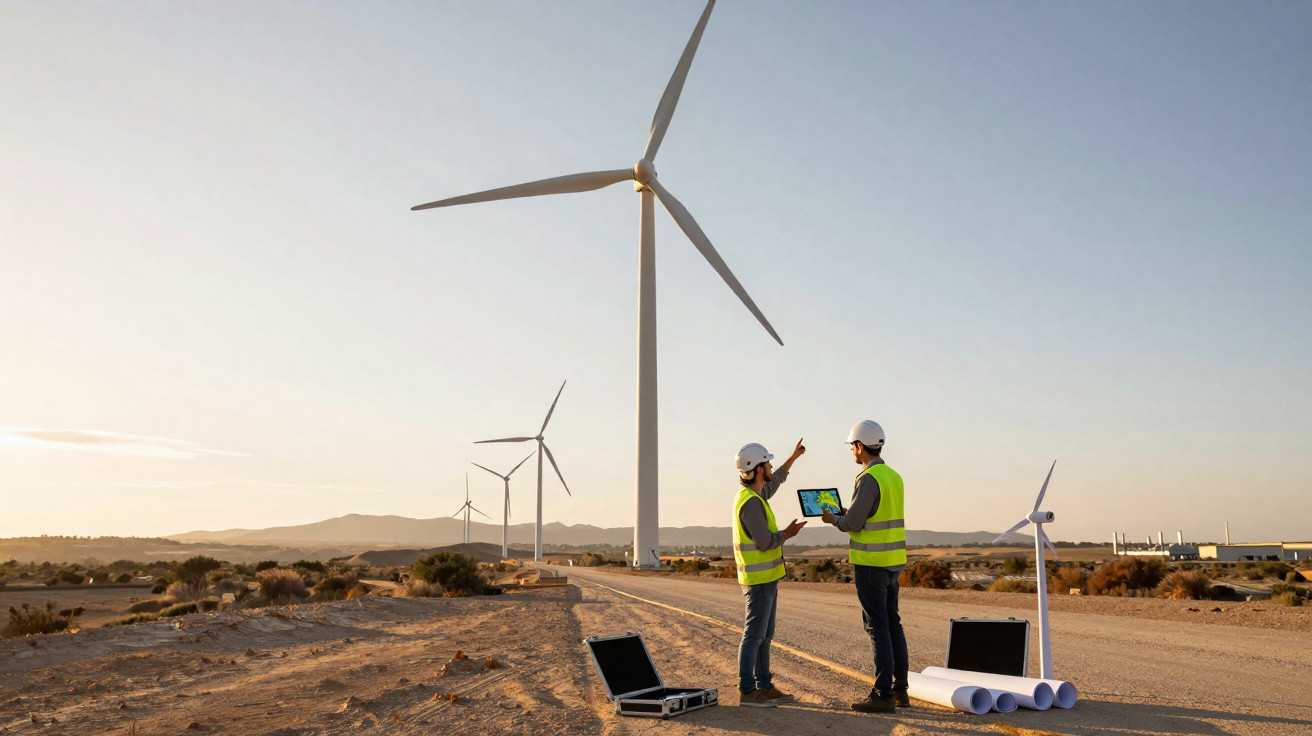
On a Spanish quay, the components look almost unreal: a blade longer than a football pitch, tower sections lying on trailers, and crews watching the convoy inch forwards. The arrival of the first giant wind turbine in Spain is not merely a matter of logistics or the energy transition. It also highlights a broader, distinctly European concern: that the continent may deploy the technologies it will rely on tomorrow without consistently manufacturing them itself. At first sight, this machine offers the prospect of generating more power with fewer turbines. That is appealing. Yet behind its extraordinary dimensions, the same question is being asked in factories, ports and government departments: who will truly capture the value from this new race for wind power? The sign may be subtle, but it is hard to overlook.
An XXL machine that reshapes the scale of Europe’s debate
When a next-generation wind turbine reaches Spain, it cannot go unnoticed, even far from the coast. Its components require widened roads, escorted convoys and, at times, work on port access routes; for several days, an entire area has to adapt around it. This giant wind turbine represents a clear trend: generating more electricity through ever more powerful turbines, with capacities that until recently were confined to offshore projects. For local residents, it is often a striking sight. For European manufacturers, it is also a stark reminder that the scale of the machines now mirrors the scale of global competition.
Spain is no stranger to wind and wind turbines. The country is among Europe’s leading markets, with more than 30 gigawatts of installed wind capacity according to the latest available industry data. Even so, the arrival of a giant turbine manufactured or supported by an industrial supply chain from outside Europe casts that achievement in a different light. Depending on the location and wind conditions, a very high-capacity machine can supply the equivalent of the annual electricity use of thousands of households. On paper, the equation looks straightforward: fewer towers, more megawatts and lower costs. In reality, it also hinges on servicing, spare parts and local expertise.
Europe’s unease is not rooted in a rejection of overseas innovation. It stems from the recent experience of solar power, a field in which Europe did much of the inventing and financing before allowing a decisive share of industrial production to slip away. Wind power remains one of the continent’s strongholds, supported by established groups, specialist suppliers and highly capable ports. However, margins have come under pressure, tenders have long favoured the lowest prices, and Asian manufacturers are accelerating. A giant turbine is never just a turbine: behind its nacelle sit a factory, a patent, a supplier network and jobs.
The warning is free, but the response will not be
To avoid being carried along by this trend, European states can start by looking beyond the headline price in tenders. A wind turbine that is cheap to buy may become expensive if maintenance relies on a distant supplier, delivery times lengthen or ports cannot accommodate its size. The most practical step is to include resilience criteria: the origin of critical components, local repair capacity, technician training and the manufacturer’s financial strength. This may sound technical, almost administrative. Yet it is where part of tomorrow’s energy independence will be decided, far from grand statements and construction-site photographs.
The common mistake would be to assume that simply choosing “European” resolves the issue. The continent’s manufacturers also need visible orders, stable rules and faster procedures if they are to invest in new production lines. We all know the moment when we put off a repair because it seems too expensive, only to pay far more when the breakdown finally happens. Europe has at times done much the same with its industry. Let us be honest: no one really checks every day where a blade, bearing or electrical converter comes from. Public choices, however, eventually show up in bills and jobs.
Industry professionals stress that competitiveness is no longer limited to the cost of a megawatt-hour. It is also measured by the ability to deliver on time, innovate and maintain wind farms for twenty or thirty years.
“The real challenge is not choosing between clean energy and industry: Europe must achieve both at the same time.”
- Adapt tenders by rewarding reliability, recycling and local industrial benefits.
- Secure ports and roads so they can handle increasingly oversized components.
- Train technicians quickly to maintain next-generation turbines.
- Give European manufacturers visibility over several years, rather than for one isolated project alone.
Spain becomes a testing ground for the whole continent
The arrival of this first giant wind turbine in Spain can be interpreted in two ways. First, it shows that a European country remains attractive for the most ambitious technologies, thanks to its winds, infrastructure and experience. It also exposes a vulnerability: being an excellent place for deployment does not guarantee being an industrial decision-making centre. That distinction matters. A region may host a modern wind farm, create construction jobs and cut emissions while allowing design work, high-value components and a large share of the profits to go elsewhere. Wind knows no borders; value chains do.
This story extends far beyond Spain. France, Germany, Denmark, the Netherlands and Poland, among others, are asking the same question, each with its own constraints and industrial champions. Should the arrival of new players be accepted in the name of a faster transition? Probably yes, because the climate emergency does not allow for indefinite delay. Should competition be allowed to proceed without safeguards, at the risk of weakening European manufacturers? The debate deserves more than slogans. A Europe that installs large numbers of wind turbines but can no longer make, repair or improve them would be taking a remarkably familiar risk.
| Key point | Detail | Added value for the reader |
|---|---|---|
| Giant wind turbine | Larger components and greater capacity are changing logistical requirements. | Understand why a local project can have national consequences. |
| European industry | Manufacturers face intense pressure on prices and delivery times. | See what is at stake beyond the simple cost of electricity. |
| Public response | Tenders can account for quality, maintenance and industrial sovereignty. | Identify practical levers beyond announcements. |
FAQ:
- Why is it called a “giant” wind turbine? This term refers to exceptionally high-capacity turbines with blades and towers of extraordinary dimensions. They require specialised transport, ports and cranes.
- Does a larger turbine always generate more electricity? It can generate more, particularly at a very windy site, but output also depends on the location, the machine’s availability and grid connection.
- Why is Europe concerned about its industry? European manufacturers face fierce international competition, while their production costs, standards and financial obligations are often high.
- Is the arrival of a foreign player necessarily negative? No. It can stimulate competition and speed up projects. The main issue is the conditions: local maintenance, transparency, jobs and reliance on critical components.
- What can a country such as Spain do? It can speed up approvals, modernise its infrastructure and favour projects that create lasting activity on its territory, without closing the door to innovation.

Comments
No comments yet. Be the first to comment!
Leave a Comment