
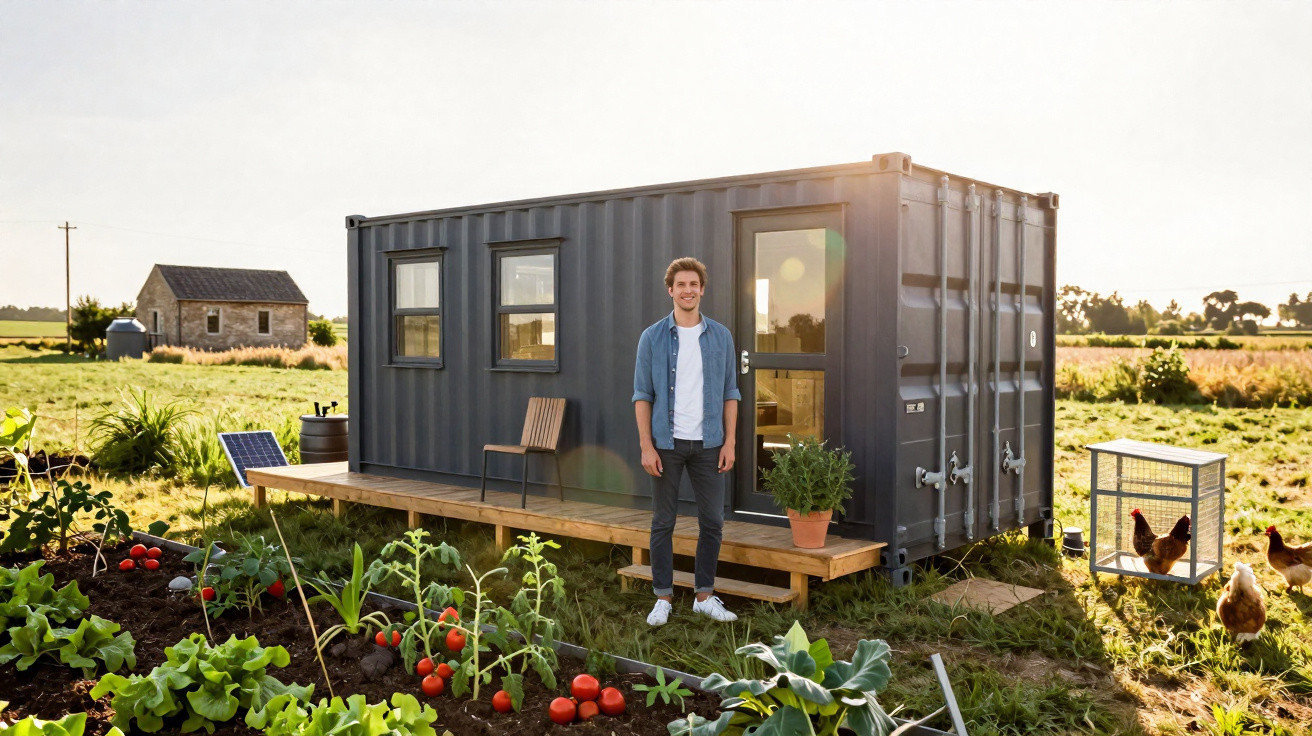
In Spain, a former graphic designer has opted for a minimalist life on a large, secluded plot in the heart of the mountains.
At 28, Emile made a radical decision to secure a home without taking out a mortgage that would last for decades. Now based in Spain, he describes his day-to-day life in a video posted on YouTube by Diego Revuelta. His home is a converted 13 m² shipping container standing on a rural plot of more than 20,000 m².
A plot of more than two hectares bought for €15,000
Before moving to the Spanish mountains, Emile worked as a graphic designer. He wanted to own a property without carrying the burden of a 25-year mortgage. His solution was to reassess his needs substantially and move away from conventional housing.
He purchased over 20,000 m² of land for €15,000, an area equivalent to just over two hectares. He then found a shipping container for €1,300, while delivery to his plot added a further €300.
Including the land and container, Emile says he kept the cost of launching his housing project below €20,000.
The purchase price alone does not reflect the full cost of setting up home. Building work, equipment, tools and the fittings needed to make a container liveable must also be factored in. Although he had limited building experience, Emile chose to complete a large share of this work himself.
A 13 m² shipping container arranged like a small home
Converting a metal box designed to carry freight into a home requires very careful planning. Emile learned through hands-on work, drawing in particular on tutorials published on YouTube.
He dealt with several parts of the project himself, including plumbing, insulation, electrics and the interior fit-out. Within his 13 m², he has managed to accommodate the essentials for daily life:
- a sleeping area;
- a kitchen;
- a desk;
- a bathroom.
Fold-away fittings are vital in such a limited space. They free up room throughout the day and allow one area to serve several purposes. This kind of home also means cutting back on possessions, bulky furniture and unnecessary purchases.
A home without conventional connections
Emile’s container is connected neither to the mains electricity network nor to running water. He generates power with solar panels linked to batteries, which store energy produced during sunny periods for use later on.
For water, he has several tanks filled by a tanker lorry. He has also fitted dry and chemical toilets to reduce water use. Dry toilets operate without flushing, but require suitable management of waste and materials.
“I live here, with electricity, water and a roof, for €10 or €20 a month,” Emile says.
By his calculations, his water costs around €80 every six months. He also buys a butane bottle for about €16 every four or five months, for cooking and heating water. Finally, he mentions property tax of around €8 a year, a figure specific to his circumstances and his land in Spain.
Vegetables, chickens and farming plans
The plot is not simply where Emile lives: he also uses it to produce some of his food. He grows tomatoes and watermelons, and keeps chickens which provide him with eggs.
The young man says he has harvested more than 400 kilograms of almonds. He now intends to take this search for self-sufficiency further. His plans include drilling a well, planting additional fruit trees and, eventually, keeping goats.
This way of life requires time, knowledge and regular attention. Growing crops means dealing with the seasons, water availability, soil conditions and unpredictable weather. Solar panels also require certain uses to be adjusted according to the amount of energy being produced.
What to check before a similar project in France
In France, placing a container on land does not automatically grant the right to live in it. Planning rules differ between local authorities and according to the relevant zone. Rural land is not necessarily suitable for development, even when it is sold with a large area.
Before starting any project, it is necessary to consult the local development plan, where one exists, and contact the town hall. Depending on the characteristics of the installation, how long it will remain in place, its footprint and the work planned, prior notification or planning permission may be required. The local authority’s planning department is the appropriate body to clarify which permissions are needed.
Access is another key consideration: emergency access, an accessible road, wastewater management, drinking-water supply and any potential electricity connection. Living off-grid may lower some bills, but it also makes the occupant responsible for supplying, storing and maintaining the installations.
A stone building to host his mother
After fitting out his own home, Emile began renovating a small stone building on his property. He wants to make it possible for his mother to stay there.
His daily routine is still shaped by building work and the constraints of isolated living. For him, this very simple lifestyle mainly provides a sense of stability. “Having a roof over your head, a roof that belongs to you and from which nobody can evict you... I do not know whether that can be called freedom, but it is certainly peace of mind,” Emile explains.


Comments
No comments yet. Be the first to comment!
Leave a Comment