
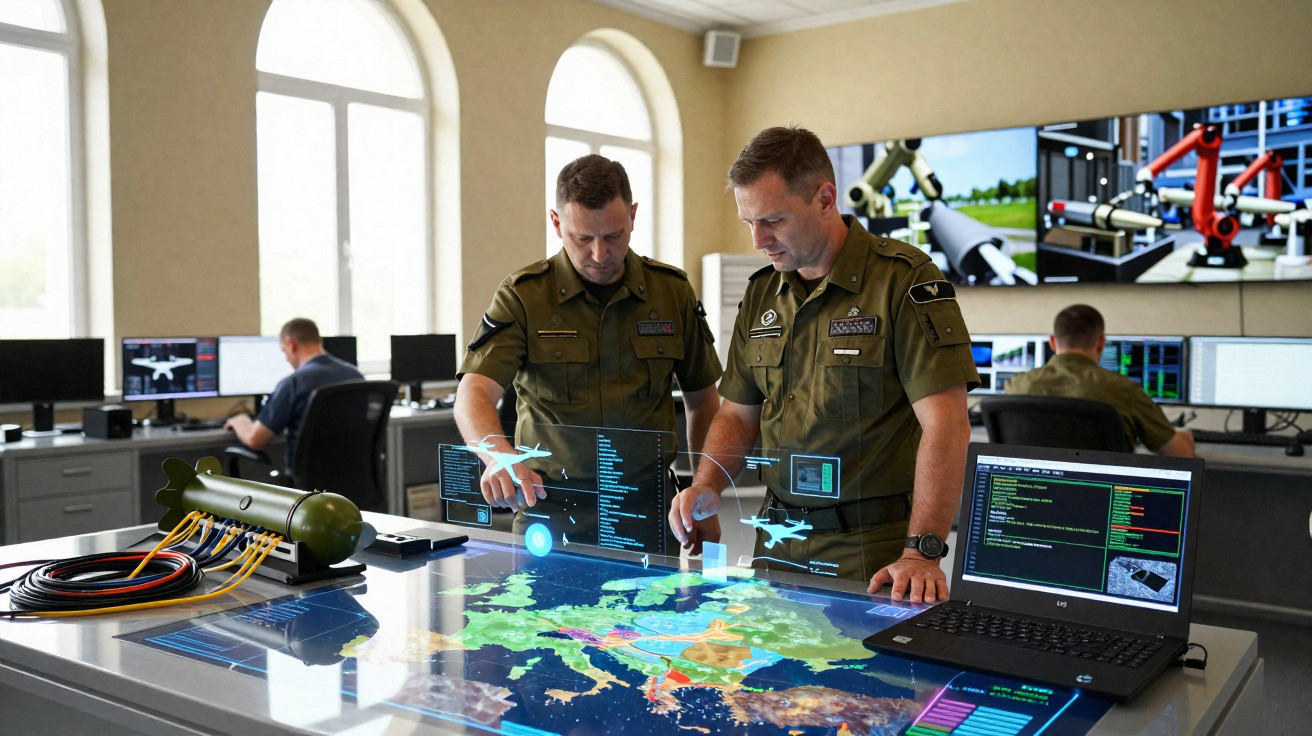
Since the start of its conflict with Russia, Ukraine has established itself as a major hub for military innovation. Faced with a modern war of attrition, the Ukrainian armed forces are developing and testing cutting-edge solutions at an unprecedented pace. This ability to adapt swiftly is turning the country into a leading strategic partner for Western nations.
As Europe’s security landscape is reshaped, Kyiv’s allies are looking to learn from its operational experience, including the use of drones and artificial intelligence (AI) on the battlefield. A few weeks ago, Airbus, for instance, announced a partnership to test its military technologies directly at the front line. The United Kingdom has now formed an unprecedented alliance with Ukraine.
Ukraine: a European defence technology laboratory
Under a strategic agreement signed in Kyiv, the United Kingdom will use millions of data points gathered on the Ukrainian front to train its future military artificial intelligences. The partnership demonstrates how Ukraine is becoming a genuine technology laboratory for European defence.
Data remains central to military AI
Andy Burnham, the British Prime Minister, and Volodymyr Zelensky, Ukraine’s President, have finalised a major agreement focused on AI. The United Kingdom is therefore the first international partner to receive direct access to Avengers AI Labs, the Ukrainian army’s strategic database.
Trained using more than 5 million battlefield images, the tool already identifies roughly 70% of enemy military targets in real time, including tanks, artillery and drones. In return, London is making its technology ecosystem, universities and several specialist start-ups available to Kyiv. The aim is to speed up the development of next-generation defence algorithms.
“This is AI sovereignty put into practice: building our own capabilities and turning the experience gained in the field into systems that protect our armed forces overseas and our critical infrastructure at home,” says Kanishka Narayan, the UK’s AI minister.
From intelligent cables to missile production lines
The partnership is already producing practical projects. In the UK, an initial system turns ordinary buried fibre-optic cables into intelligent sensors able to monitor the perimeter of military bases. In time, the technology could also safeguard critical civilian infrastructure, including airports, energy plants and railway lines.
Another element involves developing ultra-low-power AI chips to extend the operating range of drones and ground robots. There is more: the United Kingdom has authorised European manufacturer MBDA, 37.5% owned by a British group, to share classified data on the components of the long-range SCALP missile. This will allow Ukraine to integrate into local assembly lines and help secure supplies for the front.
“By bringing together British scientists, engineers and technology companies, which are among the best in the world, with Ukraine’s unique battlefield experience and data, we will strengthen the defence and security of both our nations,” says Wes Streeting, the UK’s Defence Secretary.





Comments
No comments yet. Be the first to comment!
Leave a Comment