
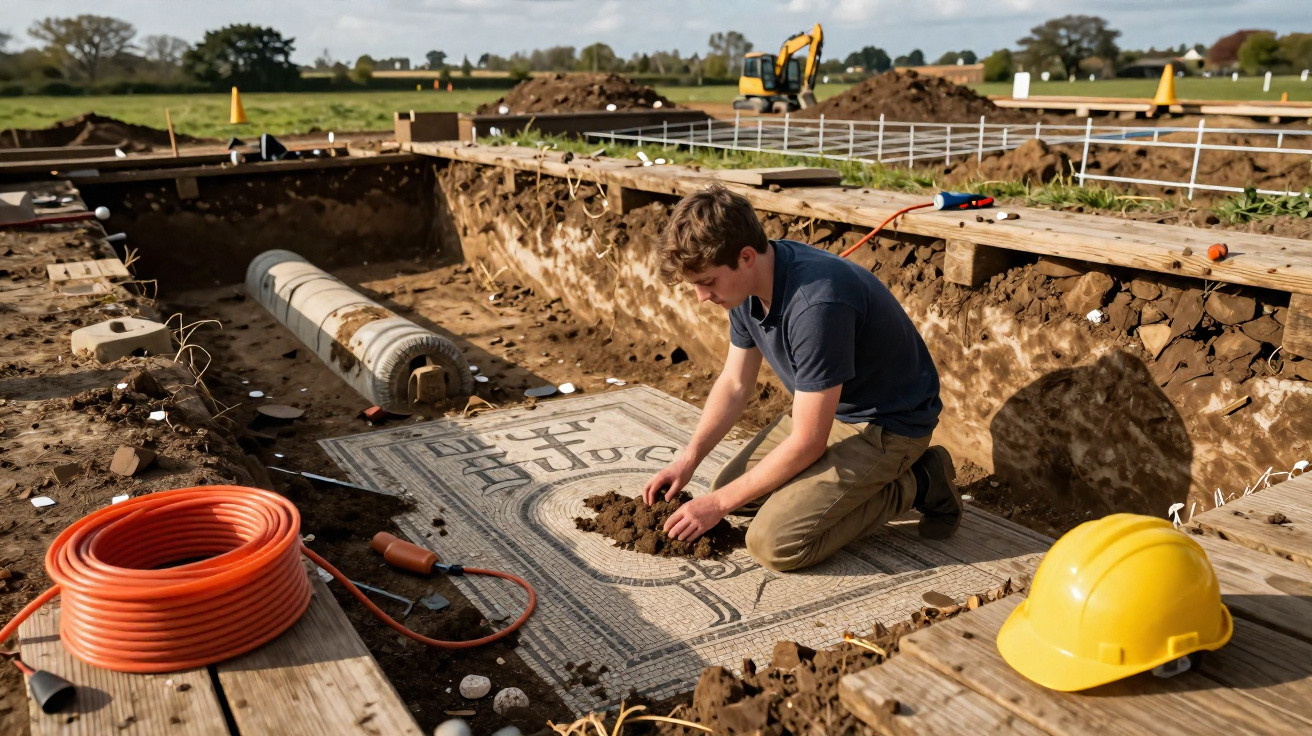
A project to carry electricity from a wind farm along the Norfolk coast in England uncovered something no one had anticipated in that stretch of land. Before underground cables were laid, archaeologists dug precautionary trenches in an area thought unlikely to yield much, only to uncover an entire Roman rural estate, including a residence, agricultural buildings and even a bath complex.
Why did archaeologists expect to find almost nothing?
The excavations took place near the town of Dereham, along an underground cable route nearly 64 kilometres long. Historic maps, archival records and magnetometer surveys had not suggested anything of particular importance at this location, so the team initially expected a fairly straightforward investigation.
That assessment changed in 2021, when the first test trenches began producing substantial quantities of Roman roof tiles. Jessica Lowther, of Headland Archaeology, told the Eastern Daily Press that it became clear something significant lay beneath the ground as fragments kept appearing throughout the excavation.
What lay beneath the cable route?
As the archaeological work expanded, a large Roman rural estate came into view. Lowther said the site comprised a villa with several ancillary buildings, a bath complex and a Roman road, as well as clear evidence of food production and processing activities.
- The excavation exposed a substantial Roman residence surrounded by ancillary buildings.
- A bath complex suggested a degree of comfort beyond that expected at an ordinary rural estate.
- Evidence of crop cultivation and food processing indicated extensive agricultural activity.
- A Roman road was also part of the group of features uncovered on the site.
In a statement quoted by Smithsonian Magazine, energy company RWE said the site was wealthy and occupied over a long period, with evidence beginning in the Iron Age and continuing into the Roman period. The estate's main period of occupation is thought to have been around the year 250.
Why did the Roman villa have a bath complex?
Bathing was an important element of Roman life and was not confined to major towns and cities. Rural estates owned by well-resourced families could have private facilities for washing, socialising and displaying status. The presence of this complex, together with the scale of the residence, supports the view that the farm belonged to relatively affluent owners.
Jessica Lowther also noted the large volume of evidence connected with crop growing and food processing, leading the team to identify the site as a large agricultural estate. Grains, animal bones and oyster shells recovered during the investigations help reconstruct the region's diet, trade and economic activity.
What was the object nicknamed “Norfolk Nessie”?
Among the artefacts was a curved, greenish bronze piece whose shape immediately recalled the silhouette popularly linked with the Loch Ness monster. Archaeologists nicknamed it “Norfolk Nessie”, although the Roman object has no historical connection to the well-known Scottish legend.
In fact, the artefact is probably the handle from a bronze vessel. Other finds underlined the site's sophisticated character, including a silver ring and a small bronze lion's head, which probably served as a decorative support on a chair or another item of furniture used by the residents.
What did a modern project reveal about two thousand years of history?
The cable route brought far more than the Roman villa to light. At various locations, archaeologists found a Neolithic structure containing pottery and stone tools, Bronze Age funerary monuments and abandoned medieval villages. RWE said this collection of discoveries helps piece together how people lived, farmed and traded in the region over millennia.
Project director Jon Darling said the archaeological work provided an exceptional demonstration of how this landscape changed over time. The contrast is hard to overlook: infrastructure designed to carry the energy of the future ended up passing through a Roman estate that nobody expected to find. Sometimes, just a few metres of cable are enough to open a window onto nearly two thousand years of history.




Comments
No comments yet. Be the first to comment!
Leave a Comment