
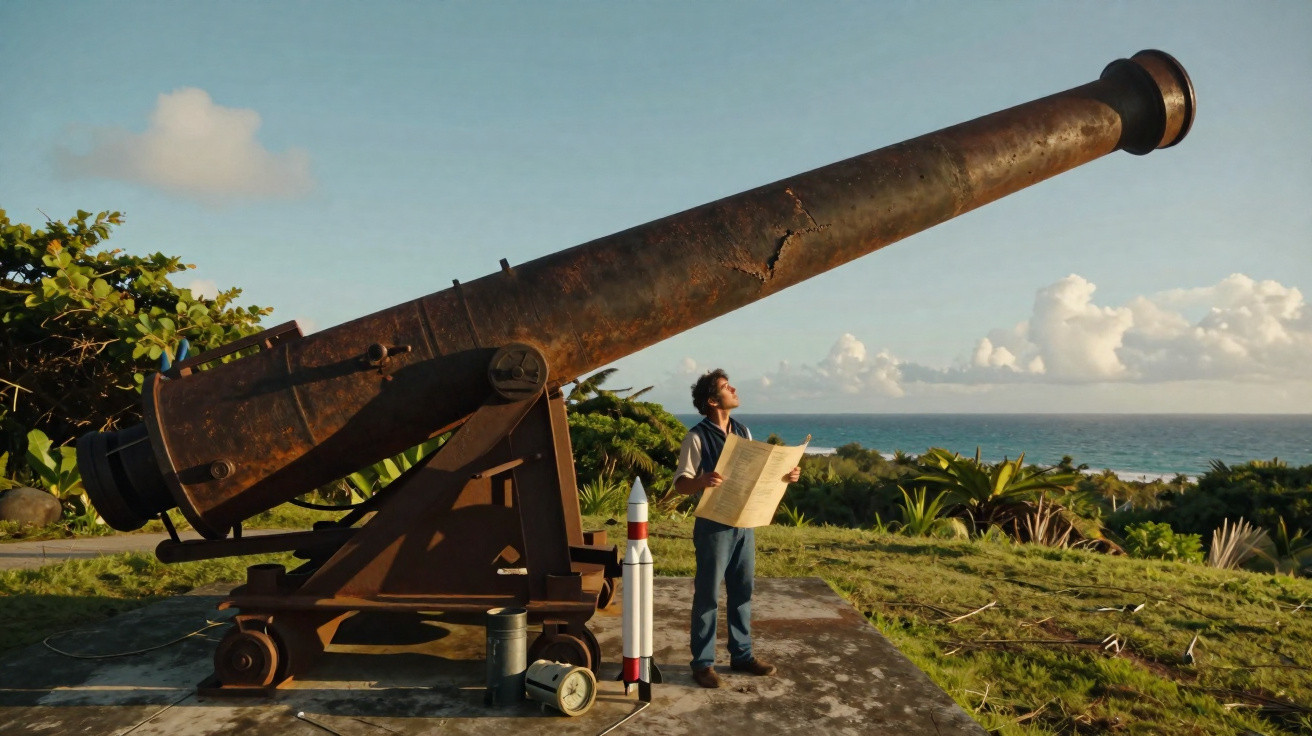
Sometimes, in Barbados, you only need to step away from the postcard scenes, turquoise water and neatly arranged sun loungers to encounter an almost absurd sight. Close to the shoreline, a vast steel tube lies beneath the sun, worn away by salt and decades of exposure. At 36 metres long, this cannon seems far too large to belong in such surroundings. Yet it was genuinely used: in 1966, it sent a projectile to roughly 180 kilometres above the Earth, beyond the commonly recognised boundary of space. Since the HARP programme ended in 1967, this extraordinary machine has not fired again. It remains there, an overlooked fragment of the Cold War between palm trees and the Atlantic. It is a relic that inspires vertigo.
In Barbados, the HARP cannon tells an almost forgotten race to space
Standing in front of this HARP cannon - short for High Altitude Research Project - rarely prompts an immediately scientific reaction. It looks more like a stranded metal whale, or a film set left out in the rain for far too long. Built from joined sections of naval gun barrels, the tube stretched for more than 36 metres and was once aimed skywards with an audacious goal: reaching space without relying on a conventional rocket. The concept looked straightforward on paper, but was far less so in practice. At the time, every major power wanted to prove it could go higher, faster and further.
On 18 November 1966, the Barbados HARP cannon launched a Martlet 2G projectile to an estimated altitude of 180 kilometres. Much smaller than a space rocket, this device crossed the Kármán line, set at around 100 kilometres above Earth and often used as the boundary of space. The achievement remains remarkable, particularly given that its initial propulsion came from a violent explosion at the base of a barrel. No other cannon-fired projectile has officially surpassed this performance since.
The project was led by Canadian researcher Gerald Bull, a figure as gifted as he was controversial in modern artillery. His argument could be summed up simply: a rocket must carry its fuel from the outset, whereas a cannon delivers an immense thrust from the ground. The possible saving appeared substantial. The difficulty was that this force exposed the projectile to such extreme acceleration that electronic instruments, materials and even payloads had to endure the unimaginable. The record is genuine, but making the approach viable on a regular basis involved numerous obstacles.
Why the rusty giant never replaced rockets
To grasp the relative failure of the space cannon, picture a car going from zero to several thousand kilometres per hour in a fraction of a second. That is essentially what every HARP projectile endured. A rocket builds speed progressively; a cannon delivers a massive initial shock, which is hard for a satellite, solar panels or sensitive scientific equipment to withstand. This technique can therefore suit certain robust sensors, atmospheric experiments or very small payloads designed specifically for it. It becomes much less useful when the objective is to place an object in a stable orbit around Earth.
We all know the moment when an idea seems brilliant until everyday practicalities make it more complicated. For a space cannon, those practicalities included barrel wear, firing accuracy, cost, weather and safety. Reaching an altitude of 180 kilometres does not mean remaining in space: the projectile then falls back because it lacks the horizontal speed needed to enter orbit. Many accounts still confuse these two concepts. Let us be honest: hardly anyone deals with this every day, even among astronomy enthusiasts. Climbing very high and orbiting Earth are two entirely different achievements.
When confronted with dramatic images of the Barbados cannon, the right approach is to check precisely what the word “record” means. In this case, it is the altitude record for a projectile fired by a cannon, not the highest space launch across all technologies.
“The HARP projectile reached space, but it could not remain there.”
- The record shot peaked at around 180 kilometres in altitude.
- The HARP programme was halted in 1967 because it lacked lasting support.
- A rocket is still required to achieve orbital velocity.
- The Barbados cannon remains one of the most striking symbols of this venture.
The unsettling fate of a record that has never been beaten
Perhaps the most compelling aspect is not the force of the shot, but the silence that followed. Funding for the programme ended in 1967, and the enormous cannon lost its purpose. It was neither turned into a major attraction nor installed in a brightly lit museum. Instead, it remained near the beaches of Barbados, exposed to time, sea spray and the curiosity of a handful of informed travellers. That understatement gives the site an unusual power: the history of space does not exist only at Cape Canaveral or in NASA’s white rooms.
The cannon also shows that major breakthroughs never follow a straight path. Some avenues fail, while others return decades later in a different form. Companies and researchers are still exploring ways to send small payloads into the upper atmosphere using alternative launch systems, although the physical constraints remain unchanged. Space begins very high up, but orbit requires almost unforgiving precision. In Barbados, this old rusty machine asks a simple question: how many abandoned ideas are still waiting to be viewed differently?
| Key point | Detail | Value for the reader |
|---|---|---|
| A historic record | The Martlet 2G projectile reached approximately 180 km in altitude in 1966. | Understand why the HARP shot remains unique in the history of artillery. |
| An extraordinary cannon | The Barbados installation measured more than 36 metres in length. | Appreciate the physical and technical scale of the project. |
| A scientific limit | Reaching space is not enough to put an object into orbit. | Avoid confusing a record altitude with an orbital launch. |



Comments
No comments yet. Be the first to comment!
Leave a Comment