
Standfirst - Behind a ceremony that is often short, a sequence of checks and precise actions accompanies the deceased through to the handover of the urn.
This stage remains largely unknown to the public. Many relatives watch the coffin depart before leaving with very practical questions. What happens beyond the door? Can flames be seen? How can they be sure that the correct ashes will be returned? A funeral professional who has worked for ten years in the Barcelona area reveals the workings of a discreet role that is both technical and deeply human.
A closing door, followed by a full protocol
For families, the most striking part of the occasion lasts only a few moments. The coffin is taken to the cremation area, a door opens and then closes. This is often the image that stays with relatives. Yet this visible moment is only a small part of the whole process.
“The scene feared by some relatives does not reflect reality: flames are virtually never visible when the coffin enters.”
This employee says that the same question comes up regularly: relatives ask whether they will see fire. Their concern is understandable, since the collective imagination still links the practice with a harsh image. In reality, the equipment is enclosed and the process does not take place in public view. The support offered is intended precisely to protect the dignity of both the deceased and their relatives.
Well before the ceremony, staff check a range of administrative and physical details. The aim is straightforward: to prevent any mix-up and ensure uninterrupted tracking. This requirement calls for constant care, because an identity error would be irreparable.
The number that follows the deceased at every stage
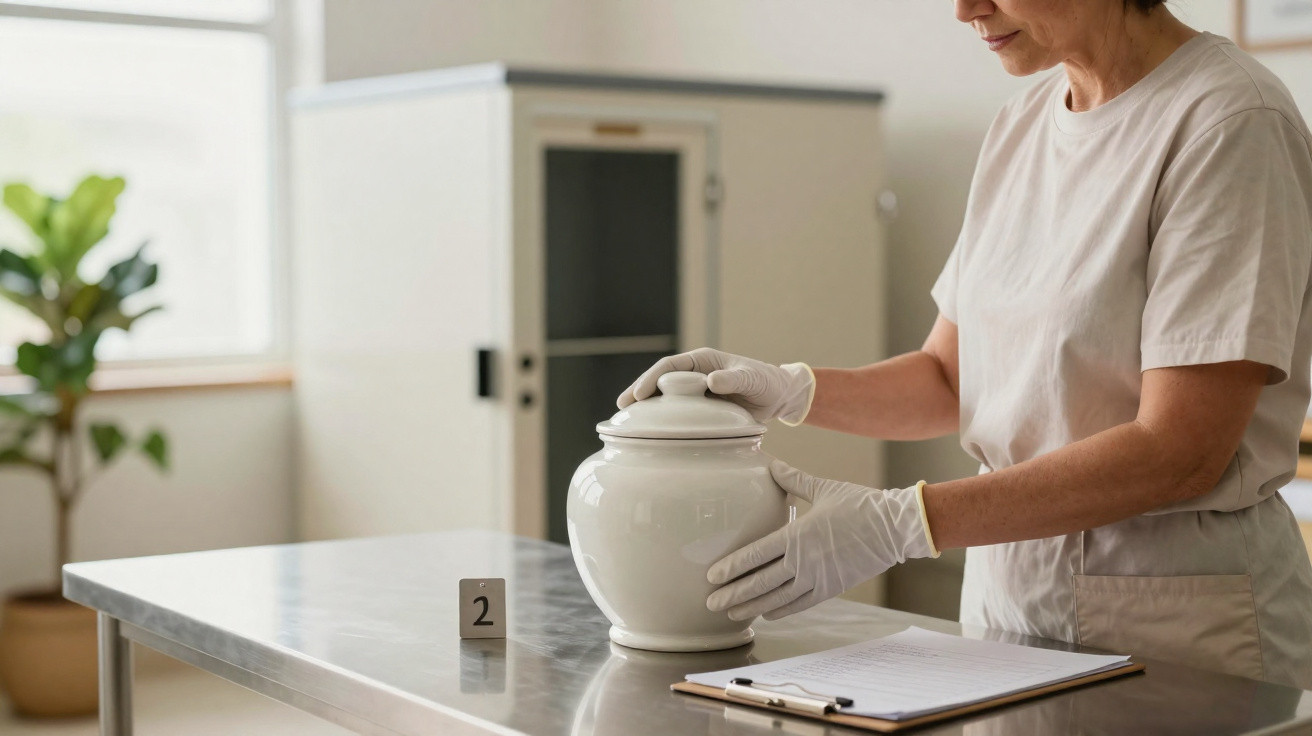
As soon as the coffin arrives, it is given an identification reference. Linked to the deceased’s name, it is recorded in internal documentation. At the establishment where this professional works, the label is also photographed beside the identity shown on the coffin, creating an additional record.
This marker remains with the file throughout the procedure. It is used when the coffin enters the cremator, during the handling of the remains and when the urn is prepared. The family therefore receives an urn bearing the same reference.
- Receipt of the coffin and verification of the documents;
- Allocation of an identification number;
- Recording of the reference in the internal tracking system;
- Tracking throughout the technical operations;
- Labelling of the urn handed to relatives.
Specific rules vary between countries and establishments. The underlying principle is unchanged: to provide complete traceability, from the deceased’s arrival to the final destination of the ashes. This organisation explains why staff place such emphasis on concentration and compliance with procedures.
A role extending far beyond operating equipment
The employee interviewed works at a large wooded cemetery of around 50 hectares in El Papiol, near Barcelona. His day-to-day work is therefore not limited to farewell ceremonies. He moves between welcoming families, maintaining the grounds, carrying out work at burial sites and completing maintenance duties.
Painting, minor masonry work, repairing glazing, cleaning pathways and maintaining site furniture: the required skills are wide-ranging. At a funeral site, the condition of the surroundings matters greatly. A clean path, clear signage or a well-kept bench may appear insignificant. However, for someone visiting to pay their respects, such details can transform the experience.
Teams also assist with burial and exhumation operations, where procedures and permissions allow. These duties require knowledge of health rules, administrative obligations and the practices specific to each site.
“Technical work can be prepared for and learned. Listening to a bereaved person requires a different kind of skill.”
Listening: a skill that is difficult to teach
Internal training covers safety protocols, the use of equipment and compulsory procedures. However, the Spanish professional believes that the most challenging aspect is not found in a manual: staff must know how to speak with relatives who may be distressed, silent or angry.
Every response to bereavement is different. Some families want to understand every stage, while others would rather receive only the essential information. The teams’ role is to adapt without forcing a particular approach, while still providing dependable answers.
This position requires balance. Too much distance may be seen as indifference, whereas too much emotion can disrupt the proper delivery of the service. Professionals must remain composed, accurate and tactful while relatives are often going through one of the hardest days of their lives.
Why crematoria remain so poorly understood
The lack of information is not due solely to the technical nature of the facilities. It is also linked to our relationship with death. Many people avoid the subject until they are personally confronted with it. They may then know nothing about the stages involved, the timescales, the documents required or the options available for ashes.
Discussing these matters before a death can nevertheless make some decisions easier. Relatives can find out about the deceased’s wishes, the choice of an urn, a civil or religious ceremony, and the legally permitted destination for the ashes. In France, ashes cannot be kept freely at home: under a specific legal framework, they must, for example, be placed in a cinerary site, buried or scattered in an authorised location.
Ashes prepared before they are handed over
Following cremation, the remains are not placed in the urn immediately. They undergo a preparation stage intended to produce uniform ashes. This step is carried out away from the public, using the same tracking number assigned on arrival.
Metal components may remain, for instance after surgery or because of certain parts of the coffin. These are separated in line with regulated procedures. The ashes are then collected in an identified container before being transferred to the urn selected by the family.
This unseen work meets a fundamental expectation: certainty that every urn corresponds to the person whose funeral has been arranged. Behind closed doors, teams are not merely operating technical equipment. They hold an intimate responsibility at a time when even the slightest inaccuracy would be experienced by relatives as an additional wound.




Comments
No comments yet. Be the first to comment!
Leave a Comment